Motoda Taichi, Chen Fu-Chia, Ando Daisuke
a Institute of Wood Technology, Akita Prefectural University.
b Jin-Sing Chen's mushroom farm.
Mycoscience. 2024 Nov 30;66(1):67-71. doi: 10.47371/mycosci.2024.10.006. eCollection 2025.
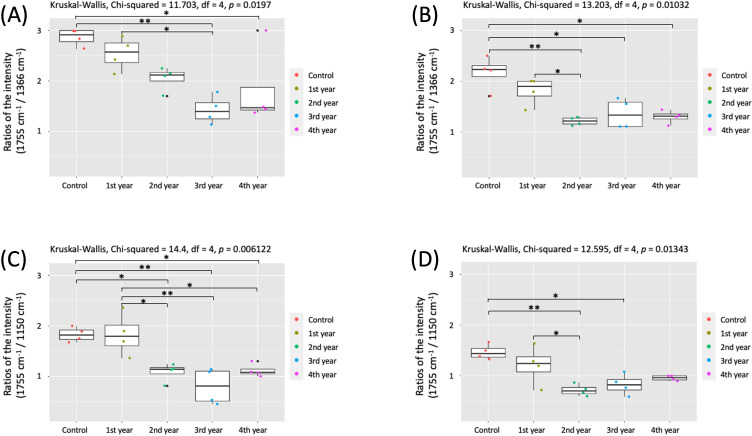
In nature, only white-rot fungi can completely decompose wood biomass in the environmental carbon cycle. However, their degradation strategy is still unclear. Despite many studies on the lab-scale wood-decay process, investigations on the open-field process have been limited by their difficulty. Here, we aimed to elucidate the degradation strategy of white-rot fungi in nature by monitoring the chemical composition changes of logs exposed to the white-rot fungus, , over 4 y of cultivation using Fourier transform infrared spectroscopy. began to decompose lignin and deacetylate hemicellulose in the first 2 y and then degraded polysaccharides in the next 1 y. Finally, lignin decomposition recurred after the third year. Thus, our study revealed that decayed wood in a repetitive two-stage process: lignin and polysaccharide degradation. The switching cycle may promote efficient degradation.
在自然界中,只有白腐真菌能够在环境碳循环中完全分解木材生物质。然而,它们的降解策略仍不明确。尽管对实验室规模的木材腐朽过程进行了许多研究,但野外过程的研究因难度较大而受到限制。在这里,我们旨在通过使用傅里叶变换红外光谱监测暴露于白腐真菌的原木在4年培养过程中的化学成分变化,来阐明自然界中白腐真菌的降解策略。在最初的2年里开始分解木质素并使半纤维素脱乙酰化,然后在接下来的1年里降解多糖。最后,第三年后木质素分解再次发生。因此,我们的研究表明,白腐真菌以重复的两阶段过程腐朽木材:木质素和多糖降解。这种转换循环可能促进高效降解。