
右美托咪定可有效且可逆地调节应激介导的行为。
Dexmedetomidine potently and reversibly regulates stress-mediated behaviors.
作者信息
Yocca Frank D, Dhull Dinesh K, Seth Subhendu, Chugh Manisha, Sharma Sameer, Nandabalan Krishnan, Postma Friso R, De Vivo Michael
机构信息
BioXcel Therapeutics Inc., New Haven, CT, United States.
E. Z. BioXcel Solutions Pvt. Ltd., Gurugram, Haryana, India.
出版信息
Front Pharmacol. 2025 Jul 2;16:1589075. doi: 10.3389/fphar.2025.1589075. eCollection 2025.
AIMS
Demonstrate that dexmedetomidine is potentially useful for treatment of psychiatric symptoms caused by acute or chronic stress by using relevant rodent models and doses predicted to achieve sufficient brain levels to activate alpha2-adrenoceptors.
METHODS
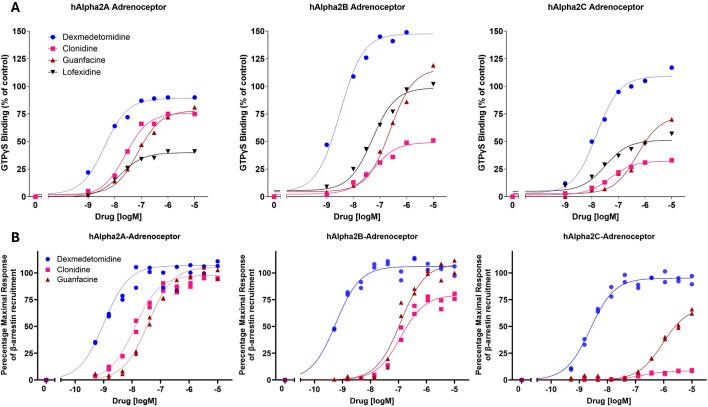
characterization was performed using labeled GTPγS binding and β-arrestin recruitment. Free brain levels were measured by using microdialysis probes in rats. behavioral characterization of dexmedetomidine was performed both an acute stress model (forced swim test or despair test) and a repeat stress model with repeat dosing (the open space swim test). Dexmedetomidine was assessed using translational models: the CCK-4 induced panic test in Wistar rats and latency to rapid eye movement sleep (REM sleep). Rotarod assessments (Swiss mice) and a cued memory consolidation model (Wistar rats) were used to ensure that effective doses had no overt effects on motor coordination or memory consolidation.
RESULTS
Dexmedetomidine is both more potent (<10 nM EC50) and has higher intrinsic activity than other α2-AR agonists (clonidine, lofexidine or guanfacine). Estimates of free brain levels at efficacious doses are sufficient to activate all 3 α2-ARs. Dexmedetomidine was effective in decreasing immobility (increasing escape behaviors) in the forced swim test after a single acute stress and in the open space swim test after repeat dosing. Effects of dexmedetomidine were completely reversible and no withdrawal effects were observed. Doses used in the open space swim test had no overt effect on the rotarod indicating no impairment of motor coordination. Dexmedetomidine was highly effective in reversing a CCK-4 induced mediated deficit in the elevated plus maze, a translatable model for anxiety and panic. Dexmedetomidine also increased latency to REM sleep and shortened latency to slow wave sleep, positive attributes for a neuropsychiatric drug.
CONCLUSION
Dexmedetomidine may be a suitable drug for a chronic dosing for a wide range of stress-mediated symptoms, not limited to the acute treatment of agitation. Brain levels are highly predictable based on plasma exposures and are consistent with the known affinity for α2-ARs.
目的
通过使用相关啮齿动物模型和预测能达到足够脑内浓度以激活α2肾上腺素能受体的剂量,证明右美托咪定对治疗急性或慢性应激引起的精神症状可能有用。
方法
使用标记的GTPγS结合和β-抑制蛋白募集进行特性分析。通过在大鼠中使用微透析探针测量脑内游离浓度。在急性应激模型(强迫游泳试验或绝望试验)和重复给药的重复应激模型(开放空间游泳试验)中对右美托咪定进行行为特性分析。右美托咪定使用转化模型进行评估:在Wistar大鼠中进行CCK-4诱导的惊恐试验和快速眼动睡眠(REM睡眠)潜伏期。使用转棒试验评估(瑞士小鼠)和线索记忆巩固模型(Wistar大鼠)以确保有效剂量对运动协调或记忆巩固没有明显影响。
结果
右美托咪定比其他α2-AR激动剂(可乐定、洛非西定或胍法辛)更有效(EC50<10 nM)且具有更高的内在活性。有效剂量下脑内游离浓度的估计足以激活所有3种α2-AR。右美托咪定在单次急性应激后的强迫游泳试验中以及重复给药后的开放空间游泳试验中有效降低不动时间(增加逃避行为)。右美托咪定的作用完全可逆,未观察到撤药效应。开放空间游泳试验中使用的剂量对转棒试验没有明显影响,表明运动协调未受损。右美托咪定在升高加迷宫试验中对CCK-4诱导的介导缺陷具有高度逆转作用,升高加迷宫试验是焦虑和惊恐的可转化模型。右美托咪定还增加了REM睡眠潜伏期并缩短了慢波睡眠潜伏期,这是神经精神药物的积极特性。
结论
右美托咪定可能是一种适用于多种应激介导症状长期给药的药物,不限于急性躁动治疗。基于血浆暴露,脑内浓度具有高度可预测性,并且与已知的对α2-AR的亲和力一致。



 Zotero 插件