Department Neuroscience, Yale University School of Medicine, New Haven, CT, 056510, USA.
Department Anesthesiology, Critical Care and Pain Medicine, Massachusetts General Hospital, Harvard Medical School, Boston, MA, 02114, USA.
Mol Psychiatry. 2023 Nov;28(11):4540-4552. doi: 10.1038/s41380-023-02057-4. Epub 2023 Apr 7.
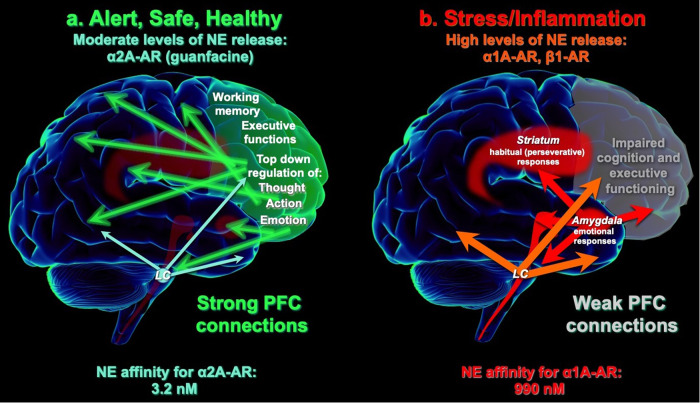
Neuroinflammatory disorders preferentially impair the higher cognitive and executive functions of the prefrontal cortex (PFC). This includes such challenging disorders as delirium, perioperative neurocognitive disorder, and the sustained cognitive deficits from "long-COVID" or traumatic brain injury. There are no FDA-approved treatments for these symptoms; thus, understanding their etiology is important for generating therapeutic strategies. The current review describes the molecular rationale for why PFC circuits are especially vulnerable to inflammation, and how α2A-adrenoceptor (α2A-AR) actions throughout the nervous and immune systems can benefit the circuits in PFC needed for higher cognition. The layer III circuits in the dorsolateral PFC (dlPFC) that generate and sustain the mental representations needed for higher cognition have unusual neurotransmission and neuromodulation. They are wholly dependent on NMDAR neurotransmission, with little AMPAR contribution, and thus are especially vulnerable to kynurenic acid inflammatory signaling which blocks NMDAR. Layer III dlPFC spines also have unusual neuromodulation, with cAMP magnification of calcium signaling in spines, which opens nearby potassium channels to rapidly weaken connectivity and reduce neuronal firing. This process must be tightly regulated, e.g. by mGluR3 or α2A-AR on spines, to prevent loss of firing. However, the production of GCPII inflammatory signaling reduces mGluR3 actions and markedly diminishes dlPFC network firing. Both basic and clinical studies show that α2A-AR agonists such as guanfacine can restore dlPFC network firing and cognitive function, through direct actions in the dlPFC, but also by reducing the activity of stress-related circuits, e.g. in the locus coeruleus and amygdala, and by having anti-inflammatory actions in the immune system. This information is particularly timely, as guanfacine is currently the focus of large clinical trials for the treatment of delirium, and in open label studies for the treatment of cognitive deficits from long-COVID.
神经炎症性疾病优先损害前额叶皮层(PFC)的高级认知和执行功能。这包括诸如谵妄、围手术期神经认知障碍以及“长新冠”或创伤性脑损伤引起的持续认知缺陷等挑战性疾病。目前还没有 FDA 批准的治疗这些症状的方法;因此,了解其病因对于制定治疗策略很重要。目前的综述描述了为什么 PFC 回路特别容易受到炎症影响的分子原理,以及整个神经系统和免疫系统中的 α2A-肾上腺素能受体(α2A-AR)作用如何有益于 PFC 中用于高级认知的回路。背外侧前额叶皮层(dlPFC)的 III 层回路产生和维持用于高级认知的心理表征,具有不寻常的神经传递和神经调节。它们完全依赖于 NMDA 受体神经传递,AMPA 受体贡献很小,因此特别容易受到阻断 NMDA 受体的犬尿氨酸炎症信号的影响。dlPFC 树突棘也具有不寻常的神经调节,钙信号在树突棘中被 cAMP 放大,从而打开附近的钾通道,迅速减弱连接并减少神经元放电。这个过程必须受到严格的调节,例如通过 mGluR3 或树突棘上的 α2A-AR,以防止放电丢失。然而,GCPII 炎症信号的产生会降低 mGluR3 的作用,并显著减少 dlPFC 网络的放电。基础和临床研究均表明,α2A-AR 激动剂如胍法辛可通过直接作用于 dlPFC 恢复 dlPFC 网络放电和认知功能,但也可通过降低与应激相关的回路(如蓝斑核和杏仁核)的活动以及在免疫系统中发挥抗炎作用来实现。这一信息尤其及时,因为胍法辛目前是治疗谵妄的大型临床试验的重点,也是治疗长新冠认知缺陷的开放标签研究的重点。