
西班牙加那利群岛的抗抑郁药使用情况:一项关于省级、岛屿级和市级趋势及相关因素的回顾性研究
Antidepressant use in the Canary Islands (Spain): a retrospective study of provincial, island and municipal trends and associated factors.
作者信息
Oliva Alexis, Moreno Vanessa, Sapino Mariana, Dévora Sandra, Abdala-Kuri Susana
机构信息
Departamento de Ingeniería Química y Tecnología Farmacéutica, Facultad de Farmacia, Universidad de La Laguna, Tenerife, Spain.
Departamento de Medicina Física y Farmacología, Facultad de Farmacia, Universidad de La Laguna, Tenerife, Spain.
出版信息
Front Pharmacol. 2025 Jul 2;16:1511936. doi: 10.3389/fphar.2025.1511936. eCollection 2025.
INTRODUCTION
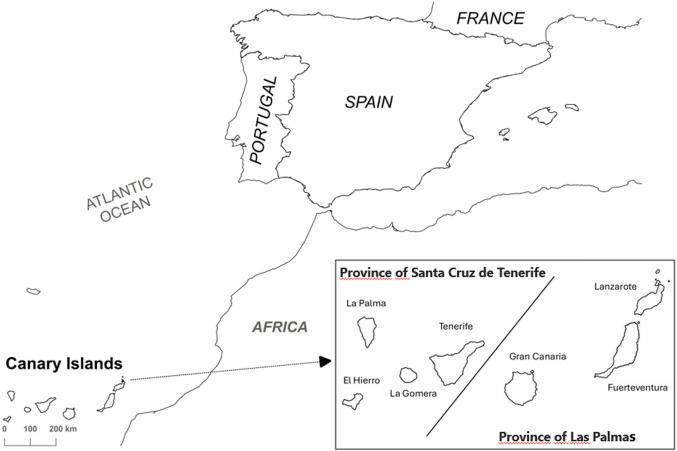
The presence of a diagnosis by a general practitioner is a major reason for the use of antidepressant (ADs). However, the simultaneous analysis of several and interrelated socioeconomic and demographic factors could provide a picture of the distribution of AD use in a given population across diverse geographical regions and socioeconomic backgrounds. The aim of the present study was to provide a picture of the trends in the consumption of ADs at the provincial, island and municipal levels for the period 2016-2021 in the Canary Islands (Spain), as an example of a geographically isolated area. To this end, several factors were analyzed, such as living in a rural or urban area, the population over 65 years of age, the population density or the socioeconomic status.
METHODS
Data were extracted from the community pharmacy wholesaler at the population level. A model with two nested fixed factors and a co-variable were used to analyze the trends in the use of ADs and the factors associated. Dispensation ADs use was measured as defined daily doses (DDD) per 1000 inhabitant per day. This provided total overall dispensation of AD and its rate of change for each island, as well as differences in dispensation at the island and municipal level.
RESULTS
Over the study period, prescription rates increased steadily at all population levels, although the level of dispensing and the rate of variation varied between island and municipalities but no between provinces. The data on the use of ADs at the level of the province and islands are more accurate because they include the entire population that is resident in that zone. At the municipal level, there is a bias, but it is difficult to quantify. The prescription patterns at municipal level were similar to those observed at island level, although with small variations in the dispensation level. Selective serotonin reuptake inhibitors (SSRIs) were the most commonly used, followed by "other ADs," whereas the use of tricyclic ADs remained stable. 1n addition, all AD drugs are equally available regardless of the geographical area of residence or socio-economic status although the type of AD and ranking varied slightly between islands due to the differences in general medical practice.
CONCLUSION
The observed differences in ADs use between rural and urban areas cannot be attributed to the factors of urbanization, population age, population density and socioeconomic status. However, the medical practices, the social and cultural traditions of each island, may provide insights into the underlying reasons for this variation.
引言
全科医生做出的诊断是使用抗抑郁药(ADs)的主要原因。然而,同时分析几个相互关联的社会经济和人口因素,可以描绘出给定人群在不同地理区域和社会经济背景下抗抑郁药使用情况的分布。本研究的目的是呈现2016 - 2021年期间西班牙加那利群岛作为地理上孤立地区的省级、岛屿级和市级抗抑郁药消费趋势。为此,分析了几个因素,如生活在农村或城市地区、65岁以上人口、人口密度或社会经济地位。
方法
从社区药房批发商处提取人口层面的数据。使用一个包含两个嵌套固定因素和一个协变量的模型来分析抗抑郁药使用趋势及相关因素。抗抑郁药的配药使用量以每1000居民每天的限定日剂量(DDD)来衡量。这提供了每个岛屿抗抑郁药的总配药量及其变化率,以及岛屿和市级层面配药量的差异。
结果
在研究期间,所有人口层面的处方率都稳步上升,尽管配药水平和变化率在岛屿和各市之间有所不同,但在各省之间没有差异。省级和岛屿级的抗抑郁药使用数据更准确,因为它们涵盖了该地区的全部常住人口。在市级层面存在偏差,但难以量化。市级层面的处方模式与岛屿级观察到的模式相似,尽管配药水平有小的差异。选择性5-羟色胺再摄取抑制剂(SSRIs)是最常用的,其次是“其他抗抑郁药”,而三环类抗抑郁药的使用保持稳定。此外,无论居住的地理区域或社会经济地位如何,所有抗抑郁药都同样可得,尽管由于一般医疗实践的差异,不同岛屿的抗抑郁药类型和排名略有不同。
结论
观察到的农村和城市地区抗抑郁药使用差异不能归因于城市化、人口年龄、人口密度和社会经济地位等因素。然而,每个岛屿的医疗实践、社会和文化传统可能为这种差异的潜在原因提供见解。

 Zotero 插件