Almeida Laila Lídia Faria, Neves Gabriel Lage, Pinhati Matheus Eduardo Soares, Lamaita Rivia Mara, Cândido Eduardo Batista, da Silva Agnaldo Lopes
Universidade Federal de Minas Gerais Faculdade de Medicina Belo HorizonteMG Brazil Faculdade de Medicina, Universidade Federal de Minas Gerais, Belo Horizonte, MG, Brazil.
Faculdade Ciências Médicas de Minas Gerais Belo HorizonteMG Brazil Faculdade Ciências Médicas de Minas Gerais, Belo Horizonte, MG, Brazil.
Rev Bras Ginecol Obstet. 2025 Jul 15;47. doi: 10.61622/rbgo/2025rbgo55. eCollection 2025.
This study aims to evaluate the clinical and functional implications of cesarean section (CS) skin scars on women's lives, emphasizing the relationship between scar characteristics and quality of life.
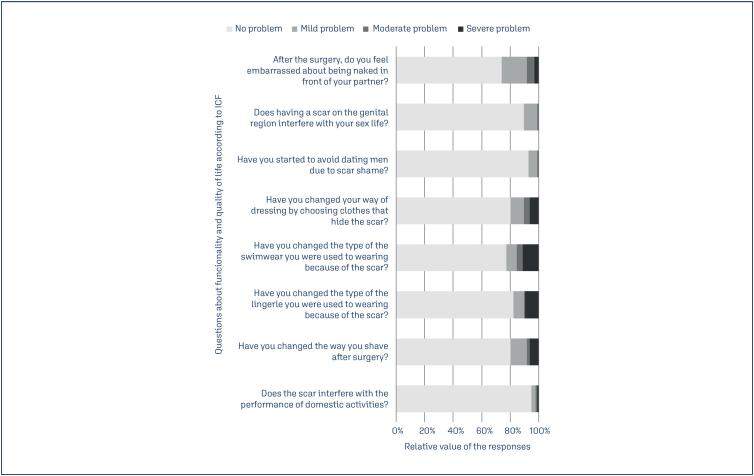
In this cross-sectional study, women older than 18 years old who had undergone CS with a Pfannenstiel incision within the past 6-36 months were evaluated. The Patient Scar Assessment Questionnaire (PSAQ) and the Patient and Observer Scar Assessment Scale (POSAS) were used to assess clinical scar parameters. Functionality was appraised using eight questions derived from the International Classification of Functionality, Disability, and Health (ICF). The association between scar appearance scores and functionality questions was analyzed statistically.
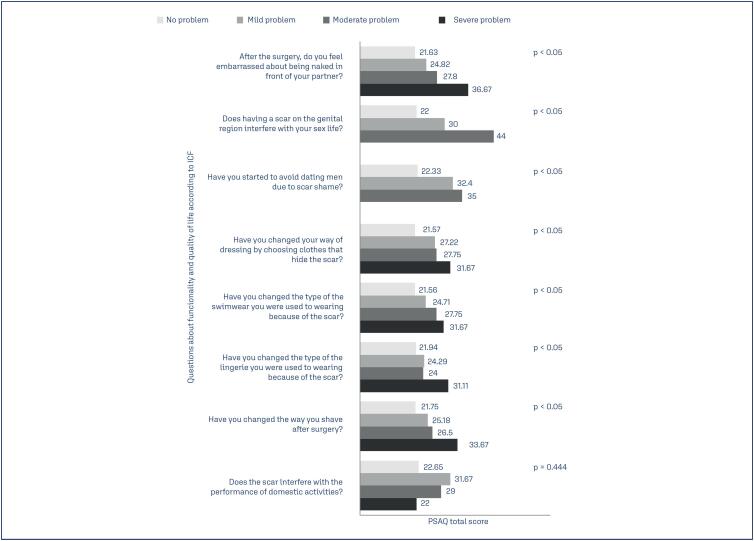
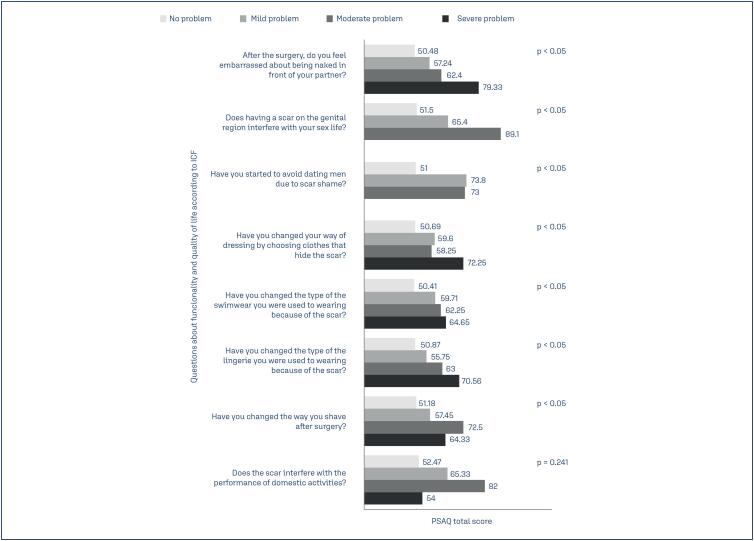
Ninety-six women were assessed, revealing that appearance and satisfaction with appearance had the worst scores on the PSAQ. Scar irregularity was the most frequently reported scar characteristic on the POSAS. On the ICF-derived questionnaire, the "self-care" domain was the most affected, with women reporting problems on activities such as choosing swimwear and lingeries. There was a significant correlation (p < 0,05) between the women dissatisfaction with the scar appearance and impairment in 'interpersonal interactions and relationships' and 'self-care', as the "domestic life" domain wasn't affected.
Cesarean section skin scars can lead to dissatisfaction and functional impairments, affecting women's quality of life. These findings underscore the necessity for multidisciplinary care and thorough discussions about delivery methods to improve post-surgical outcomes.
本研究旨在评估剖宫产(CS)皮肤疤痕对女性生活的临床和功能影响,重点关注疤痕特征与生活质量之间的关系。
在这项横断面研究中,对过去6至36个月内接受过耻骨联合上横切口剖宫产的18岁以上女性进行了评估。使用患者疤痕评估问卷(PSAQ)和患者及观察者疤痕评估量表(POSAS)来评估临床疤痕参数。使用从国际功能、残疾和健康分类(ICF)中衍生出的八个问题来评估功能。对疤痕外观评分与功能问题之间的关联进行了统计学分析。
对96名女性进行了评估,结果显示在PSAQ中,外观及对外观的满意度得分最低。疤痕不规则是POSAS上最常报告的疤痕特征。在源自ICF的问卷中,“自我护理”领域受影响最大,女性在选择泳衣和内衣等活动方面存在问题。女性对疤痕外观的不满与“人际互动和关系”及“自我护理”方面的损伤之间存在显著相关性(p<0.05),而“家庭生活”领域未受影响。
剖宫产皮肤疤痕可导致不满和功能障碍,影响女性的生活质量。这些发现强调了多学科护理以及就分娩方式进行深入讨论以改善术后结果的必要性。