Montgomery Lane I, Krichbaum Sarah, Katz Jeffrey S
Department of Psychological Sciences, Auburn University, 226 Thach Hall, Auburn, AL, 36849, USA.
Canine Performance Sciences, College of Veterinary Medicine, Auburn University, Auburn, AL, 36849, USA.
Sci Rep. 2025 Jul 17;15(1):20274. doi: 10.1038/s41598-025-06580-y.
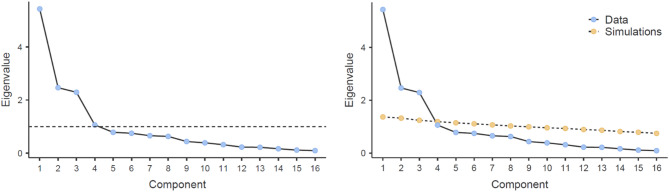
Televisions provide a unique perceptual experience to dogs, which can result in added enrichment (e.g., mental stimulation) or stressors (e.g., reactivity towards images) in a dog's day to day life. However, little research has sought to quantify and identify the mechanisms responsible for television viewing behaviors in dogs. A novel Dog Television Viewing Scale (DTVS) was distributed to companion dog owners. Questions were related to the types of stimuli the dog behaviorally reacted to (animals, inanimate objects) and the sensory domains through which these stimuli were perceived (vision, audition). A principal component analysis was conducted on the DTVS items using 453 responses. Generalized linear models were conducted to examine the impact of demographic and temperament factors on component scores. Notably, DTVS scores were best explained by components related to the types of stimuli (animals, inanimate objects) present on the television and the types of behavior the dog exhibited (following behaviors, stationary behaviors). Furthermore, measures of certain temperament traits assessed by dog owners, namely excitement and negative reactivity, were predictive of component scores. These results suggest that television viewing habits may be predicted by aspects of a dog's personality and that dogs may represent objects in the 2D television format similarly to the 3D environment. These results inform toward the perceptual experience of companion dogs and potential dog welfare interventions (e.g., shelter dog enrichment). In practice, engagement with television could provide dogs with an enriching, meaningful experience.
电视为狗狗提供了独特的感知体验,这可能会给狗狗的日常生活带来更多丰富感(如精神刺激)或压力源(如对图像的反应)。然而,很少有研究试图量化并确定导致狗狗观看电视行为的机制。一种新型的狗狗电视观看量表(DTVS)被分发给宠物狗主人。问题涉及狗狗产生行为反应的刺激类型(动物、无生命物体)以及感知这些刺激的感官领域(视觉、听觉)。使用453份回复对DTVS项目进行了主成分分析。进行了广义线性模型分析,以检验人口统计学和气质因素对成分得分的影响。值得注意的是,DTVS得分最好由与电视上出现的刺激类型(动物、无生命物体)以及狗狗表现出的行为类型(跟随行为、静止行为)相关的成分来解释。此外,狗狗主人评估的某些气质特征指标,即兴奋度和负面反应性,可预测成分得分。这些结果表明,狗狗的观看电视习惯可能由其个性方面来预测,并且狗狗可能以类似于三维环境的方式在二维电视画面中识别物体。这些结果为宠物狗的感知体验和潜在的狗狗福利干预措施(如收容所狗狗的丰富活动)提供了参考。在实际应用中,让狗狗接触电视可以为它们提供丰富而有意义的体验。