
尿簇集素是肾上皮细胞衰老的生物标志物,并可预测人类肾脏疾病进展。
Urinary Clusterin is a Biomarker of Renal Epithelial Senescence and Predicts Human Kidney Disease Progression.
作者信息
Baird David P, Reck Maximilian, Campbell Ross, Docherty Marie-Helena, Janas Piotr P, Mason Tilly, Mortuza Zenuida, Vermeren Matthieu, Nam Andy, Yang Wei, Schurman Nathan, Williams Claire, Traynor Jamie P, Mark Patrick B, Mylonas Katie J, Hughes Jeremy, Denby Laura, Conway Bryan R, Ferenbach David A
机构信息
Centre for Inflammation Research, Institute for Regeneration and Repair, University of Edinburgh, UK.
Centre for Cardiovascular Science, Queen's Medical Research Institute, University of Edinburgh, Edinburgh, UK.
出版信息
Kidney Int Rep. 2025 Apr 21;10(7):2344-2356. doi: 10.1016/j.ekir.2025.04.035. eCollection 2025 Jul.
INTRODUCTION
Cellular senescence is characterized by generally irreversible cell cycle arrest and changes in secretory activity, with senescent renal epithelia proposed as drivers of kidney fibrosis. The lack of noninvasive biomarkers represents an obstacle to the design of human trials of senescent cell-depleting medications.
METHODS
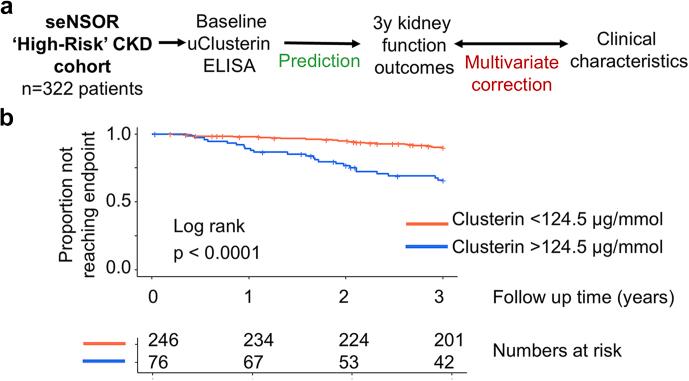
Proteomic analysis was performed on urine from patients with chronic kidney disease (CKD) alongside immunofluorescence staining of paired kidney biopsies ( = 51). Enzyme-linked immunosorbent assays (ELISAs) and immunofluorescence staining were performed in a second cohort of matched urine and kidney biopsies ( = 53). Spatial transcriptomic analysis was performed on kidney tissue from benign and fibrotic kidney disease ( = 13). Clusterin and senescence markers were analyzed by quantitative polymerase chain reaction (PCR) in irradiated human renal epithelia. Urinary biomarker concentrations were quantified by ELISA ( = 322) to assess their ability to predict patient outcomes (end-stage kidney disease or > 40% renal functional loss).
RESULTS
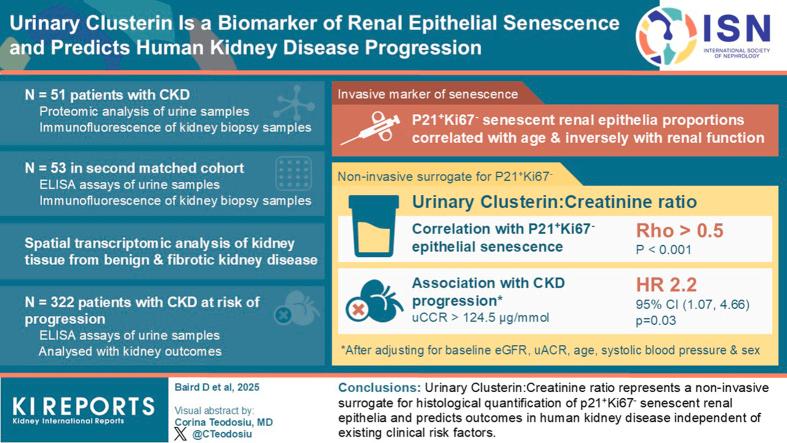
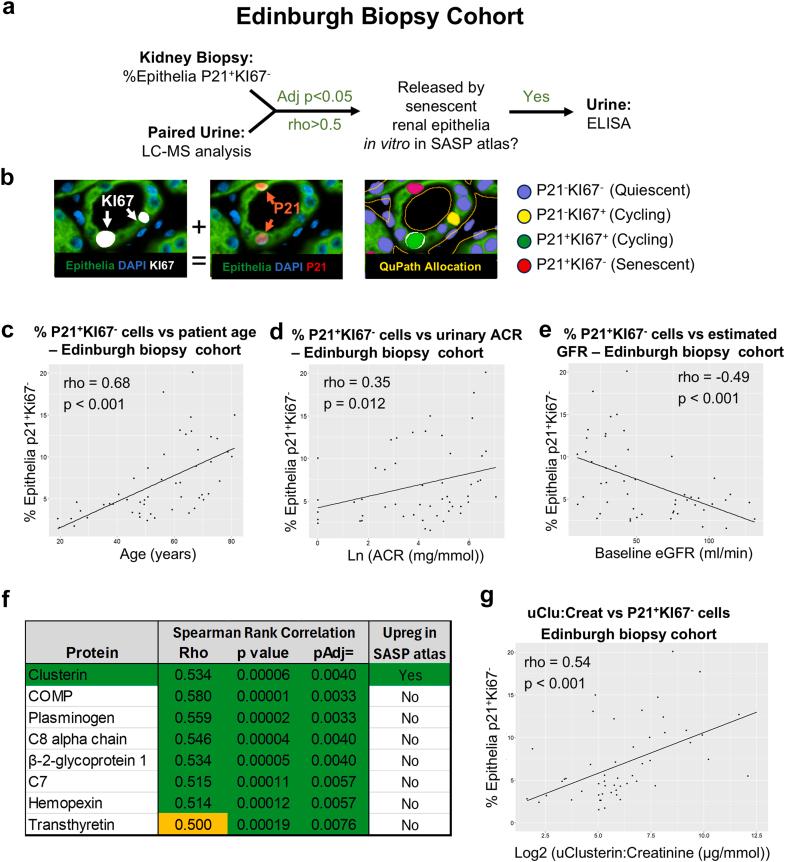
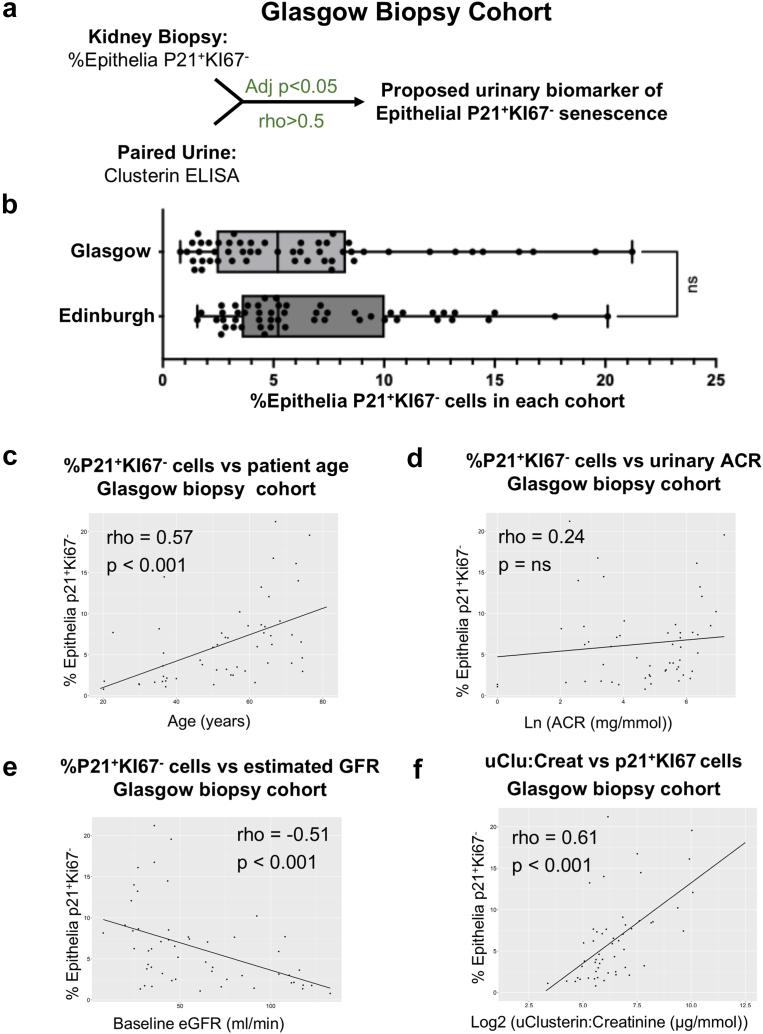
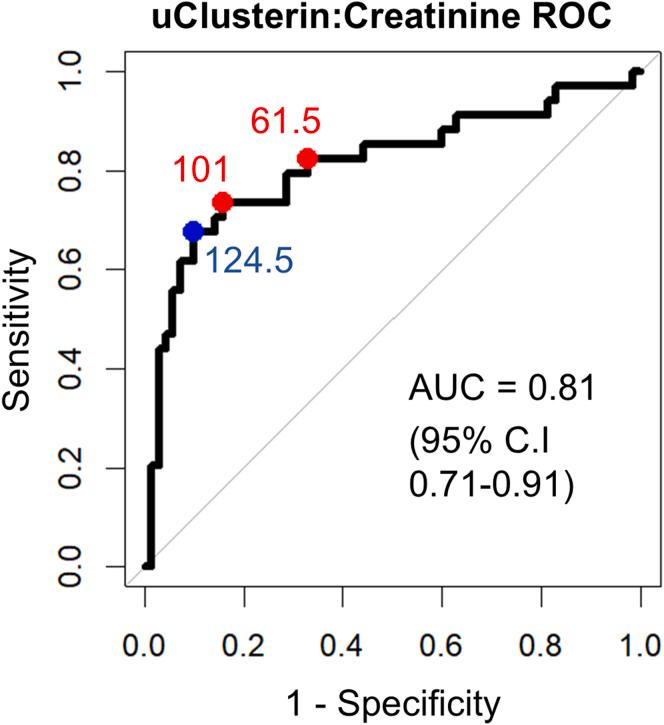
P21Ki67 epithelial senescence correlated with age and inversely with renal function. Urinary clusterin-to-creatinine ratio (uCCR) correlated tightly with P21Ki67 epithelial senescence in both matched urine and kidney biopsy cohorts (rho > 0.5, < 0.001) and predicted levels of senescence after adjusting for other variables. Clusterin was upregulated transcriptomically in (p21) expressing epithelia and . An elevated uCCR predicted adverse renal end points in a cohort of patients with CKD after adjusting for baseline estimated glomerular filtration rate (eGFR), urinary albumin-to-creatinine ratio (uACR), age, systolic blood pressure, and sex.
CONCLUSION
uCCR represents a surrogate for histologic quantification of p21Ki67 senescent renal epithelia and predicts outcomes in human kidney disease independent of existing clinical risk factors.
引言
细胞衰老的特征是细胞周期普遍不可逆停滞以及分泌活性改变,衰老的肾上皮细胞被认为是肾纤维化的驱动因素。缺乏非侵入性生物标志物是设计清除衰老细胞药物人体试验的一个障碍。
方法
对慢性肾脏病(CKD)患者的尿液进行蛋白质组分析,并对配对的肾活检组织进行免疫荧光染色(n = 51)。在另一组配对的尿液和肾活检组织(n = 53)中进行酶联免疫吸附测定(ELISA)和免疫荧光染色。对良性和纤维化肾病的肾组织进行空间转录组分析(n = 13)。通过定量聚合酶链反应(PCR)分析照射后的人肾上皮细胞中的聚集素和衰老标志物。通过ELISA对322例患者的尿液生物标志物浓度进行定量,以评估其预测患者预后(终末期肾病或肾功能丧失>40%)的能力。
结果
P21Ki67上皮细胞衰老与年龄相关,与肾功能呈负相关。在配对的尿液和肾活检队列中,尿聚集素与肌酐比值(uCCR)与P21Ki67上皮细胞衰老密切相关(rho>0.5,P<0.001),并且在调整其他变量后可预测衰老水平。在表达p21的上皮细胞中,聚集素在转录组水平上上调。在调整基线估计肾小球滤过率(eGFR)、尿白蛋白与肌酐比值(uACR)、年龄、收缩压和性别后,升高的uCCR可预测CKD患者队列中的不良肾脏终点。
结论
uCCR代表p21Ki67衰老肾上皮细胞组织学定量的替代指标,并且独立于现有临床风险因素预测人类肾脏疾病的预后。


 Zotero 插件