Cui Lishan, Perini Giordano, Minopoli Antonio, Palmieri Valentina, De Spirito Marco, Papi Massimiliano
Dipartimento di Neuroscienze, Università Cattolica del Sacro Cuore, Largo Francesco Vito 1, 00168 Rome, Italy.
Fondazione Policlinico Universitario A. Gemelli IRCSS, 00168 Rome, Italy.
Int J Pharm X. 2025 Jun 24;10:100349. doi: 10.1016/j.ijpx.2025.100349. eCollection 2025 Dec.
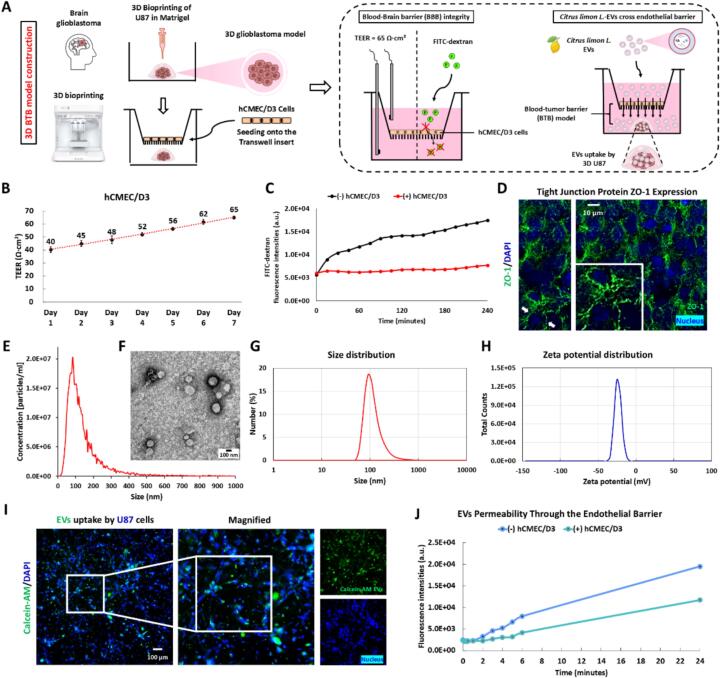
Glioblastoma (GBM) is the most aggressive primary brain tumor, with limited treatment options due to the restrictive blood-brain barrier (BBB) and the heterogeneity of the blood-tumor barrier (BTB). Temozolomide (TMZ), the standard chemotherapy, suffers from poor BBB permeability, rapid degradation, and systemic toxicity. Plant-derived extracellular vesicles (PDEVs) have emerged as promising natural nanocarriers, offering biocompatibility, stability, and the ability to cross biological barriers. This study investigates the use of extracellular vesicles from L. (LDEs) to encapsulate and deliver TMZ (EVs@TMZ) for GBM treatment. LDEs were isolated, characterized, and loaded with TMZ via ultrasonication. Encapsulation efficiency, stability, and physicochemical properties were assessed using UV-Vis and FTIR spectroscopy. A 3D BTB model was developed using bioprinted U87 glioblastoma cells in Matrigel, co-cultured with hCMEC/D3 endothelial cells to replicate the tumor microenvironment. Barrier integrity was evaluated through TEER and FITC-dextran assays. Uptake, cytotoxicity, and tumor invasion were assessed in this model, along with oxidative stress and VEGF-A secretion. LDEs effectively encapsulated TMZ, enhancing drug stability under physiological conditions. EVs@TMZ crossed the endothelial barrier while preserving barrier integrity and reducing TMZ-induced ROS production. In the 3D glioblastoma model, EVs@TMZ showed strong cytotoxic effects on tumor cells while minimizing endothelial toxicity and oxidative stress. Moreover, VEGF-A secretion was suppressed, disrupting pro-tumorigenic pathways. These findings highlight Citrus-derived EVs as biocompatible, efficient carriers for TMZ delivery, offering a promising approach to overcome current challenges in GBM therapy and supporting further development of PDEVs for brain tumor treatment.
胶质母细胞瘤(GBM)是最具侵袭性的原发性脑肿瘤,由于血脑屏障(BBB)的限制和血瘤屏障(BTB)的异质性,治疗选择有限。替莫唑胺(TMZ)作为标准化疗药物,存在血脑屏障通透性差、快速降解和全身毒性等问题。植物来源的细胞外囊泡(PDEVs)已成为有前景的天然纳米载体,具有生物相容性、稳定性以及穿越生物屏障的能力。本研究调查了来自柠檬(LDEs)的细胞外囊泡用于包裹和递送TMZ(EVs@TMZ)以治疗GBM的情况。分离、表征了LDEs,并通过超声处理将TMZ加载到其中。使用紫外可见光谱和傅里叶变换红外光谱评估包封效率、稳定性和物理化学性质。使用生物打印的U87胶质母细胞瘤细胞在基质胶中与hCMEC/D3内皮细胞共培养,构建三维BTB模型,以复制肿瘤微环境。通过跨上皮电阻(TEER)和异硫氰酸荧光素 - 葡聚糖(FITC - dextran)测定评估屏障完整性。在该模型中评估摄取、细胞毒性和肿瘤侵袭,以及氧化应激和血管内皮生长因子 - A(VEGF - A)分泌情况。LDEs有效地包裹了TMZ,增强了药物在生理条件下的稳定性。EVs@TMZ穿过内皮屏障,同时保持屏障完整性并减少TMZ诱导的活性氧(ROS)产生。在三维胶质母细胞瘤模型中,EVs@TMZ对肿瘤细胞显示出强烈的细胞毒性作用,同时将内皮毒性和氧化应激降至最低。此外,VEGF - A分泌受到抑制,破坏了促肿瘤发生途径。这些发现突出了柑橘来源的细胞外囊泡作为生物相容性良好、高效的TMZ递送载体,为克服GBM治疗中的当前挑战提供了一种有前景的方法,并支持PDEVs在脑肿瘤治疗中的进一步发展。