Zhang Xiaojuan, Liao Yuhua, Han Xue, Shi Guangduoji, Wang Wanxin, Guo Lan, He Yuancheng, Li Yanzhi, Zhang Huimin, Zhao Hao, Chen Yan, Sun Xuedie, Liu Yifeng, Hao Jiejing, Wen Chengxi, Phan Lee, Mclntyre Roger S, Fan Beifang, Lu Ciyong
Department of Medical Statistics and Epidemiology, School of Public Health, Sun Yat-sen University, Guangzhou, China.
Department of Psychiatry, Shenzhen Nanshan Center for Chronic Disease Control, Shenzhen, China.
Transl Psychiatry. 2025 Jul 18;15(1):248. doi: 10.1038/s41398-025-03471-8.
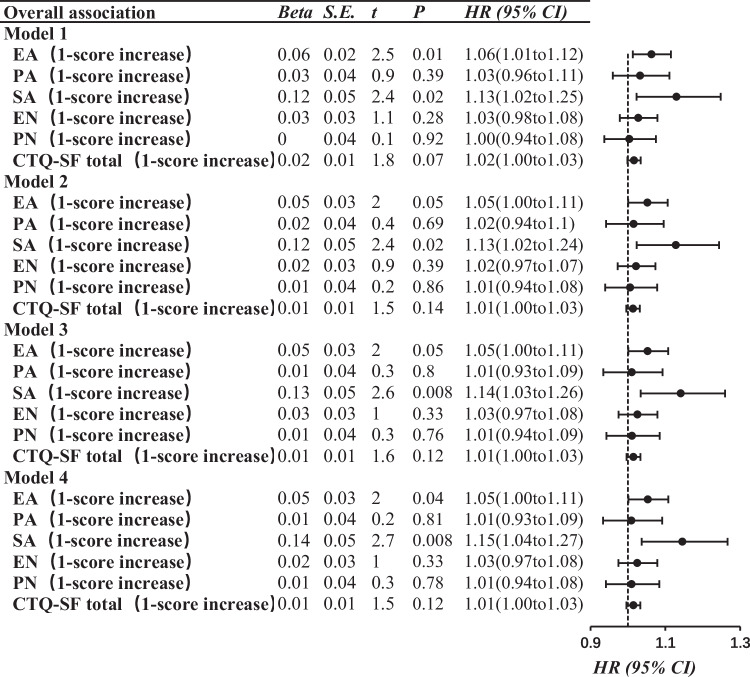
Early and accurate identification and management of bipolar disorders (BDs) among major depressive disorders (MDDs) in clinical practice would place these patients in progressive early-onset bipolar care. The associations between childhood maltreatment, exercise and transition from MDD to BD remain unclear. To determine whether MDD patients reporting childhood maltreatment are at an increased risk of transition to BD. The secondary objective is to evaluate the moderating effects of exercise on the association. This prospective cohort study with a maximum follow-up of four years was based on the Depression Cohort in China. 1392 MDD with 18-65 years of age were enrolled between March 2019 and November 2023 after diagnosis by trained psychiatrists using the Mini-International Neuropsychiatric Interview and 1034 with complete data were finally included in the primary analysis. The Childhood Trauma Questionnaire-Short Form and exercise were collected at baseline, and clinician referrals for BD were confirmed at follow-up. Of the 1034 MDD patients included, the mean(SD) age was 28.32(7.00) years, and 714(69.1%) were women. 58 transitions to BD (39.64 per 1000 person years) were reported among MDD patients. Childhood emotional abuse (aHR, 1.05; 95%CI, 1.00-1.11; P = 0.04) and sexual abuse (aHR, 1.15; 95%CI, 1.04-1.27; P = 0.008) were positively associated with transition to BD. Stratified analyses showed that childhood emotional abuse (aHR, 1.08; 95%CI, 1.02-1.14; P = 0.007) was associated with transition to BD among patients without habitual exercise, but not among those with habitual exercise. Childhood emotional abuse and sexual abuse may be significant risk factors for the transition from MDD to BD, while exercise may partly offset the risk effects of emotional abuse and this transition. MDD patients who reported related childhood maltreatment, their families and health professionals should monitor closely and screen frequently for the possible emergence of BD.
在临床实践中,早期准确识别和管理重度抑郁症(MDD)中的双相情感障碍(BD),将使这些患者得到早期双相情感障碍的渐进性护理。童年期虐待、运动与从MDD转变为BD之间的关联尚不清楚。目的是确定报告童年期虐待的MDD患者转变为BD的风险是否增加。次要目的是评估运动对这种关联的调节作用。这项前瞻性队列研究的最长随访期为四年,基于中国抑郁症队列。2019年3月至2023年11月期间,1392名年龄在18至65岁之间的MDD患者经训练有素的精神科医生使用《迷你国际神经精神病学访谈》诊断后入组,最终1034名有完整数据的患者纳入初步分析。在基线时收集儿童期创伤问卷简表和运动情况,并在随访时确认临床医生转诊的BD病例。在纳入的1034名MDD患者中,平均(标准差)年龄为28.32(7.00)岁,714名(69.1%)为女性。MDD患者中报告了58例转变为BD(每1000人年39.64例)。童年期情感虐待(调整后风险比,1.05;95%置信区间,1.00 - 1.11;P = 0.04)和性虐待(调整后风险比,1.15;95%置信区间,1.04 - 1.27;P = 0.008)与转变为BD呈正相关。分层分析表明,童年期情感虐待(调整后风险比,1.08;95%置信区间,1.02 - 1.14;P = 0.007)在无习惯性运动的患者中与转变为BD有关,但在有习惯性运动的患者中则不然。童年期情感虐待和性虐待可能是从MDD转变为BD的重要危险因素,而运动可能部分抵消情感虐待对这种转变的风险影响。报告有相关童年期虐待的MDD患者、其家人和卫生专业人员应密切监测并经常筛查BD可能的出现情况。