Donatiello Valerio, Alfieri Aniello, Mazza Maria Civita, Buonavolontà Pietro, Scalvenzi Antonio, Prisco Elena, Maffei Vincenzo, Lanza Cono Alberto, Coppolino Francesco, Pace Maria Caterina, Sansone Pasquale, Passavanti Maria Beatrice
Department of Anesthesiology, V.Le Antonio Cardarelli 9, A.O.R.N. Antonio Cardarelli, 80131, Naples, Italy.
Department of Women, Child and General and Specialized Surgery, University of Campania Luigi Vanvitelli, Piazza Miraglia 2, 80138, Naples, Italy.
J Anesth Analg Crit Care. 2025 Jul 18;5(1):46. doi: 10.1186/s44158-025-00265-8.
Proximal femur fractures in the elderly are a common and serious condition with high morbidity and mortality. Effective postoperative pain control reduces complications, hospital stay, and opioid use. The PEricapsular Nerve Group (PENG) block is a regional anesthesia technique offering motor-sparing analgesia, facilitating spinal anesthesia and early rehabilitation. However, higher local anesthetic (LA) doses may increase the risk of systemic toxicity, particularly in frail, sarcopenic patients. This study evaluates the analgesic efficacy and safety of two ropivacaine concentrations (0.375% vs 0.25%) in PENG blocks.
This prospective observational monocentric study included 217 patients (aged 65-100) undergoing surgery for osteoporotic proximal femur fractures. Patients received a 20-mL PENG block with either 0.375% or 0.25% ropivacaine prior to spinal anesthesia. Postoperative analgesia included paracetamol and ketorolac, with intramuscular morphine available as rescue. The primary endpoint was the proportion of patients requiring morphine; secondary outcomes included time to first rescue dose. Statistical analyses included chi-square testing, Kaplan-Meier estimates, and non-inferiority analysis (Δ = 0.05).
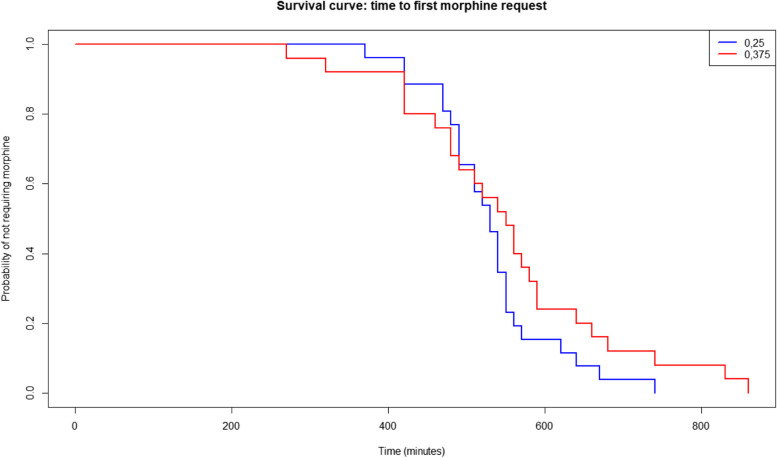
The proportion of patients requiring rescue morphine was 23% in the 0.375% group and 25% in the 0.25% group (p = 0.87). Non-inferiority was demonstrated, with a difference of - 0.019 (95% CI: - 0.0344 to - 0.0036). No significant differences were observed in time to first rescue dose.
PENG block with 0.25% ropivacaine provides non-inferior analgesia compared to 0.375%, supporting its use in elderly patients to reduce opioid reliance and minimize the risk of local anesthetic systemic toxicity.
Not applicable.
老年患者股骨近端骨折是一种常见且严重的疾病,发病率和死亡率都很高。有效的术后疼痛控制可减少并发症、缩短住院时间并减少阿片类药物的使用。关节周围神经组(PENG)阻滞是一种区域麻醉技术,可提供保留运动功能的镇痛效果,有助于脊髓麻醉和早期康复。然而,较高剂量的局部麻醉药(LA)可能会增加全身毒性的风险,尤其是在体弱、肌肉减少的患者中。本研究评估了两种罗哌卡因浓度(0.375%与0.25%)在PENG阻滞中的镇痛效果和安全性。
这项前瞻性观察性单中心研究纳入了217例年龄在65至100岁之间接受骨质疏松性股骨近端骨折手术的患者。患者在脊髓麻醉前接受了20毫升含0.375%或0.25%罗哌卡因的PENG阻滞。术后镇痛包括对乙酰氨基酚和酮咯酸,必要时可肌肉注射吗啡进行解救。主要终点是需要吗啡的患者比例;次要结局包括首次使用解救剂量的时间。统计分析包括卡方检验、 Kaplan-Meier估计和非劣效性分析(Δ = 0.05)。
0.375%组需要解救吗啡的患者比例为23%,0.25%组为25%(p = 0.87)。证明了非劣效性,差异为 -0.019(95% CI:-0.0344至-0.0036)。首次使用解救剂量的时间未观察到显著差异。
与0.375%的罗哌卡因相比,0.25%的罗哌卡因进行PENG阻滞提供了非劣效的镇痛效果,支持其在老年患者中使用,以减少对阿片类药物的依赖并将局部麻醉药全身毒性的风险降至最低。
不适用。