Song Tingwei, Guo Liang, Sun Qian, Gao Guizhen, Chen Jing, Zhang Qikun
College of Forestry and Landscape Architecture, Xinjiang Agricultural University, Urumqi, 830052, People's Republic of China.
College of Resources and Environment, Xinjiang Agricultural University, Urumqi, 830052, People's Republic of China.
Sci Rep. 2025 Jul 19;15(1):26244. doi: 10.1038/s41598-025-08848-9.
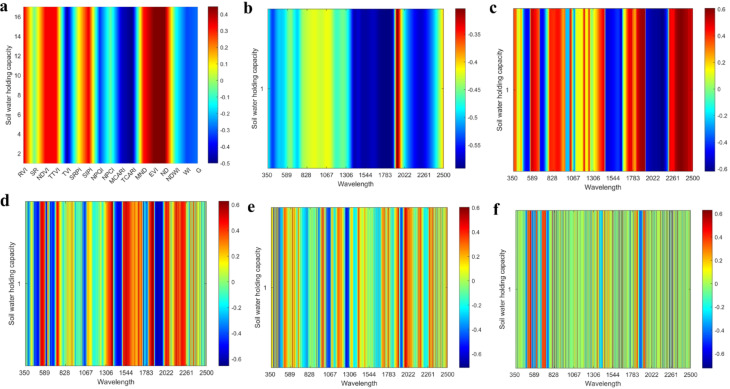
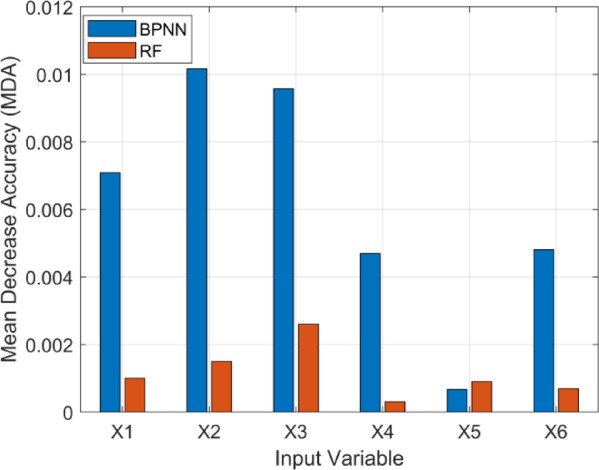
Soil water retention is a critical aspect of water conservation. To quantitatively assess the Soil Water-Holding Capacity (SWHC), this study focused on a typical wild fruit forest in Xinjiang, China. The spectral characteristics of the forest canopy were employed as a bridge to enhance the sensitivity between the SWHC and various vegetation indices using mathematical statistical methods. This study integrated hyperspectral technology with machine learning algorithms to model complex nonlinear relationships and to select the optimal SWHC model. The spatial distribution of SWHC in the wild fruit forests of Emin County was retrieved using Sentinel-2 imagery. The results revealed a significant negative correlation between SWHC and the smoothed leaf spectral reflectance, with the best correlation coefficient was r = - 0.59. The use of third-order derivatives and logarithmic second-order derivatives further enhanced this correlation, yielding optimal coefficients of r = - 0.78 and r = - 0.72, respectively. Moreover, uncertainty analysis demonstrated that the SWHC estimation model constructed using the Random Forest (RF) algorithm exhibited the highest stability, with a coefficient of determination R = 0.73, RMSE = 0.158, and RPD = 1.90. The spatial inversion results indicated that SWHC values were relatively higher in areas with dense wild fruit forest coverage and valley terrain. This study is the first to jointly incorporate high-order spectral derivatives and uncertainty analysis into the modeling of SWHC in wild fruit forests, underscoring the advantages of spectral feature enhancement and variable perturbation analysis for improving model stability. The findings provide novel insights into SWHC inversion and offer valuable references for ecological restoration, enhancing the water conservation function of wild fruit forests, and formulating targeted management strategies.
土壤水分保持是水资源保护的一个关键方面。为了定量评估土壤持水能力(SWHC),本研究聚焦于中国新疆的一片典型野生果林。利用数学统计方法,将林冠层的光谱特征作为桥梁,以增强SWHC与各种植被指数之间的敏感性。本研究将高光谱技术与机器学习算法相结合,对复杂的非线性关系进行建模,并选择最优的SWHC模型。利用哨兵 - 2影像反演了额敏县野生果林SWHC的空间分布。结果表明,SWHC与平滑后的叶片光谱反射率之间存在显著的负相关,最佳相关系数为r = -0.59。使用三阶导数和对数二阶导数进一步增强了这种相关性,分别得到最优系数r = -0.78和r = -0.72。此外,不确定性分析表明,使用随机森林(RF)算法构建的SWHC估计模型表现出最高的稳定性,决定系数R = 0.73,均方根误差RMSE = 0.158,相对分析误差RPD = 1.90。空间反演结果表明,在野生果林覆盖密集和山谷地形的区域,SWHC值相对较高。本研究首次将高阶光谱导数和不确定性分析共同纳入野生果林SWHC建模中,强调了光谱特征增强和变量扰动分析在提高模型稳定性方面的优势。研究结果为SWHC反演提供了新的见解,并为生态恢复、增强野生果林的水分保持功能以及制定针对性管理策略提供了有价值的参考。