Schneider Samuel Lukas, Gopalakrishnan Abiram, Teale Misha Alexander, Eibl Regine
Center for Cell Cultivation Techniques, Tissue Engineering and Medical Biology, Institute of Chemistry and Biotechnology, School of Life Sciences and Facility Management, ZHAW Zurich University of Applied Sciences, Wädenswil, Switzerland.
Front Bioeng Biotechnol. 2025 Jul 4;13:1611703. doi: 10.3389/fbioe.2025.1611703. eCollection 2025.
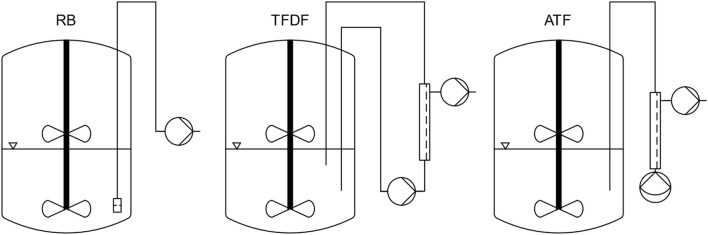
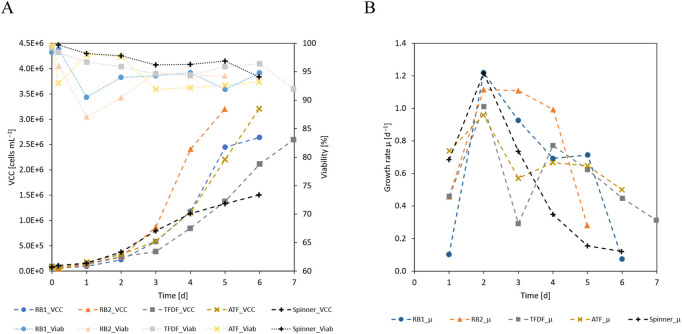
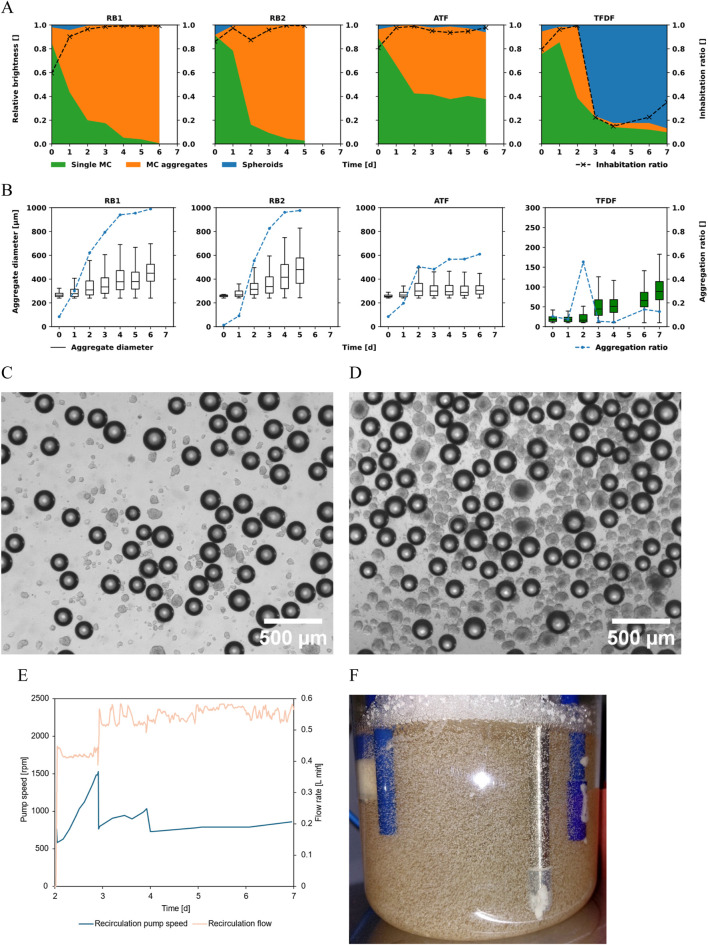
The production of clinically relevant quantities of human mesenchymal stromal cells (hMSCs) requires scalable and intensified manufacturing processes. For this reason, the applicability of alternating tangential flow filtration (ATF) and tangential flow depth filtration (TFDF) based cell retention systems for hMSC expansion on microcarriers (MCs) in perfusion mode was assessed. The processes were conducted in stirred tank bioreactors at a scale of 1.8 L and compared with repeated-batch cultivations. In the perfusion and repeated-batch control cultivations, competitive viable cell concentrations of ≈2.9 · 10 cells mL were reached within a cultivation period of 5-7 days, resulting in an expansion factor of 41-57. The main difference between the operation modi was the aggregation behavior of the MCs. While the median MC aggregate diameter in the repeated-batch cultivation reached 470 μm, the ATF cell retention device constrained aggregate size to a median diameter of 250 µm. In the TFDF cultivation, the shear forces in the recirculation loop stripped most of the hMSCs from the MCs, resulting in the formation of spheroids that continued to proliferate, albeit at a decreased rate. While perfusion operation did not lead to increased productivity in this proof-of-concept study, manual handling and therefore contamination risk were reduced by replacing the repeated-batch process's daily 80% medium exchanges with automated perfusion operation. Additionally, the ATF system was shown to be useful for medium removal and washing of the MCs prior to adding the harvesting solution, which is highly valuable for cultivations conducted at larger scales. While the feasibility of ATF based cell retention for MC expansion processes could be demonstrated, increased growth area to medium ratios, i.e., higher MC concentrations, still need to be investigated to leverage the full potential of the perfusion process mode.
生产具有临床相关性数量的人间充质基质细胞(hMSCs)需要可扩展且强化的制造工艺。因此,评估了基于交替切向流过滤(ATF)和切向流深度过滤(TFDF)的细胞保留系统在灌注模式下用于在微载体(MCs)上扩增hMSCs的适用性。这些工艺在1.8升规模的搅拌罐生物反应器中进行,并与重复批次培养进行比较。在灌注和重复批次对照培养中,在5 - 7天的培养期内达到了约2.9·10个细胞/毫升的竞争性活细胞浓度,扩增倍数为41 - 57。操作模式之间的主要差异在于MCs的聚集行为。在重复批次培养中,MC聚集体的中位直径达到470μm,而ATF细胞保留装置将聚集体尺寸限制在中位直径250μm。在TFDF培养中,再循环回路中的剪切力将大多数hMSCs从MCs上剥离,导致形成继续增殖的球体,尽管增殖速率有所降低。虽然在这个概念验证研究中灌注操作并未提高生产力,但通过用自动灌注操作取代重复批次过程中每天80%的培养基更换,减少了人工操作,从而降低了污染风险。此外,ATF系统被证明在添加收获溶液之前用于去除培养基和清洗MCs是有用的,这对于更大规模的培养非常有价值。虽然可以证明基于ATF的细胞保留用于MC扩增过程的可行性,但仍需要研究增加生长面积与培养基的比例,即更高的MC浓度,以充分发挥灌注过程模式的潜力。