Rashed Ahmed E, Nofal Mohamed S, El-Moneim Ahmed Abd
Environmental Sciences Department, Faculty of Science, Alexandria University, Alexandria, 21511, Egypt.
Graphene Center of Excellence, Egypt-Japan University of Science and Technology, New Borg El Arab, 21934, Egypt.
Sci Rep. 2025 Jul 22;15(1):26526. doi: 10.1038/s41598-025-09332-0.
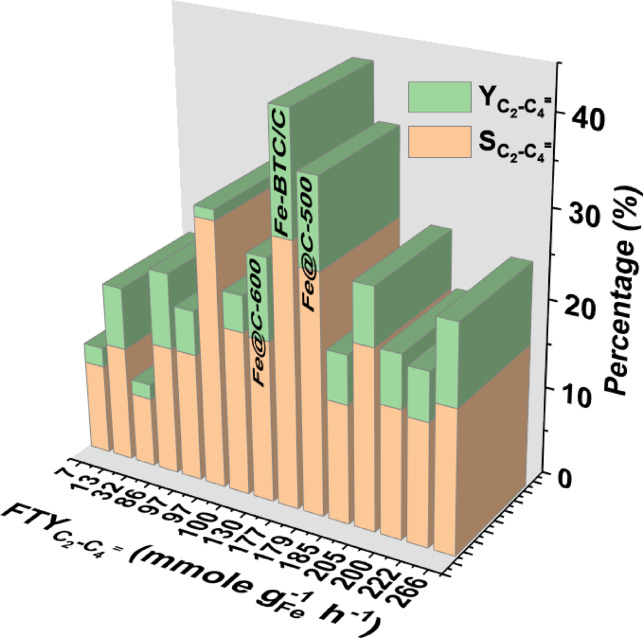
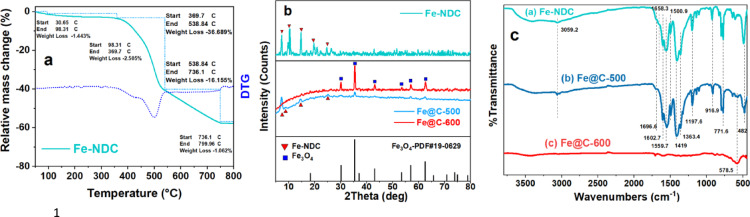
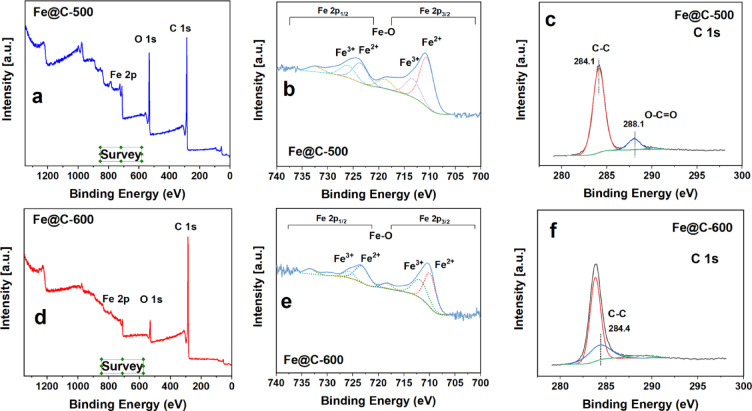
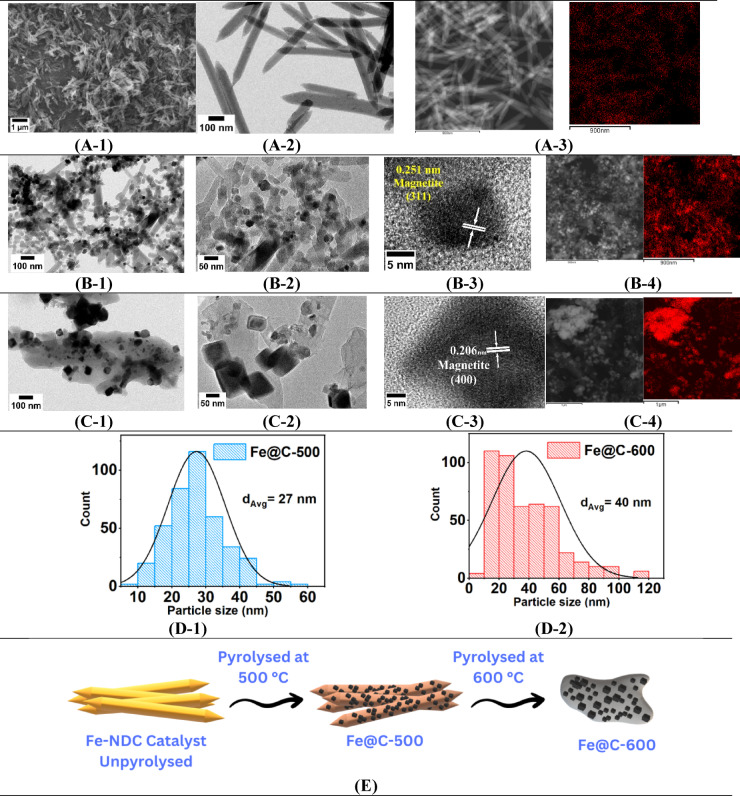
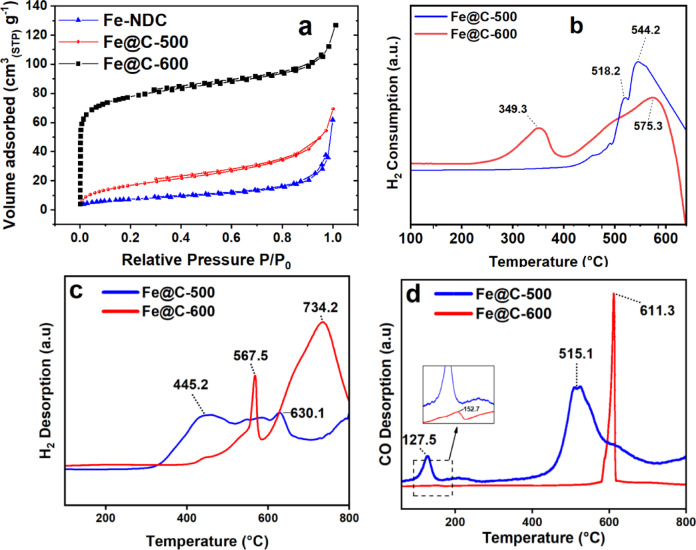
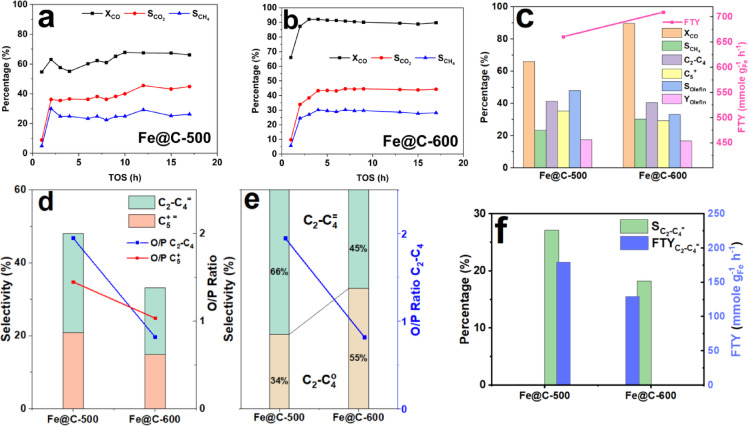
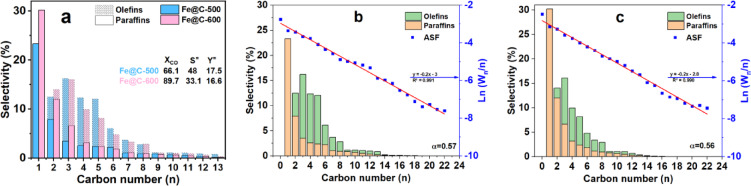
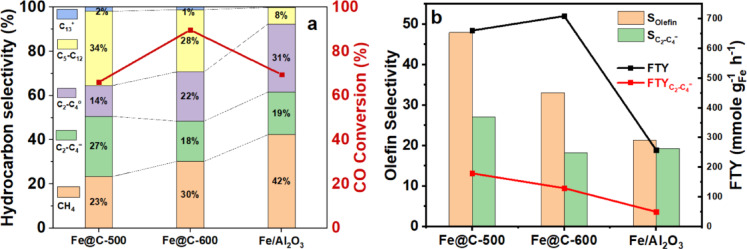
Olefins are the backbone of the petrochemical conversion industries, like polymers, plastic, lubricating oil, surfactants, and synthetic fuels. It is a wide but challenging process to customize. Metal-organic frameworks (MOFs) are highly regarded for their potential in Fischer-Tropsch synthesis (FTS), yet they often have inadequate thermal stability. This study demonstrated the remarkable potential of the Fe-NDC MOF. It maintains its initial structure until it reaches a temperature of 500 °C (Fe@C-500), which is efficient for syngas conversion to olefin. The Fe@C-500 catalyst exceeded a twofold increase in the ratio of olefin to paraffin compared to Fe@C-600 (2 vs. 0.8). The maintained structure of Fe@C-500 enhances the transport of reactants and restricts the hydrogenation of olefins. The Fe@C-500 catalyst showed ~ 50% and 27% selectivity to total olefin and light olefin, respectively, with a Fe-time yield (FTY) for light olefins of 180 mmol g h. In contrast, Fe@C-600 exhibits a shift in product selectivity towards paraffin (~ 70%) at a lower FTY for light olefins of 130 mmol g h. The performance of the Fe@C-500 catalyst is particularly intriguing and warrants further investigation. Retaining the porous structure of MOF-derived catalysts might greatly enhance olefin production.
烯烃是石化转化行业的支柱,如聚合物、塑料、润滑油、表面活性剂和合成燃料。定制是一个广泛但具有挑战性的过程。金属有机框架(MOF)因其在费托合成(FTS)中的潜力而备受关注,但它们的热稳定性往往不足。本研究展示了Fe-NDC MOF的显著潜力。它在达到500°C的温度(Fe@C-500)之前保持其初始结构,这对于合成气转化为烯烃是有效的。与Fe@C-600相比,Fe@C-500催化剂的烯烃与石蜡比例增加了两倍多(分别为2和0.8)。Fe@C-500保持的结构增强了反应物的传输并限制了烯烃的氢化。Fe@C-500催化剂对总烯烃和轻质烯烃的选择性分别约为50%和27%,轻质烯烃的铁时空产率(FTY)为180 mmol g h。相比之下,Fe@C-600在较低的轻质烯烃FTY为130 mmol g h时,产品选择性向石蜡转移(约70%)。Fe@C-500催化剂的性能特别引人关注,值得进一步研究。保留MOF衍生催化剂的多孔结构可能会大大提高烯烃产量。