Cercato Cintia, Stumpf Matheo A M, da Cunha Freire Gabriel Neimann, Kawahara Eduardo Zanatta, Fernandes Ariana E, de Melo Maria E, Mancini Marcio C
Obesity Unit, Division of Endocrinology and Metabolism, University of São Paulo Medical School Hospital, Av. Dr. Enéas Carvalho de Aguiar, 155 8° andar, Bloco 8ª, Cerqueira César, São Paulo, CEP 05403-000, Brazil.
Diabetol Metab Syndr. 2025 Jul 21;17(1):289. doi: 10.1186/s13098-025-01842-1.
Long-term treatment of obesity with lifestyle changes alone is unsustainable for most individuals. Antiobesity medications are recommended for individuals with a body mass index (BMI) ≥ 30 kg/m² or ≥ 27 kg/m² with one or more comorbidities. In Brazil, the prescription of combined sibutramine plus topiramate for obesity management is common in daily clinical practice. However, data on its effectiveness and safety are lacking. Thus, the objective of this study was to evaluate this combination for treating obesity in a real-world scenario.
This retrospective cohort study included individuals with obesity ≥ 18 years prescribed sibutramine and topiramate for at least 3 months between 2012 and 2022 at a large tertiary healthcare center. Baseline and follow-up data were collected from medical records.
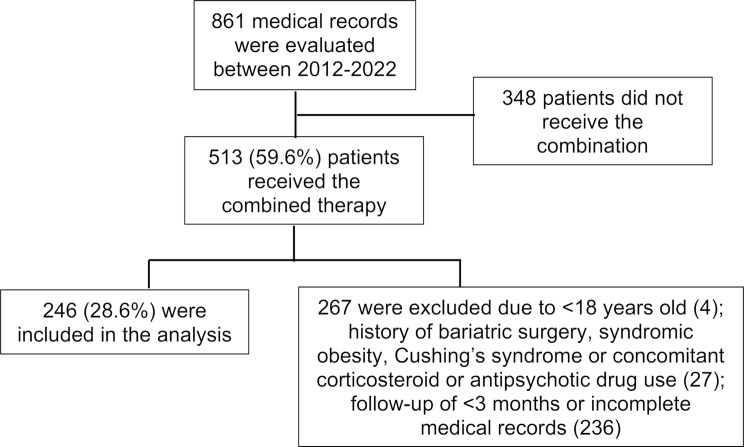
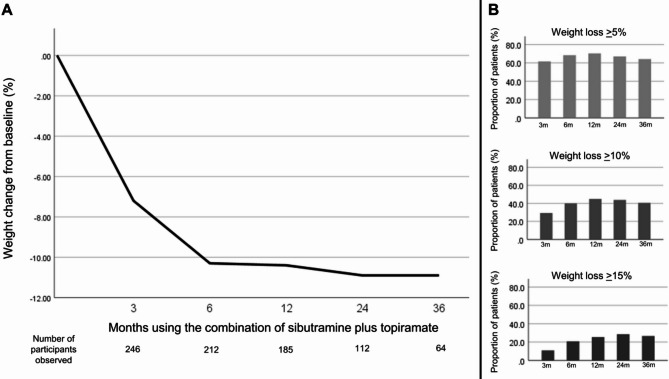
Among 861 medical records screened, 246 (28.6%) were included. Most participants were female (86.2%) with a mean age of 42.8 ± 12.7 years, 52% had hypertension, 31.3% type 2 diabetes and 30% dyslipidemia. The average baseline BMI and weight were 39.7 kg/m² and 104.2 kg, respectively. The mean daily doses of sibutramine and topiramate were 11 ± 2.1 mg and 119.7 ± 54.7 mg, respectively. There was a significant change in body weight precociously at 3 months on the combination (96.8 ± 20.7 kg, p < 0.001), with 61.8% of patients achieving at least ≥ 5% of weight loss, 29.4% ≥10% and 10.9% ≥15%. At 36 months, 64% maintained at least ≥ 5% of weight loss, 40.6% ≥10% and 26.5% ≥15%. Common adverse effects included paresthesia, memory impairment, bradyphrenia and elevated blood pressure. The discontinuation rate was 24.4%. No major safety concern was observed in a mean follow-up of 25.3 months.
In a real-world setting, sibutramine and topiramate combination therapy was associated with clinically meaningful weight loss alongside a good tolerability profile.
对于大多数人而言,仅通过生活方式改变来长期治疗肥胖是难以维持的。对于体重指数(BMI)≥30 kg/m² 或≥27 kg/m² 且伴有一种或多种合并症的个体,推荐使用抗肥胖药物。在巴西,联合使用西布曲明和托吡酯治疗肥胖在日常临床实践中很常见。然而,关于其有效性和安全性的数据尚缺乏。因此,本研究的目的是在真实世界场景中评估这种联合用药治疗肥胖的效果。
这项回顾性队列研究纳入了2012年至2022年期间在一家大型三级医疗中心接受西布曲明和托吡酯治疗至少3个月的18岁及以上肥胖个体。从医疗记录中收集基线和随访数据。
在筛选的861份医疗记录中,纳入了246份(28.6%)。大多数参与者为女性(86.2%),平均年龄为42.8±12.7岁,52%患有高血压,31.3%患有2型糖尿病,30%患有血脂异常。平均基线BMI和体重分别为39.7 kg/m²和104.2 kg。西布曲明和托吡酯的平均日剂量分别为11±2.1 mg和119.7±54.7 mg。联合用药3个月时体重出现显著早期变化(96.8±20.7 kg,p<0.001),61.8%的患者体重减轻至少≥5%,29.4%≥10%,10.9%≥15%。在36个月时,64%的患者体重减轻至少≥5%,40.6%≥10%,26.5%≥15%。常见的不良反应包括感觉异常、记忆障碍、思维迟缓及血压升高。停药率为24.4%。在平均25.3个月的随访中未观察到重大安全问题。
在真实世界环境中,西布曲明和托吡酯联合治疗与具有临床意义的体重减轻相关,且耐受性良好。