Chen Weixiao, Chen Qingzhou, Tang Zhiwei, Li Zhibo, Chen Weiyan, Xiong Xuming, Wen Deliang, Zhang Zhenhui
Department of Critical Care, The Second Affiliated Hospital of Guangzhou Medical University, No. 250 Changgang East Road, Haizhu District, Guangzhou, China.
State Key Laboratory of Respiratory Disease, Clinical Laboratory Medicine Department, Guangzhou, China.
Mediators Inflamm. 2025 Jul 14;2025:9930648. doi: 10.1155/mi/9930648. eCollection 2025.
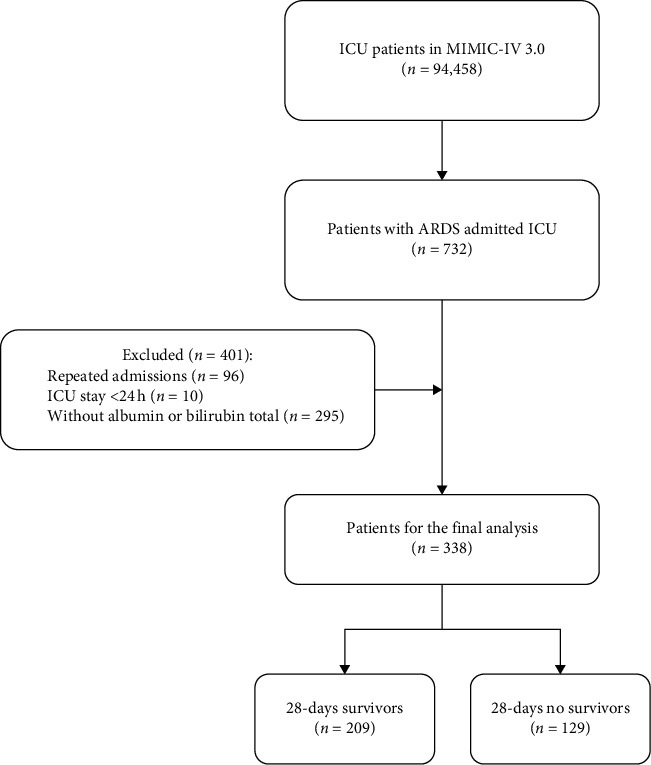
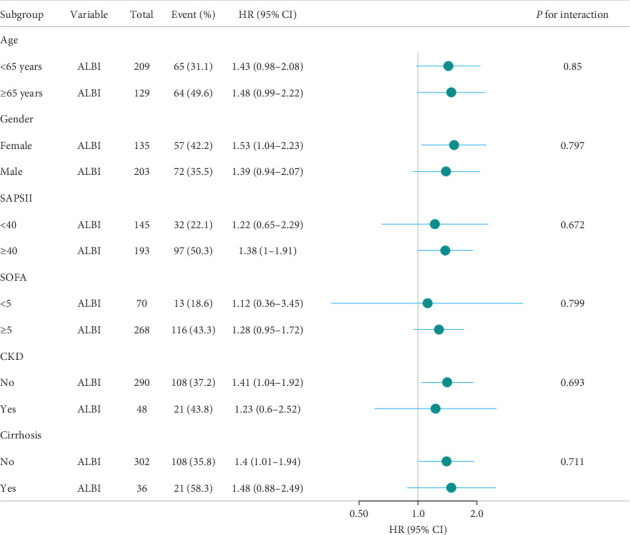
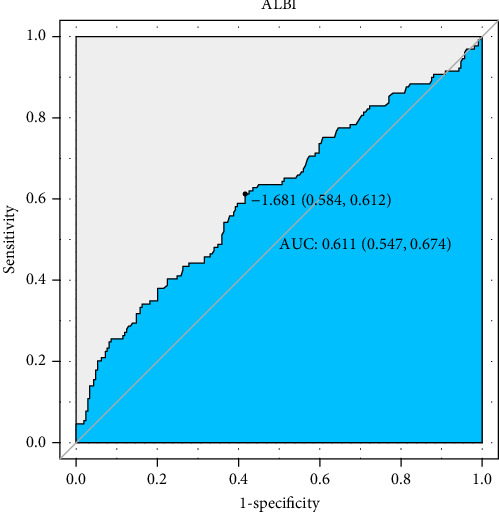
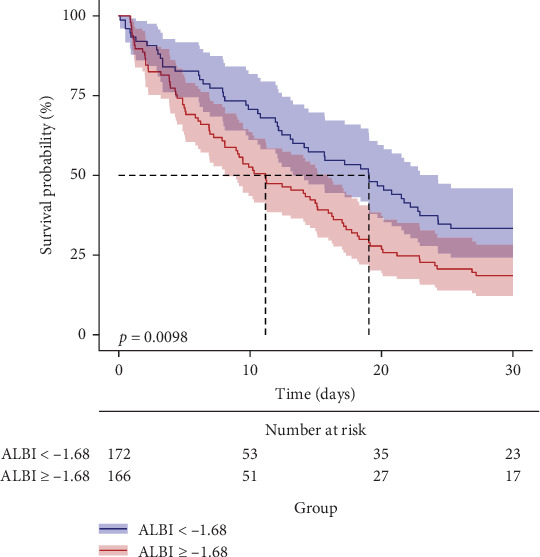
The albumin-bilirubin (ALBI) grade, a validated prognostic tool in cancers such as hepatocellular carcinoma, has not been evaluated in acute respiratory distress syndrome (ARDS). This retrospective cohort study, utilizing data from the MIMIC-IV (v3.0) database, aimed to assess ALBI's predictive value for 28-day all-cause mortality in 338 adult ARDS patients admitted to the ICU. Patients were stratified into survivors (209 cases) and nonsurvivors (129 cases), with a 28-day mortality rate of 38.2%. Multivariable Cox regression identified ALBI as an independent predictor of 28-day mortality (HR = 1.46, 95% CI: 1.09-1.95, =0.011). Receiver operating characteristic (ROC) analysis yielded an area under the curve (AUC) of 61.1% (95% CI: 54.7%-67.4%) with an optimal ALBI cutoff of -1.681; Kaplan-Meier (KM) survival curves confirmed significantly higher mortality in patients with ALBI ≥-1.681 versus ALBI <-1.681 (=0.0098). Subgroup analyses revealed no significant interactions between ALBI and clinical variables (interaction : 0.672-0.85). These findings demonstrate ALBI's utility as a novel, independent prognostic marker for short-term mortality risk in ARDS patients.
白蛋白-胆红素(ALBI)分级是一种在肝细胞癌等癌症中经过验证的预后工具,尚未在急性呼吸窘迫综合征(ARDS)中进行评估。这项回顾性队列研究利用多因素重症监护信息库-IV(MIMIC-IV,版本3.0)数据库的数据,旨在评估ALBI对338例入住重症监护病房(ICU)的成年ARDS患者28天全因死亡率的预测价值。患者被分为幸存者(209例)和非幸存者(129例),28天死亡率为38.2%。多变量Cox回归分析确定ALBI是28天死亡率的独立预测因素(风险比[HR]=1.46,95%置信区间[CI]:1.09-1.95,P=0.011)。受试者工作特征(ROC)曲线分析得出曲线下面积(AUC)为61.1%(95%CI:54.7%-67.4%),最佳ALBI临界值为-1.681;Kaplan-Meier(KM)生存曲线证实,ALBI≥-1.681的患者死亡率显著高于ALBI<-1.681的患者(P=0.0098)。亚组分析显示,ALBI与临床变量之间无显著交互作用(交互作用P值:0.672-0.85)。这些研究结果表明,ALBI可作为ARDS患者短期死亡风险的一种新型独立预后标志物。