Yuan Meng, Kollar Leslie M, Sacchi Bianca M, Carey Sarah B, Choudhury Baharul I, Jones Teresa, Grimwood Jane, Barrett Spencer C H, McDaniel Stuart F, Wright Stephen I, Stinchcombe John R
Department of Ecology and Evolutionary Biology, University of Toronto, Toronto, ON, Canada.
Department of Biology, University of Florida, Gainesville, FL, USA.
Genome Biol Evol. 2025 Jul 30;17(8). doi: 10.1093/gbe/evaf138.
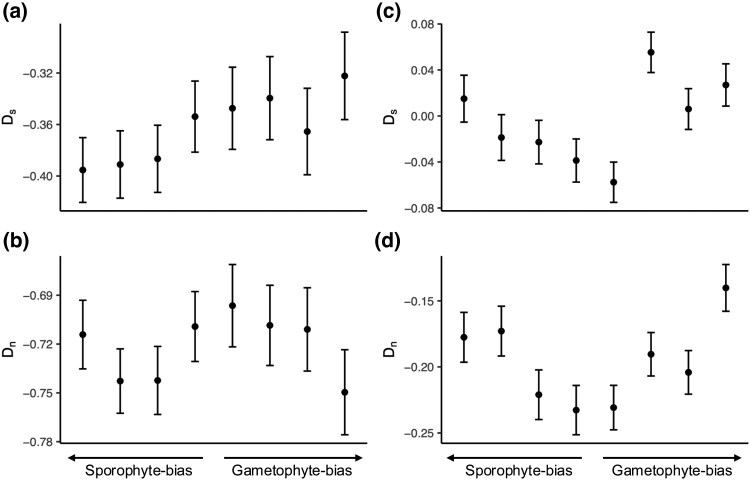
The maintenance of genetic variation by balancing selection is of considerable interest to evolutionary biologists. An important but understudied potential driver of balancing selection is antagonistic pleiotropy between diploid and haploid stages of the plant life cycle. Despite sharing a common genome, sporophytes (2n) and gametophytes (n) may undergo differential or even opposing selection. Theoretical work suggests antagonistic pleiotropy between life stages can generate balancing selection and maintain genetic variation. Despite the potential for far-reaching consequences of gametophytic selection, empirical tests of its pleiotropic effects (neutral, synergistic, or antagonistic) on sporophytes are generally lacking. Here, we examined the population genomic signals of selection across life stages in the angiosperm Rumex hastatulus and the moss Ceratodon purpureus. We compared gene expression between life stages and sexes, combined with neutral diversity statistics and the analysis of the distribution of fitness effects. In contrast to what would be predicted under balancing selection due to antagonistic pleiotropy, we found that unbiased genes between life stages were under stronger purifying selection, likely explained by a predominance of synergistic pleiotropy between life stages and strong purifying selection on broadly expressed genes. In addition, we found that 30% of candidate genes under balancing selection in R. hastatulus were located within inversion polymorphisms. Our findings provide novel insights into the genome-wide characteristics and consequences of plant gametophytic selection.
通过平衡选择来维持遗传变异是进化生物学家相当感兴趣的问题。平衡选择一个重要但未得到充分研究的潜在驱动因素是植物生命周期中二倍体和单倍体阶段之间的拮抗多效性。尽管共享一个共同的基因组,但孢子体(2n)和配子体(n)可能会经历不同甚至相反的选择。理论研究表明,生命阶段之间的拮抗多效性可以产生平衡选择并维持遗传变异。尽管配子体选择可能会产生深远的影响,但对其对孢子体的多效性影响(中性、协同或拮抗)的实证检验普遍缺乏。在这里,我们研究了被子植物戟叶酸模和苔藓紫萼藓整个生命阶段的选择的群体基因组信号。我们比较了生命阶段和性别之间的基因表达,并结合中性多样性统计和适合度效应分布分析。与由于拮抗多效性导致的平衡选择所预测的情况相反,我们发现生命阶段之间无偏向性的基因受到更强的纯化选择,这可能是由于生命阶段之间协同多效性占主导以及对广泛表达基因的强烈纯化选择所致。此外,我们发现戟叶酸模中处于平衡选择下的候选基因有30%位于倒位多态性区域内。我们的研究结果为植物配子体选择的全基因组特征和后果提供了新的见解。