Lou Shaoyang, Luo Xiaojun, Chen Zhonggou, Gao Zhiji, Wang Ruida, Feng Linjin, Zhang Guoyi, Zhang Yanfei, Zhao Ye, Li Bei
Department of Landscape and Architecture, Zhejiang Agriculture and Forestry University, Hangzhou, 311300, China.
China Construction Fifth Engineering Division Corp., Ltd, Hangzhou, 311300, China.
Sci Rep. 2025 Jul 22;15(1):26644. doi: 10.1038/s41598-025-12165-6.
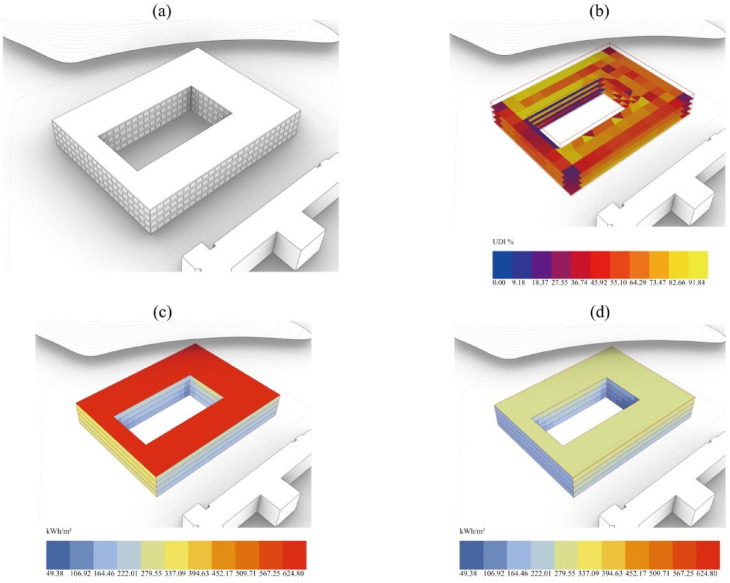
Optimizing solar radiation and daylighting performance is a fundamental concern in architectural design, as these factors are directly linked to enhancing building energy efficiency and environmental comfort. This study seeks to balance solar radiation and daylighting performance through architectural geometry optimization, includes building's length, width, height, orientation, and mass distribution. Parametric modeling based on the additive and subtractive design generation algorithms included in EvoMass on the Grasshopper platform, with the goal of minimizing the solar radiation variation between summer and winter on building envelopes and maximizing useful daylight illuminance (UDI). A multi-objective evolutionary algorithm named Steady-State Island Evolutionary Algorithm (SSIEA) was applied to optimize the building geometry, ultimately yielding the Pareto front optimal solution. When compared to the reference building, the optimized design enables the building to achieve a more balanced solar radiation distribution across different seasons, resulting in a 26.89% improvement in performance. Additionally, the building's daylighting performance is enhanced by 19.85%. The results demonstrate that leveraging the Pareto front in the early stages of building geometric form design provides architects with effective strategies and solutions for geometry optimization, enabling performance-based design decisions in subsequent stages.
优化太阳辐射和采光性能是建筑设计中的一个基本问题,因为这些因素与提高建筑能源效率和环境舒适度直接相关。本研究旨在通过建筑几何优化来平衡太阳辐射和采光性能,包括建筑物的长度、宽度、高度、朝向和质量分布。基于Grasshopper平台上EvoMass中包含的加法和减法设计生成算法进行参数化建模,目标是最小化建筑物围护结构夏季和冬季之间的太阳辐射变化,并最大化有用日光照度(UDI)。应用一种名为稳态岛进化算法(SSIEA)的多目标进化算法来优化建筑几何形状,最终得到帕累托前沿最优解。与参考建筑相比,优化后的设计使建筑在不同季节实现更平衡的太阳辐射分布,性能提高了26.89%。此外,建筑的采光性能提高了19.85%。结果表明,在建筑几何形状设计的早期阶段利用帕累托前沿为建筑师提供了几何优化的有效策略和解决方案,从而能够在后续阶段做出基于性能的设计决策。