Chen Juan, Zhao Xiaohang, Li Jiayu, Chen Wei, Jiang Cheng, Wang Xinran
School of Modern Pharmaceutical Industry, China Pharmaceutical University, 639 Longmian Road, Jiangning District, Nanjing, 210009, China.
School of Education Science, Nanjing Normal University, No.1 Wenyuan Road, Qixia District, Nanjing, 210046, China.
BMC Med Educ. 2025 Jul 22;25(1):1096. doi: 10.1186/s12909-025-07686-7.
From the students' perspective, the research evaluates their views on core competencies and their own developmental needs within pharmaceutical education, attempting to explore potential pathways for optimizing students' core competencies. This study seeks to enhance students' core competencies, enrich learning and development theories, and establish a basis and reference for cultivating high-caliber pharmaceutical talents.
Establishing a core competency index system for pharmacy major, a survey questionnaire comprising 41 items across four dimensions (knowledge, skills, abilities, and values) was designed. Using stratified cluster sampling, 919 valid responses were collected. Descriptive statistics, variance analysis, and chi-square test were used to analyze the perceptions of pharmaceutical students on core competencies' importance for professional growth and their satisfaction with teaching, and to examine disparities in the development of core competencies among different groups of students.
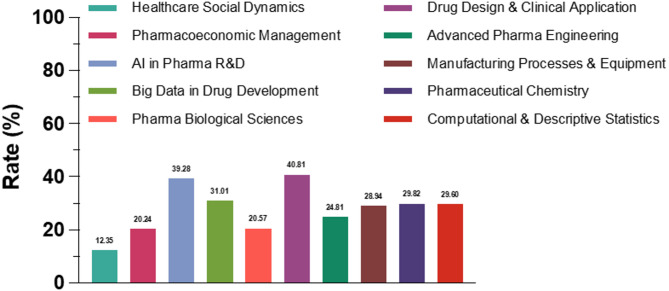
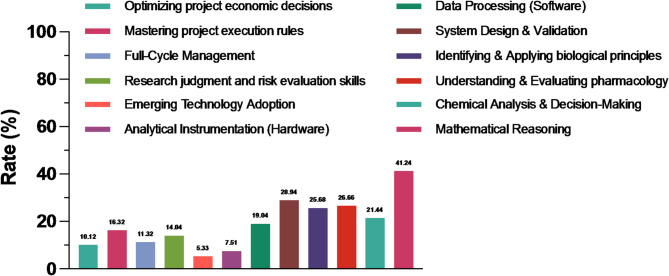
The study revealed deficiencies in pharmaceutical students' core competencies regarding artificial intelligence, pharmaceutical application, medical care, etc. Differential analysis indicated that significant differences across education levels: undergraduates prioritized foundational knowledge and ethical norms, while postgraduates emphasized project-based learning and ability improvement. Students with work or project experience placed higher value on knowledge application, systematic thinking, strategic capabilities, and innovative technologies such as artificial intelligence.
This study evaluates pharmaceutical core competency education from the student perspective, revealing their perceptions of developmental requirements. The research proposes an optimization pathway: the curriculum reform of pharmaceutical higher education should be scientific, general, innovative, practical and humanistic, thereby providing a reference for reforming pharmaceutical higher education.
本研究从学生的角度评估他们对药学教育核心能力及其自身发展需求的看法,试图探索优化学生核心能力的潜在途径。本研究旨在提高学生的核心能力,丰富学习与发展理论,并为培养高素质药学人才奠定基础和提供参考。
构建药学专业核心能力指标体系,设计一份包含四个维度(知识、技能、能力和价值观)共41项内容的调查问卷。采用分层整群抽样法,收集到919份有效问卷。运用描述性统计、方差分析和卡方检验,分析药学专业学生对核心能力对职业成长重要性的认知以及他们对教学的满意度,并考察不同学生群体在核心能力发展方面的差异。
研究揭示了药学专业学生在人工智能、药物应用、医疗护理等核心能力方面存在不足。差异分析表明,不同学历层次存在显著差异:本科生更注重基础知识和道德规范,而研究生则强调基于项目的学习和能力提升。有工作或项目经验的学生对知识应用、系统思维、战略能力以及人工智能等创新技术更为重视。
本研究从学生角度评估药学核心能力教育,揭示了他们对发展要求的认知。该研究提出了一条优化途径:药学高等教育的课程改革应具有科学性、通用性、创新性、实践性和人文性,从而为药学高等教育改革提供参考。