Xue Shenglong, Feng Yan, Shi Tian, Halike Halina, Maimaitireyimu Ayinuer, Abudurexiti Adilai, Xie Jinjin, Yao Shanxia, Gao Feng
College of Life Science and Technology, Xinjiang University, Urumqi, China.
Department of Gastroenterology, People's Hospital of Xinjiang Uygur Autonomous Region, Urumqi, China.
Front Immunol. 2025 Jul 8;16:1606237. doi: 10.3389/fimmu.2025.1606237. eCollection 2025.
Celiac disease (CeD), an autoimmune enteropathy, is often associated with multiple glandular autoimmune diseases. However, the prevalence and staging characteristics of autoimmune polyglandular syndrome (APS) among CeD patients remain unclear. The aim of this study was to assess the prevalence and clinical features of APS among Chinese CeD patients.
Clinical data and medical records of 243 CeD patients diagnosed in northwest China were retrospectively analyzed to identify comorbid autoimmune diseases among CeD patients. Serum interferon-ω1, interferon-α, and thyroid autoantibodies (TPOAb and TgAb) were measured, and AIRE mutations were detected. APS typing was conducted based on serum antibodies, gene sequencing (AIRE mutation analysis), and comorbidity analysis.
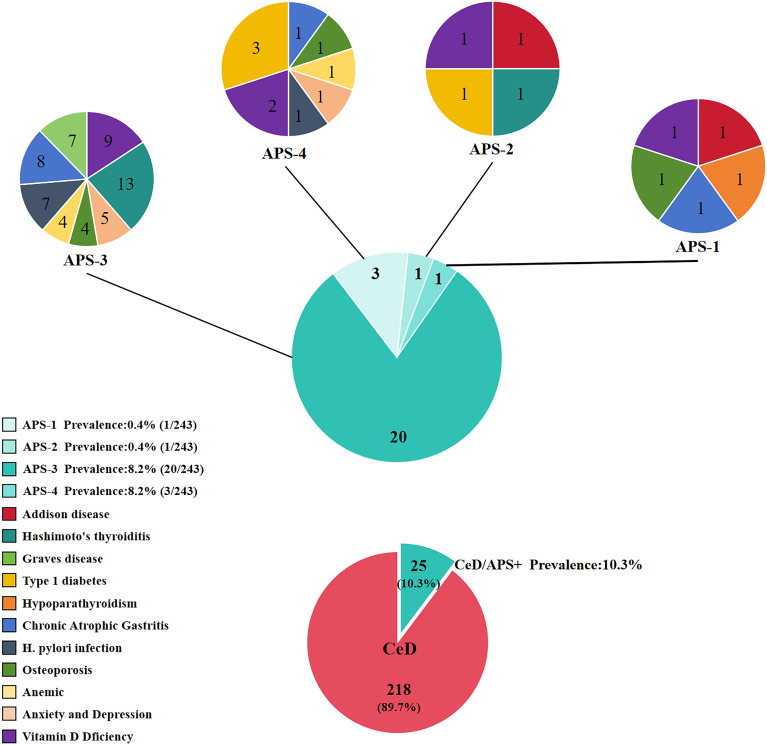
The overall prevalence of APS in CeD patients was 10.3% (25/243), and the prevalence of different types of APS varied as follows: APS-1: 0.4%, APS-2: 0.4%, APS-3: 8.2%, and APS-4: 1.2%. The prevalence of APS in CeD patients was significantly higher than that in the general population, especially the prevalence of APS-3. Patients with CeD combined with APS had a higher prevalence of vitamin D deficiency (13 of 25 patients, 52%) and infection (8 of 25 patients, 32%). In addition, CeD patients with combined APS were more likely to have anxiety and depressive symptoms ( < 0.05), but there were no significants differences in gender, ethnicity, or body mass index.
This study is the first to systematically evaluate the prevalence and staging characteristics of APS among CeD patients, thereby filling the epidemiological data gap in this area. We emphasize the significance of screening for APS among CeD patients to enable early detection and treatment of associated autoimmune diseases and enhance patients' quality of life.
乳糜泻(CeD)是一种自身免疫性肠病,常与多种腺体自身免疫性疾病相关。然而,CeD患者中自身免疫性多腺体综合征(APS)的患病率及分期特征仍不清楚。本研究旨在评估中国CeD患者中APS的患病率及临床特征。
回顾性分析在中国西北部诊断的243例CeD患者的临床资料和病历,以确定CeD患者中的合并自身免疫性疾病。检测血清干扰素-ω1、干扰素-α和甲状腺自身抗体(TPOAb和TgAb),并检测AIRE突变。基于血清抗体、基因测序(AIRE突变分析)和合并症分析进行APS分型。
CeD患者中APS的总体患病率为10.3%(25/243),不同类型APS的患病率如下:APS-1:0.4%,APS-2:0.4%,APS-3:8.2%,APS-4:1.2%。CeD患者中APS的患病率显著高于普通人群,尤其是APS-3的患病率。CeD合并APS的患者维生素D缺乏(25例患者中的13例,52%)和感染(25例患者中的8例,32%)的患病率更高。此外,CeD合并APS的患者更易出现焦虑和抑郁症状(P<0.05),但在性别、种族或体重指数方面无显著差异。
本研究首次系统评估了CeD患者中APS的患病率及分期特征,从而填补了该领域的流行病学数据空白。我们强调在CeD患者中筛查APS的重要性,以便早期发现和治疗相关自身免疫性疾病并提高患者生活质量。