
用于结直肠内镜黏膜下剥离术的远程实践培训系统的潜力。
Potential for remote hands-on training system for colorectal endoscopic submucosal dissection.
作者信息
Ono Kohei, Ohata Ken, Ide Daisuke, Ohno Akiko, Muramoto Takashi, Tsuji Yosuke, Chiba Hideyuki, Kato Hiroaki
机构信息
Department of Gastrointestinal Endoscopy, NTT Medical Center Tokyo, Tokyo, Japan.
Department of Gastroenterology, The Cancer Institute Hospital of Japanese Foundation for Cancer Research, Tokyo, Japan.
出版信息
VideoGIE. 2025 Apr 6;10(8):428-433. doi: 10.1016/j.vgie.2025.03.037. eCollection 2025 Aug.
BACKGROUND AND AIMS
Hands-on training plays a crucial role in the acquisition of endoscopic skills; however, its transition to an online format has been considered challenging due to the inherently tactile and direct nature of instruction. Since 2020, we have conducted an online colorectal endoscopic submucosal dissection (ESD) training course, holding 9 sessions and training a total of 75 participants. The aim of this study is to evaluate the effectiveness of our remote hands-on training program for colorectal ESD.
METHODS
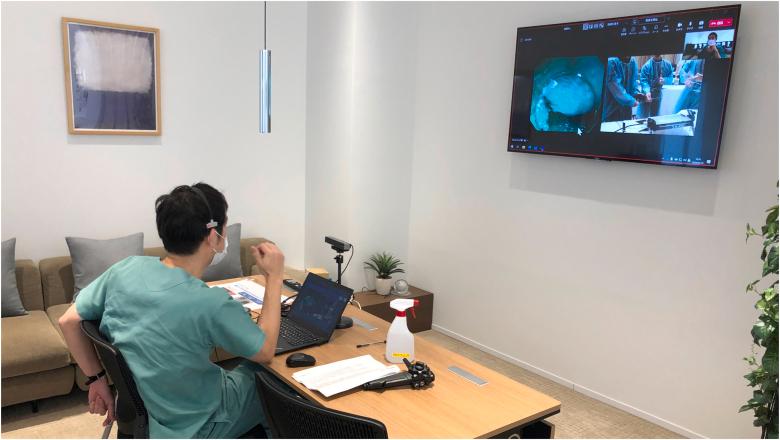
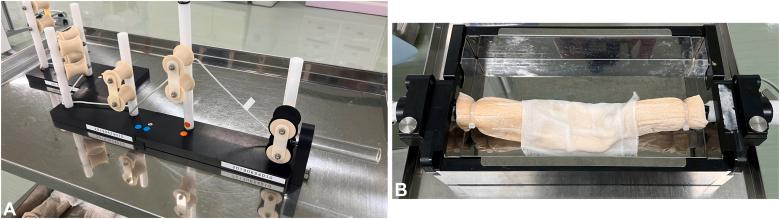
Using a wired 50 Mbps connection, we linked a central facility to 3 remote sites across Japan. A 4-screen Picture-in-Picture (PinP) video integrating hand, scope, posture, and endoscopic views was streamed for real-time demonstration. Each participant underwent a structured 70-minute training session consisting of an initial and final time trial using the Scope handling Training (ST) kit, endoscope handling practice, and hands-on ESD training with an artificial model. During the remote hands-on phase, trainees performed procedures while receiving real-time instruction from experts via a Picture-in-Picture video system, which displayed both the endoscopic view and hand movements. There were no detectable delays in audio or video communication, enabling seamless 2-way interaction.
RESULTS
The results of the ST kit time trials conducted before and after the training showed a significant improvement in speed after the training (from 89.3 seconds before training to 49.4 seconds after training). Additionally, a questionnaire survey conducted among participants revealed that 94% expressed a desire to participate in similar remote training sessions in the future.
CONCLUSIONS
Colorectal ESD, which involves delicate and highly intricate techniques, is challenging to teach even in face-to-face settings. However, we were able to provide high-quality instruction in this program. This method provides training opportunities for physicians in remote areas, reducing the burden of time, travel, and costs, and has the potential to become a promising educational tool for the future.
背景与目的
实践培训在内镜技能的掌握中起着至关重要的作用;然而,由于其教学本质上具有触觉性和直接性,向在线形式的转变一直被认为具有挑战性。自2020年以来,我们开展了一项在线大肠内镜黏膜下剥离术(ESD)培训课程,共举办了9期,培训了75名参与者。本研究的目的是评估我们的远程实践培训项目对大肠ESD的有效性。
方法
我们使用50Mbps的有线连接,将一个中心设施与日本各地的3个远程站点相连。通过实时播放一个整合了手部、内镜、姿势和内镜视野的四画面画中画(PinP)视频进行演示。每位参与者都接受了一次为期70分钟的结构化培训课程,包括使用内镜操作训练(ST)套件进行初始和最终计时试验、内镜操作练习以及使用人工模型进行ESD实践培训。在远程实践阶段,学员在通过画中画视频系统接受专家实时指导的同时进行操作,该系统同时显示内镜视野和手部动作。音频和视频通信中没有可检测到的延迟,实现了无缝的双向互动。
结果
培训前后进行的ST套件计时试验结果显示,培训后速度有显著提高(从培训前的89.3秒提高到培训后的49.4秒)。此外,对参与者进行的问卷调查显示,94%的人表示希望未来参加类似的远程培训课程。
结论
大肠ESD涉及精细且高度复杂的技术,即使在面对面的环境中教学也具有挑战性。然而,我们能够在这个项目中提供高质量的教学。这种方法为偏远地区的医生提供了培训机会,减少了时间、差旅和成本负担,并且有可能成为未来一种有前景的教育工具。





 Zotero 插件