Cao Boya, Pu Dandan, Sun Baoguo, Wang Yanbo, Zhang Yuyu
Key Laboratory of Geriatric Nutrition and Health (Beijing Technology and Business University), Ministry of Education, 100048, China.
Food Laboratory of Zhongyuan, Beijing Technology and Business University, 100048, China.
Food Chem X. 2025 Jul 12;29:102789. doi: 10.1016/j.fochx.2025.102789. eCollection 2025 Jul.
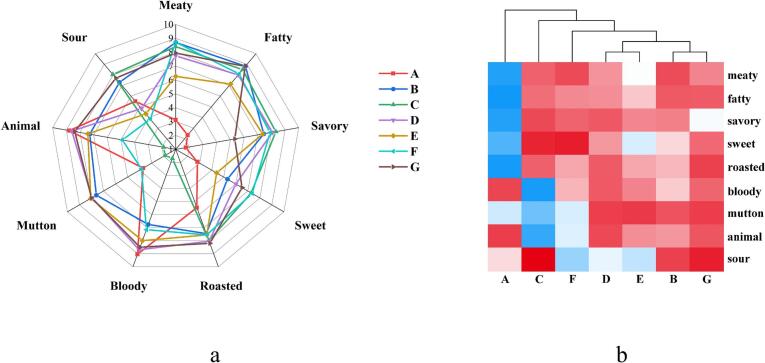
China is the world's largest producer of meat ducks. Decoding the aroma composition of duck broth (DB) produced from different parts can help improve the sensory quality and diversified development of duck meat products. The aroma compounds of DB stewed from seven parts were characterized by solid-phase microextraction-gas chromatography-mass spectrometry, headspace-gas chromatography-ion mobility spectrometry, sensory evaluation, odor activity value (OAV) analysis, and partial least squares regression (PLSR) analysis. Two categories including the DB produced from head part and DB produced from the rest of the six parts were divided based on the hierarchical cluster analysis of pleasant (meaty, fatty, savory, and roasted) and unpleasant (bloody, mutton, animal and sour) aroma attributes. A total of 113 aroma compounds were identified, among which aldehydes, alcohols and the nitrogen-containing compound (mainly trimethylamine) were the most abundant. Significant variances were observed among the seven DB samples. The highest total concentration of volatile compounds was observed in from duck leg broth (2924.2 μg/L) and the lowest was duck wing broth (1935.96 μg/L). Thirty aroma compounds with OAVs ≥ 1 in DB were confirmed. Twenty compounds were predicted as the potential compounds contributing to aroma profile differences among seven DBs by PSLR analysis. Considering their higher OAVs and coefficient, hexanal, octanal, nonanal, ()-2-nonenal, ethyl isovalerate, dimethyl sulfide, and trimethylamine were identified as the differential markers of DBs.
中国是世界上最大的肉鸭生产国。解析不同部位所制鸭汤(DB)的香气成分有助于提升鸭肉产品的感官品质及推动其多元化发展。采用固相微萃取-气相色谱-质谱联用、顶空-气相色谱-离子迁移谱、感官评价、气味活性值(OAV)分析以及偏最小二乘回归(PLSR)分析等方法,对七个部位炖煮的鸭汤的香气化合物进行了表征。基于愉悦(肉香、脂香、鲜香和烤香)和不愉悦(血腥、羊肉味、动物味和酸味)香气属性的层次聚类分析,将鸭汤分为两类,即头部鸭汤和其余六个部位的鸭汤。共鉴定出113种香气化合物,其中醛类、醇类和含氮化合物(主要是三甲胺)含量最为丰富。七个鸭汤样品之间存在显著差异。挥发性化合物总浓度最高的是鸭腿汤(2924.2μg/L),最低的是鸭翅汤(1935.96μg/L)。确定了30种在鸭汤中OAV≥1的香气化合物。通过PLSR分析预测出20种可能导致七个鸭汤香气特征差异的潜在化合物。综合考虑其较高的OAV和系数,己醛、辛醛、壬醛、(E)-2-壬烯醛、异戊酸乙酯、二甲基硫醚和三甲胺被确定为鸭汤的差异标志物。