Lee Dong-Wook, Kim Inah, Hwang Jungho, Choi Sunhaeng, Jang Tae-Won, Chung Insung, Kim Hwan-Cheol, Park Jaebum, Kim Jungwon, Jeong Kyoung Sook, Kim Youngki, Lee Eun-Soo, Kim Yangwoo, Jeong Inchul, Oh Hyunjeong, Oh Hyeoncheol, Ha Jea Chul, Min Jeehee, Lee Chul Gab, Kim Heon, Song Jaechul
Department of Occupational and Environmental Medicine, Inha University College of Medicine, Incheon, Korea.
Korea Occupational Diseases Surveillance Center, Inha University Hospital, Incheon, Korea.
Ewha Med J. 2025 Jan;48(1):e9. doi: 10.12771/emj.2025.e9. Epub 2025 Jan 31.
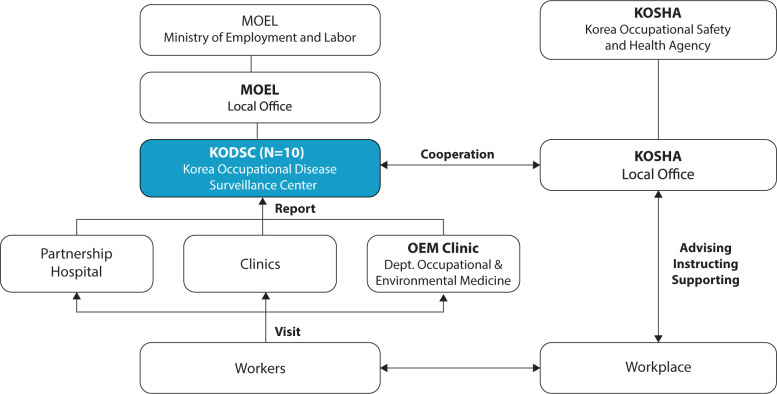
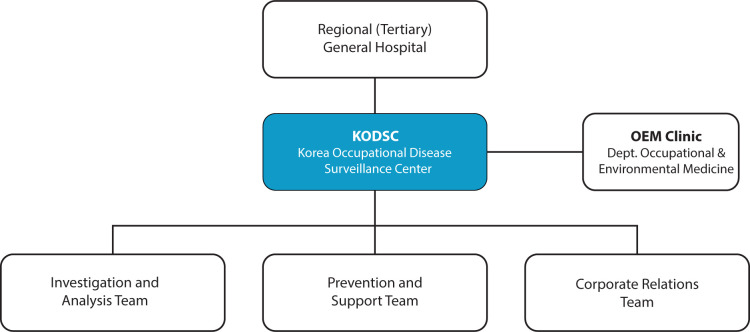
This review examines the challenges associated with occupational disease surveillance in Korea, particularly emphasizing the limitations of current data sources such as the Industrial Accident Compensation Insurance (IACI) statistics and special health examinations. The IACI system undercounts cases due to its emphasis on severe diseases and restrictions on approvals. Special health examinations, although they cover a broad workforce, are constrained by their annual scheduling, which leads to missed acute illnesses and subclinical conditions. The paper also explores the history of occupational disease surveillance in Korea, highlighting the fragmented and disease-specific approach of earlier systems. The authors introduce the newly established Korea Occupational Disease Surveillance Center (KODSC), a comprehensive nationwide system designed to gather, analyze, and interpret data on occupational diseases through a network of regional centers. By incorporating hospital-based surveillance and focusing on acute poisonings and other sentinel events, the KODSC aims to overcome the limitations of previous systems and promote collaboration with various agencies. Although it is still in the early stages of implementation, the KODSC demonstrates potential for improving data accuracy and contributing valuable insights for public health policy.
本综述探讨了韩国职业病监测所面临的挑战,特别强调了当前数据来源的局限性,如工业事故赔偿保险(IACI)统计数据和特殊健康检查。IACI系统由于侧重于严重疾病和审批限制,导致病例计数不足。特殊健康检查虽然覆盖了广泛的劳动力群体,但受其年度安排的限制,导致急性疾病和亚临床状况被漏诊。本文还探讨了韩国职业病监测的历史,强调了早期系统分散且针对特定疾病的方法。作者介绍了新成立的韩国职业病监测中心(KODSC),这是一个全面的全国性系统,旨在通过区域中心网络收集、分析和解释职业病数据。通过纳入基于医院的监测并关注急性中毒和其他哨点事件,KODSC旨在克服先前系统的局限性,并促进与各机构的合作。尽管KODSC仍处于实施初期,但它显示出提高数据准确性并为公共卫生政策提供有价值见解的潜力。