Jiang Jian, Liu Shun, Wei Nan, Lin Zhifeng, Hu Yiming, Chen Xiaoqi, Yao Ling, Yao Zhiying, Chen Qingquan
Fuzhou University Affiliated Provincial Hospital; Shengli Clinical Medical College of Fujian Medical University, Fujian Provincial Key Laboratory of Emergency Medicine, Fujian Emergency Medical Center, Fuzhou, China.
Fujian Medical University, Fuzhou, China.
Front Nutr. 2025 Jul 9;12:1599851. doi: 10.3389/fnut.2025.1599851. eCollection 2025.
The aim of this study was to investigate the efficacy of 13 obesity- and lipid-related indices in screening and predicting activities of daily living (ADL) disability, as well as to determine the optimal cutoffs for these indices in the middle-aged and elderly population in China.
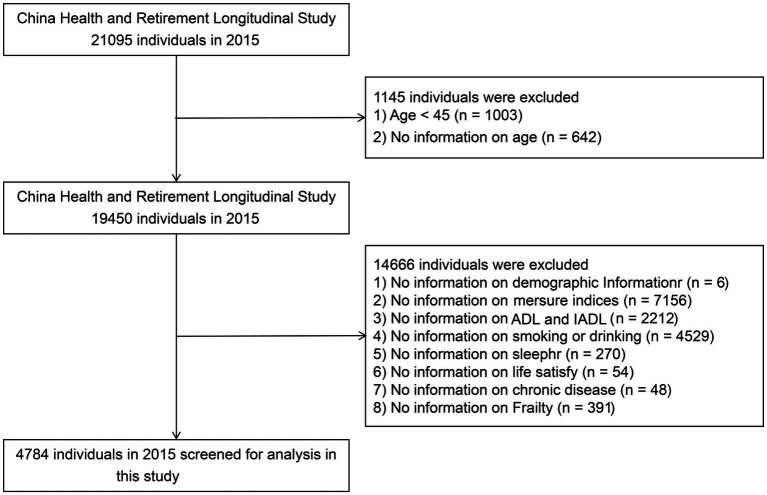
This study was based on cross-sectional data from the China Health and Retirement Longitudinal Study (CHARLS), which included 4,784 participants aged 45 years and older. Thirteen obesity- and lipid-related indices, including body mass index (BMI), waist circumference (WC), the waist-height ratio (WHtR), the visceral adiposity index (VAI), the body shape index (ABSI), the body roundness index (BRI), the lipid accumulation product (LAP), the conicity index (CI), the Chinese visceral adiposity index (CVAI), the triglyceride-glucose (TyG) index and its correlation index (TyG-BMI, TyG-WC, TyG-WHtR), were analyzed. Unadjusted and adjusted correlations between these indices and ADL disability were assessed via logistic regression analyses, and the area under the curve (AUC) of each index as a predictor of ADL ability was calculated via receiver operating characteristic (ROC) curves to compare the predictive efficacy and determine the optimal cutoff value.
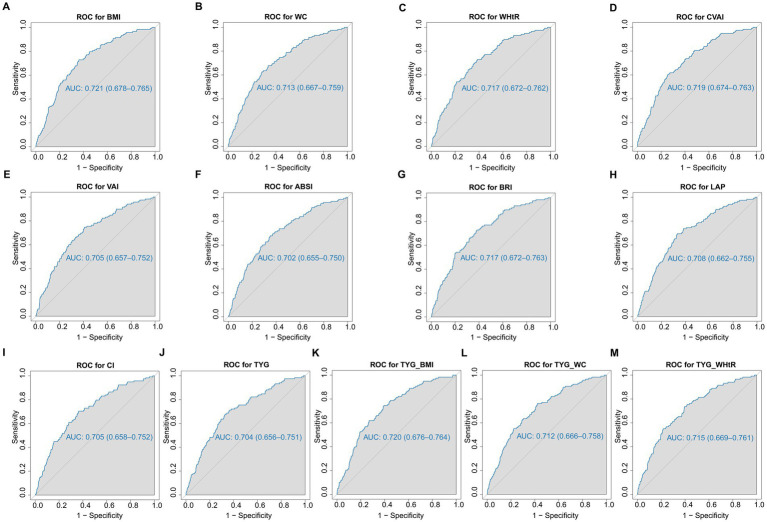
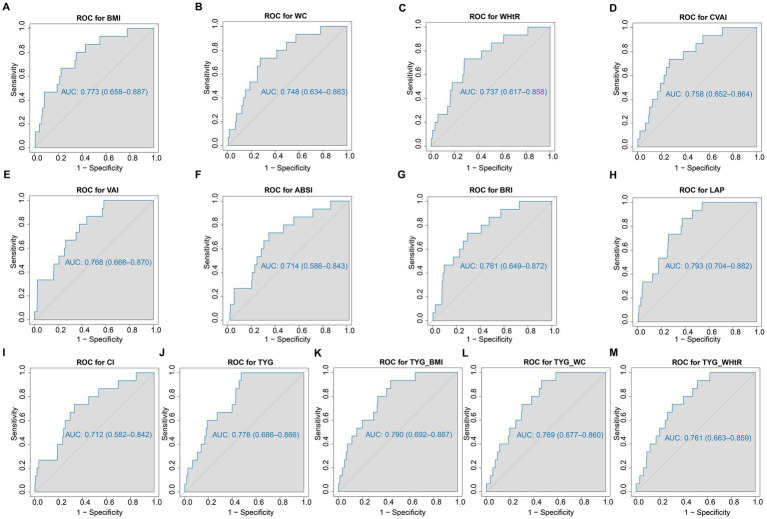
After adjustment for confounders, all 13 obesity- and lipid-related indices were independently associated with the risk of ADL disability ( < 0.05). All 13 indices had predictive value for ADL disability according to the ROC analysis (all AUCs > 0.7). The LAP index exhibited the highest predictive efficacy in men (AUC = 0.793, 95% CI: 0.704-0.882, and optimal cutoff = 35.669), and BMI was optimal in women (AUC = 0.721, 95% CI: 0.678-0.765, and optimal cutoff = 26.142). The TyG-BMI performed well in both sexes (men AUC = 0.790, female AUC = 0.720). The risk of ADL disability increased significantly with each unit increase in obesity and lipid indices.
All 13 obesity- and lipid-related indices were effective predictors of ADL disability risk in Chinese middle-aged and older adults. LAP and BMI emerged as the best predictors of ADL disability in men and women, respectively. These indices can serve as simple screening tools to identify the risk of ADL disability and facilitate early intervention.
本研究旨在探讨13项肥胖及血脂相关指标在筛查和预测日常生活活动(ADL)能力障碍方面的效能,并确定这些指标在中国中老年人群中的最佳临界值。
本研究基于中国健康与养老追踪调查(CHARLS)的横断面数据,纳入了4784名年龄在45岁及以上的参与者。分析了13项肥胖及血脂相关指标,包括体重指数(BMI)、腰围(WC)、腰高比(WHtR)、内脏脂肪指数(VAI)、体型指数(ABSI)、体圆度指数(BRI)、脂质蓄积产物(LAP)、锥度指数(CI)、中国内脏脂肪指数(CVAI)、甘油三酯-葡萄糖(TyG)指数及其相关指数(TyG-BMI、TyG-WC、TyG-WHtR)。通过逻辑回归分析评估这些指标与ADL能力障碍之间未调整和调整后的相关性,并通过受试者工作特征(ROC)曲线计算每个指标作为ADL能力预测指标的曲线下面积(AUC),以比较预测效能并确定最佳临界值。
在对混杂因素进行调整后,所有13项肥胖及血脂相关指标均与ADL能力障碍风险独立相关(P<0.05)。根据ROC分析,所有13项指标对ADL能力障碍均具有预测价值(所有AUC均>0.7)。LAP指数在男性中表现出最高的预测效能(AUC=0.793,95%CI:0.704-0.882,最佳临界值=35.669),而BMI在女性中最佳(AUC=0.721,95%CI:0.678-0.765,最佳临界值=26.142)。TyG-BMI在两性中表现良好(男性AUC=0.790,女性AUC=0.720)。随着肥胖和血脂指标每增加一个单位,ADL能力障碍风险显著增加。
所有13项肥胖及血脂相关指标均是中国中老年人群ADL能力障碍风险的有效预测指标。LAP和BMI分别是男性和女性ADL能力障碍的最佳预测指标。这些指标可作为简单的筛查工具,用于识别ADL能力障碍风险并促进早期干预。