Lu Yiwen, Tong Jiayi, Zhang Dazheng, Chen Jiajie, Li Lu, Lei Yuqing, Zhou Ting, Aragon Leyna V, Becich Michael J, Blecker Saul, Blum Nathan J, Christakis Dimitri A, Hornig Mady, Hornig-Rohan Maxwell M, Jhaveri Ravi, Jones W Schuyler, Keebler Amber Brown, Kelleher Kelly, Kim Susan, Mosa Abu Saleh Mohammad, Pajer Kathleen, Platt Jonathan, Schwenk Hayden T, Taylor Bradley W, Utidjian Levon H, Williams David A, Prasad Raghuram, Elia Josephine, Forrest Christopher B, Chen Yong
Center for Health AI and Synthesis of Evidence (CHASE), Department of Biostatistics, Epidemiology and Informatics, Perelman School of Medicine, University of Pennsylvania, Philadelphia, PA, USA.
The Graduate Group in Applied Mathematics and Computational Science, School of Arts and Sciences, University of Pennsylvania, Philadelphia, PA, USA.
Nat Commun. 2025 Jul 24;16(1):6829. doi: 10.1038/s41467-025-61961-1.
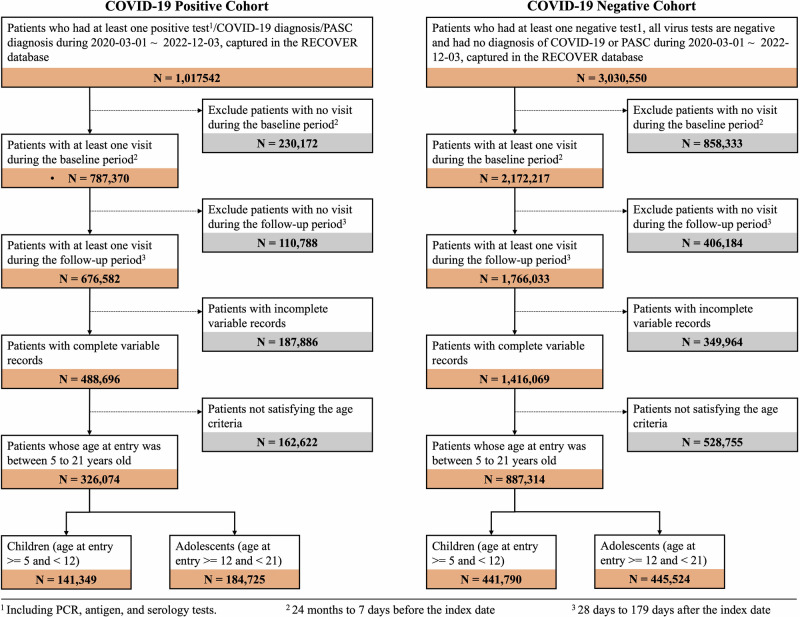
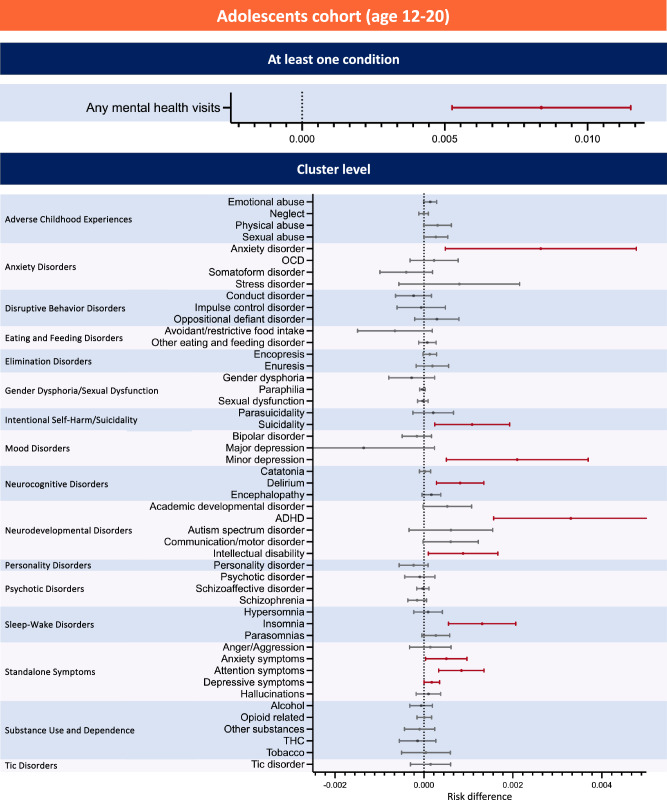
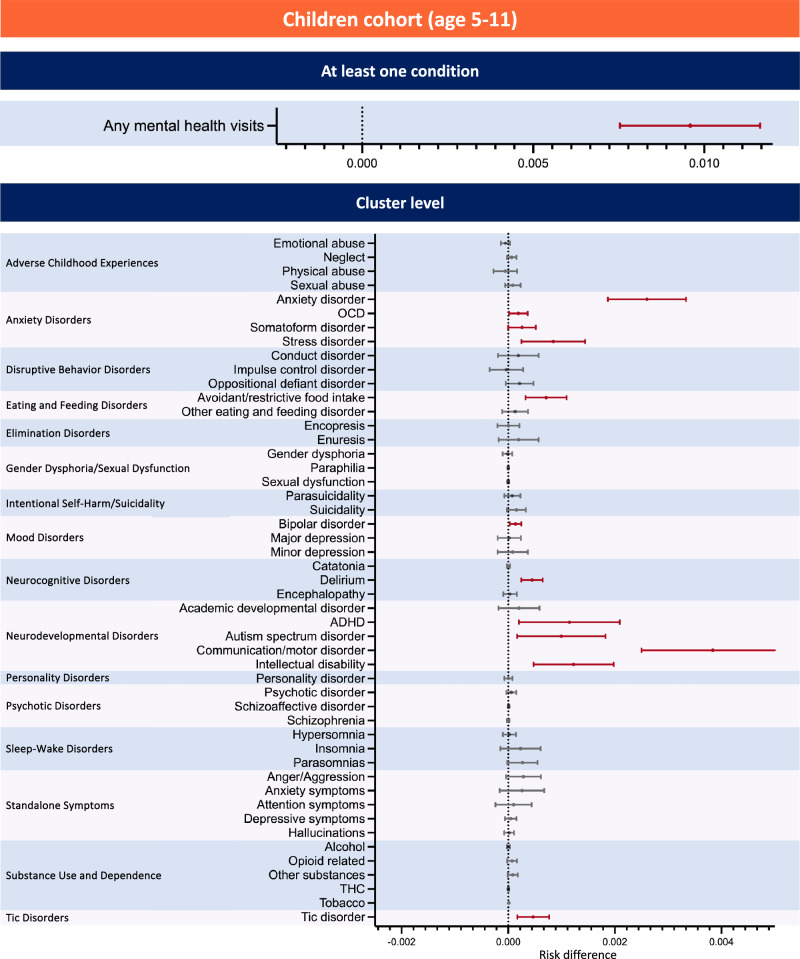
The COVID-19 pandemic has been associated with increased neuropsychiatric conditions in children and youths, with evidence suggesting that SARS-CoV-2 infection may contribute additional risks beyond pandemic stressors. This study aims to assess the full spectrum of neuropsychiatric conditions in COVID-19 positive children (ages 5-12) and youths (ages 12-20) compared to a matched COVID-19 negative cohort, accounting for factors influencing infection risk. Using EHR data from 25 institutions in the RECOVER program, we conduct a retrospective analysis of 326,074 COVID-19 positive and 887,314 negative participants matched for risk factors and stratified by age. Neuropsychiatric outcomes are examined 28 to 179 days post-infection or negative test between March 2020 and December 2022. SARS-CoV-2 positivity is confirmed via PCR, serology, or antigen tests, while negativity requires negative test results and no related diagnoses. Risk differences reveal higher frequencies of neuropsychiatric conditions in the COVID-19 positive cohort. Children face increased risks for anxiety, OCD, ADHD, autism, and other conditions, while youths exhibit elevated risks for anxiety, suicidality, depression, and related symptoms. These findings highlight SARS-CoV-2 infection as a potential contributor to neuropsychiatric risks, emphasizing the importance of research into tailored treatments and preventive strategies for affected individuals.
新冠疫情与儿童和青少年神经精神疾病的增加有关,有证据表明,除了疫情压力源之外,感染新冠病毒可能会带来更多风险。本研究旨在评估新冠病毒检测呈阳性的5至12岁儿童和12至20岁青少年的全谱神经精神疾病情况,并与匹配的新冠病毒检测呈阴性的队列进行比较,同时考虑影响感染风险的因素。利用RECOVER项目中25家机构的电子健康记录(EHR)数据,我们对326,074名新冠病毒检测呈阳性和887,314名检测呈阴性的参与者进行了回顾性分析,这些参与者按风险因素匹配并按年龄分层。在2020年3月至2022年12月期间,在感染或检测呈阴性后的28至179天对神经精神疾病结果进行检查。通过聚合酶链反应(PCR)、血清学或抗原检测确认新冠病毒呈阳性,而呈阴性则需要检测结果为阴性且无相关诊断。风险差异显示,新冠病毒检测呈阳性的队列中神经精神疾病的发生率更高。儿童患焦虑症、强迫症、注意力缺陷多动障碍(ADHD)、自闭症和其他疾病的风险增加,而青少年患焦虑症、自杀倾向、抑郁症及相关症状的风险升高。这些发现突出了新冠病毒感染是神经精神疾病风险的一个潜在因素,强调了针对受影响个体开展量身定制的治疗和预防策略研究的重要性。