Linghu Liqin, Huang Yaxin, Qiu Lixia, Wang Xuchun, Zhang Jia, Ma Lin, Li Chenglian, Wang Lijie
Department of Health Statistics, School of Public Health, Shanxi Medical University, 56 South XinJian Road, Taiyuan, Shanxi, 030001, China.
Shanxi Centre for Disease Control and Prevention, Taiyuan, Shanxi, 030012, China.
BMC Public Health. 2025 Jul 26;25(1):2557. doi: 10.1186/s12889-025-23946-z.
The exploration of stroke risk factors provides crucial information for healthcare planning and priority setting. This study aims to utilize Bayesian network modeling to explore stroke risk factors in different genders.
We collected data from 10 cities and 13 counties in Shanxi Province, China, through questionnaire surveys, physical examinations, and laboratory tests. Logistic regression and Bayesian modeling were employed to analyze the risk factors for stroke in different genders. Preliminary analysis of stroke risk factors was conducted using chi-square tests and logistic regression models. Variables that showed statistical significance were included in the construction of the Bayesian model. Bayesian structure learning was achieved using the Max-Min Hill-Climbing algorithm, and parameter learning utilized maximum likelihood estimation.
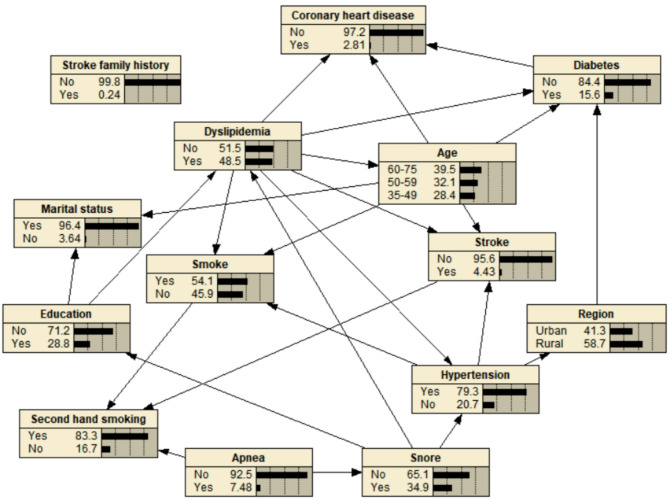
The study identified both common and gender-specific risk factors for stroke. Common risk factors for both males and females included region, marital status, education level, age, family history of stroke, secondhand smoke exposure, snoring, abnormal blood lipids, hypertension, diabetes, and coronary heart disease. Gender-specific factors were smoking and respiratory pause for males, and alcohol consumption for females. The Bayesian Network (BN) model further revealed structural relationships among these factors, showing that abnormal blood lipids, hypertension, and age were direct risk factors for stroke in males, with snoring, education level, and respiratory pause as indirect factors. For females, direct risk factors included age, hypertension, and secondhand smoke exposure, while snoring was an indirect factor.
Stroke risk factors vary by gender, highlighting the importance of gender-specific prevention and intervention strategies.
The online version contains supplementary material available at 10.1186/s12889-025-23946-z.
对中风风险因素的探索为医疗保健规划和优先事项设定提供了关键信息。本研究旨在利用贝叶斯网络建模来探索不同性别的中风风险因素。
我们通过问卷调查、体格检查和实验室检测,收集了中国山西省10个市和13个县的数据。采用逻辑回归和贝叶斯建模分析不同性别的中风风险因素。使用卡方检验和逻辑回归模型对中风风险因素进行初步分析。具有统计学意义的变量被纳入贝叶斯模型的构建。使用最大最小爬山算法实现贝叶斯结构学习,参数学习采用最大似然估计。
该研究确定了中风的常见风险因素和性别特异性风险因素。男性和女性的常见风险因素包括地区、婚姻状况、教育程度、年龄、中风家族史、二手烟暴露、打鼾、血脂异常、高血压、糖尿病和冠心病。性别特异性因素是男性的吸烟和呼吸暂停,以及女性的饮酒。贝叶斯网络(BN)模型进一步揭示了这些因素之间的结构关系,表明血脂异常、高血压和年龄是男性中风的直接风险因素,打鼾、教育程度和呼吸暂停是间接因素。对于女性,直接风险因素包括年龄、高血压和二手烟暴露,而打鼾是间接因素。
中风风险因素因性别而异,突出了针对性别预防和干预策略的重要性。
在线版本包含可在10.1186/s12889-025-23946-z获取的补充材料。