Joo Min Gyu, Heo Jeongmin, Pahk Ki Joo, Baac Hyoung Won
Department of Electrical and Computer Engineering, Sungkyunkwan University, Suwon 16419, Republic of Korea.
Department of Biomedical Engineering, Kyung Hee University, Yongin 17104, Republic of Korea.
Ultrason Sonochem. 2025 Jul 18;120:107470. doi: 10.1016/j.ultsonch.2025.107470.
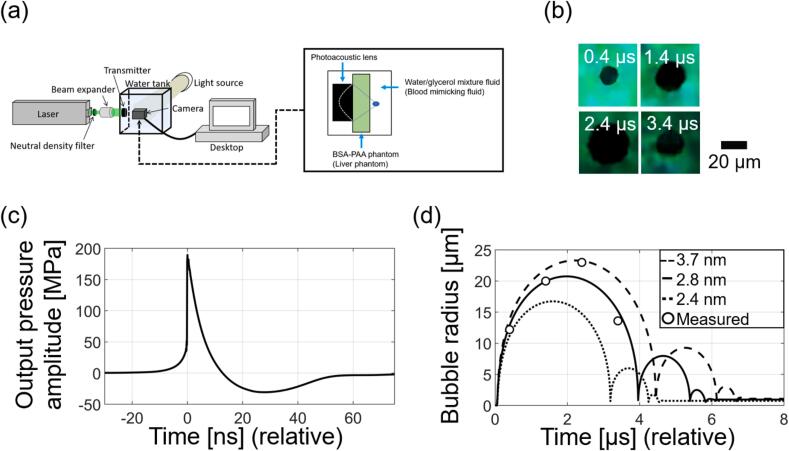
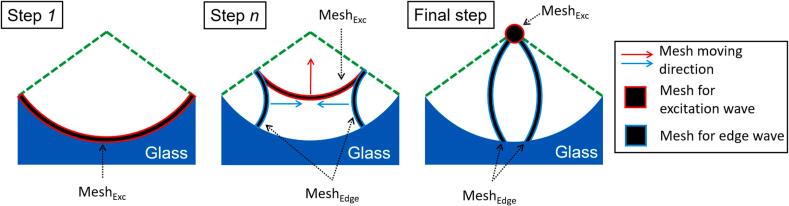
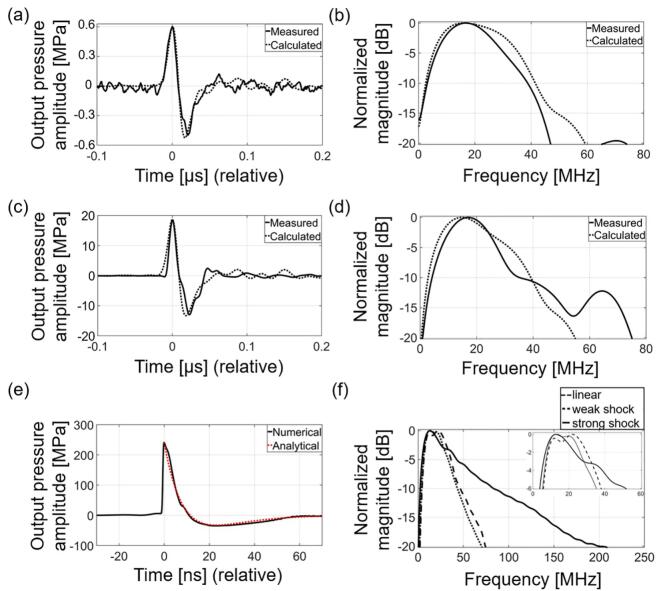
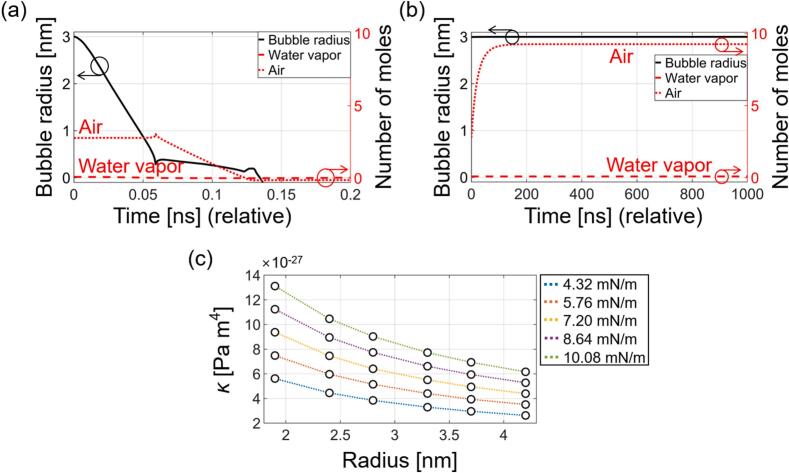
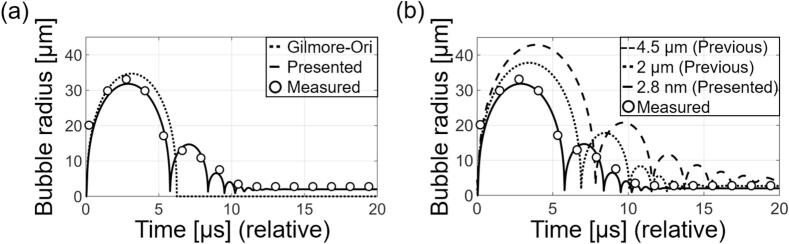
This study presents a fully coupled numerical simulation method for modeling the behavior of laser-generated focused ultrasound (LGFU) in complex structures, including in vivo environments. Using finite element method (FEM) simulations, we achieve peak pressures of 241 MPa and 34.7 MPa in the positive and negative phases, respectively, of the LGFU waveform. The use of adaptive mesh refinement (AMR) enables us to perform tight mesh simulations with a size of 0.06 μm and calculate ultrafast rise time (0.8 ns) of the LGFU wavefront. We also propose an improved LGFU-induced bubble model that can simulate nano-sized seed bubbles, which is achieved by combining the Gilmore equation with heat and mass transfer and modified Young-Laplace (MY-L) equations. We demonstrate the effectiveness of the model by validating it against experimental results in water, where we achieve a 29.6 % improvement in maximum bubble size and a 34.5 % improvement in bubble lifetime compared to the previous model. Furthermore, we apply the model to a tissue mimicking phantom and obtain results that are consistent with experimental observations. Our proposed simulation method provides a powerful tool for investigating LGFU-induced bubble behavior in complex structures, which could have important applications in fields such as biomedical engineering. © 2017 Elsevier Inc. All rights reserved.
本研究提出了一种完全耦合的数值模拟方法,用于对激光产生的聚焦超声(LGFU)在包括体内环境在内的复杂结构中的行为进行建模。通过有限元方法(FEM)模拟,我们在LGFU波形的正相和负相中分别实现了241MPa和34.7MPa的峰值压力。自适应网格细化(AMR)的使用使我们能够执行尺寸为0.06μm的紧密网格模拟,并计算LGFU波前的超快上升时间(0.8ns)。我们还提出了一种改进的LGFU诱导气泡模型,该模型可以模拟纳米级种子气泡,这是通过将吉尔摩方程与传热传质以及修正的杨-拉普拉斯(MY-L)方程相结合实现的。我们通过与水中的实验结果进行对比验证了该模型的有效性,与先前的模型相比,我们实现了最大气泡尺寸提高29.6%,气泡寿命提高34.5%。此外,我们将该模型应用于仿组织体模,并获得了与实验观察结果一致的结果。我们提出的模拟方法为研究LGFU在复杂结构中诱导的气泡行为提供了一个强大的工具,这在生物医学工程等领域可能具有重要应用。© 2017爱思唯尔公司。保留所有权利。