Yao Tsung-Chieh, Chang Sheng-Mao, Tsai Yi-Fen, Chiang Shuo-Ju, Tsai Hui-Ju
Division of Allergy, Asthma, and Rheumatology, Department of Pediatrics, Chang Gung Memorial Hospital, Taoyuan, Taiwan.
School of Medicine, Chang Gung University College of Medicine, Taoyuan, Taiwan.
Clin Transl Sci. 2025 Aug;18(8):e70311. doi: 10.1111/cts.70311.
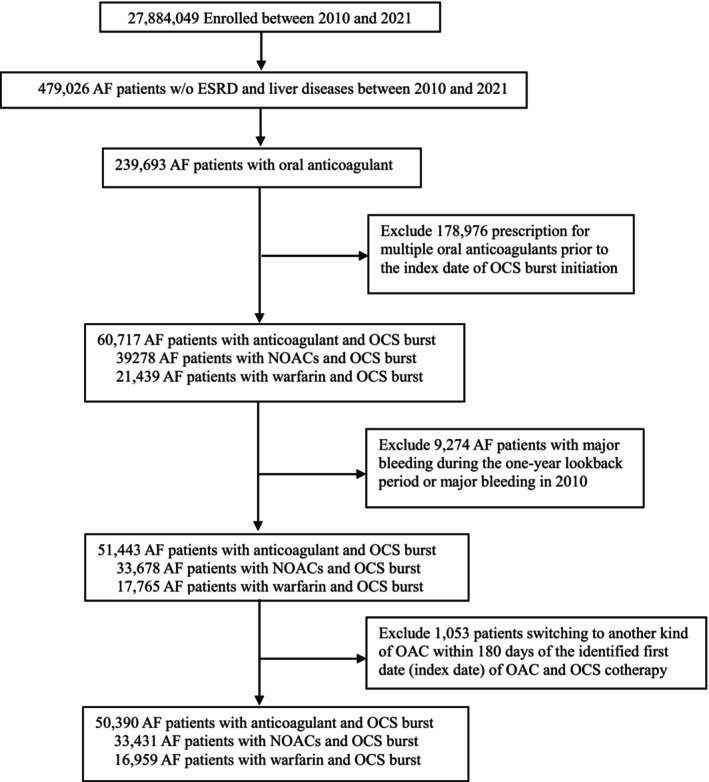
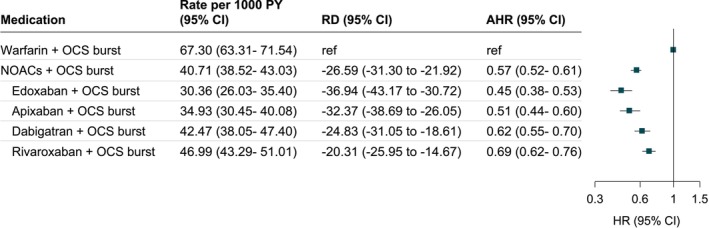
The choice of oral anticoagulants and oral corticosteroid (OCS) burst cotherapy may influence the risk of major bleeding; however, this risk remains poorly characterized. We aimed to quantify the comparative safety of non-vitamin K oral anticoagulants (NOACs) versus warfarin on major bleeding while receiving OCS burst cotherapy among patients with atrial fibrillation. A nationwide population-based cohort study was conducted using the National Health Insurance Research Database. We examined associations between NOACs (edoxaban, apixaban, dabigartran, or rivaroxaban) or warfarin with OCS burst cotherapy and major bleeding. We measured the risk by estimating incidence, incidence risk ratios (IRRs), and adjusted hazard ratios (AHRs) after adjusting for baseline differences using overlap weighting. In this study, among 239,693 patients receiving oral anticoagulants, 50,390 (21%) received at least one OCS burst, defined as OCS use for less than 30 days, were included. A lower risk of major bleeding related to OCS burst cotherapy with NOACs versus warfarin was noted (AHR = 0.57 [95% CI = 0.52-0.61]). The greatest incidence was observed in patients with warfarin and OCS burst cotherapy (67.30 per 1000 person-years). The incidence for patients prescribing OCS burst cotherapy with edoxaban (30.36 per 1000 person-years; IRR = 0.45 [95% CI = 0.38-0.53]), apixaban (34.93 per 1000 person-years; IRR = 0.52 [95% CI = 0.45-0.60]), dabigatran (42.47 per 1000 person-years; IRR = 0.63 [95% CI = 0.56-0.72]), and rivaroxaban (46.99 per 1000 person-years; IRR = 0.70 [95% CI = 0.63-0.77]), separately, was lower than that with warfarin. The results reveal that the incidence of major bleeding was lowest for edoxaban and highest for warfarin, with notable differences in incidence rates across NOACs among patients receiving oral anticoagulants and OCS burst cotherapy.
口服抗凝剂与口服糖皮质激素(OCS)冲击联合治疗的选择可能会影响大出血风险;然而,这种风险仍未得到充分描述。我们旨在量化非维生素K口服抗凝剂(NOACs)与华法林在房颤患者接受OCS冲击联合治疗时大出血方面的相对安全性。我们使用国民健康保险研究数据库进行了一项全国性的基于人群的队列研究。我们研究了NOACs(依度沙班、阿哌沙班、达比加群或利伐沙班)或华法林与OCS冲击联合治疗和大出血之间的关联。我们通过使用重叠加权调整基线差异后估计发病率、发病风险比(IRRs)和调整后的风险比(AHRs)来衡量风险。在本研究中,在239,693名接受口服抗凝剂治疗的患者中,50,390名(21%)接受了至少一次OCS冲击治疗(定义为OCS使用少于30天)并被纳入研究。结果发现,与华法林相比,NOACs与OCS冲击联合治疗相关的大出血风险较低(AHR = 0.57 [95% CI = 0.52 - 0.61])。华法林与OCS冲击联合治疗的患者大出血发生率最高(每1000人年67.30例)。单独使用依度沙班(每1000人年30.36例;IRR = 0.45 [95% CI = 0.38 - 0.53])、阿哌沙班(每1000人年34.93例;IRR = 0.52 [95% CI = 0.45 - 0.60])、达比加群(每1000人年42.47例;IRR = 0.63 [95% CI = 0.56 - 0.72])和利伐沙班(每1000人年46.99例;IRR = 0.70 [95% CI = 0.63 - 0.77])进行OCS冲击联合治疗的患者发生率低于华法林。结果显示,依度沙班的大出血发生率最低,华法林最高,在接受口服抗凝剂和OCS冲击联合治疗的患者中,不同NOACs的发生率存在显著差异。