Duchesneau Katherine, Aldeguer-Riquelme Borja, Petro Caitlin, Makke Ghiwa, Green Madison, Tfaily Malak, Wilson Rachel, Roth Spencer W, Johnston Eric R, Kluber Laurel A, Schadt Christopher W, Trejo Jesse B, Callister Stephen J, Purvine Samuel O, Chanton Jeffrey P, Hanson Paul J, Tringe Susannah, Eloe-Fadrosh Emiley, Glavina Del Rio Tijana, Konstantinidis Konstantinos T, Kostka Joel E
School of Biological Sciences and School of Earth and Atmospheric Sciences, Center for Microbial Dynamics and Infection, Georgia Institute of Technology, Atlanta, GA, USA.
School of Civil & Environmental Engineering and School of Biological Sciences, Georgia Institute of Technology, Atlanta, GA, USA.
Nat Commun. 2025 Jul 25;16(1):6869. doi: 10.1038/s41467-025-61664-7.
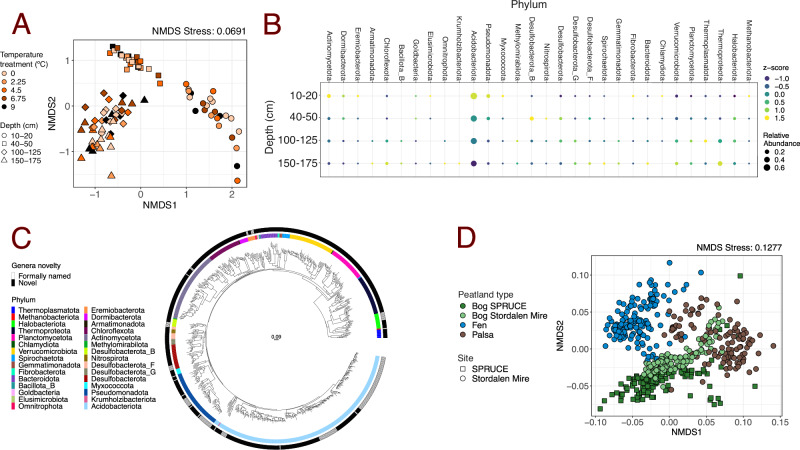
The response of microbial communities that regulate belowground carbon turnover to climate change drivers in peatlands is poorly understood. Here, we leverage a whole ecosystem warming experiment to elucidate the key processes of terminal carbon decomposition and community responses to temperature rise. Our dataset of 697 metagenome-assembled genomes (MAGs) represents the microbial community from the surface (10 cm) to 2 m deep into the peat column, with only 3.7% of genomes overlapping with other well-studied peatlands. Community composition has yet to show a significant response to warming after 3 years, suggesting that metabolically diverse soil microbial communities are resistant to climate change. Surprisingly, abundant and active methanogens in the genus Candidatus Methanoflorens, Methanobacterium, and Methanoregula show the potential for both acetoclastic and hydrogenotrophic methanogenesis. Nonetheless, the predominant pathways for anaerobic carbon decomposition include sulfate/sulfite reduction, denitrification, and acetogenesis, rather than methanogenesis based on gene abundances. Multi-omics data suggest that organic matter cleavage provides terminal electron acceptors, which together with methanogen metabolic flexibility, may explain peat microbiome composition resistance to warming.
调节泥炭地地下碳周转的微生物群落对气候变化驱动因素的响应尚不清楚。在此,我们利用一项全生态系统变暖实验来阐明末端碳分解的关键过程以及群落对温度升高的响应。我们的697个宏基因组组装基因组(MAG)数据集代表了从泥炭柱表面(10厘米)到2米深处的微生物群落,只有3.7%的基因组与其他研究充分的泥炭地重叠。经过3年,群落组成尚未显示出对变暖的显著响应,这表明代谢多样的土壤微生物群落对气候变化具有抗性。令人惊讶的是,候选类群“Methanoflorens”属、甲烷杆菌属和甲烷调节菌属中丰富且活跃的产甲烷菌显示出乙酸裂解和氢营养型产甲烷的潜力。尽管如此,基于基因丰度,厌氧碳分解的主要途径包括硫酸盐/亚硫酸盐还原、反硝化作用和乙酸生成,而非产甲烷作用。多组学数据表明,有机物裂解提供了末端电子受体,这与产甲烷菌的代谢灵活性一起,可能解释了泥炭微生物组组成对变暖的抗性。