McNeill Jessica, Brandt Nathan, Schwarzkopf Enrique J, Jimenez Mili, Smukowski Heil Caiti
Department of Biological Sciences, North Carolina State University, Raleigh, NC, USA.
Heredity (Edinb). 2025 Aug;134(8):473-484. doi: 10.1038/s41437-025-00778-6. Epub 2025 Jul 26.
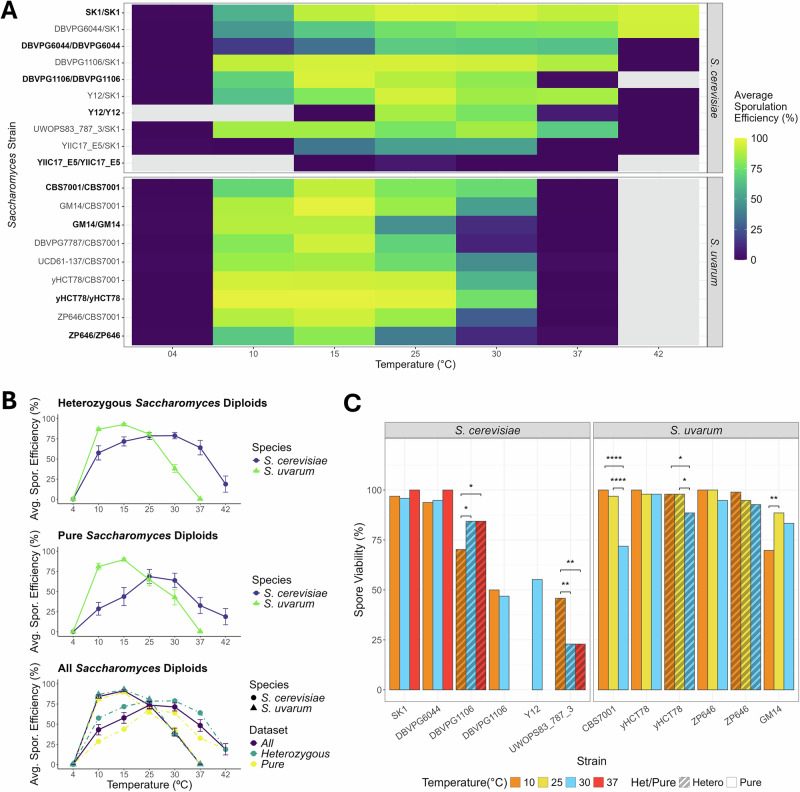
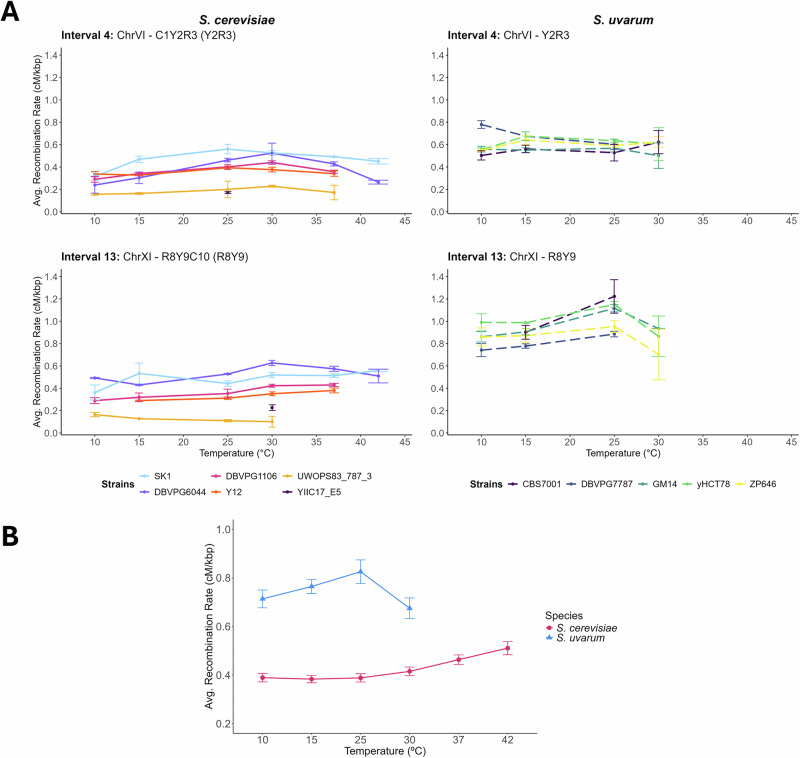
Meiosis is required for the formation of gametes in all sexually reproducing species and the process is well conserved across the tree of life. However, meiosis is sensitive to a variety of external factors, which can impact chromosome pairing, recombination, and fertility. For example, the optimal temperature for successful meiosis varies between species of plants and animals. This suggests that meiosis is temperature sensitive, and that natural selection may act on variation in meiotic success as organisms adapt to different environmental conditions. To understand how temperature alters the successful completion of meiosis, we utilized two species of the budding yeast Saccharomyces with different temperature preferences: thermotolerant Saccharomyces cerevisiae and cold-tolerant Saccharomyces uvarum. We surveyed three metrics of meiosis: sporulation efficiency, spore viability, and recombination rate in multiple strains of each species. As per our predictions, the proportion of cells that complete meiosis and form spores is temperature sensitive, with thermotolerant S. cerevisiae having a higher temperature threshold for completion of meiosis than cold-tolerant S. uvarum. We confirmed previous observations that S. cerevisiae recombination rate varies between strains and across genomic regions, and add new results that S. uvarum has comparably high recombination rates. We find significant recombination rate plasticity due to temperature in S. cerevisiae and S. uvarum, in agreement with studies in animals and plants. Overall, these results suggest that meiotic thermal sensitivity is associated with organismal thermal tolerance and may even result in temporal reproductive isolation as populations diverge in thermal profiles.
在所有有性生殖物种中,减数分裂是形成配子所必需的过程,并且该过程在整个生命之树中都得到了很好的保守。然而,减数分裂对多种外部因素敏感,这些因素会影响染色体配对、重组和育性。例如,成功进行减数分裂的最佳温度在动植物物种之间有所不同。这表明减数分裂对温度敏感,并且随着生物体适应不同的环境条件,自然选择可能作用于减数分裂成功的变异。为了了解温度如何改变减数分裂的成功完成,我们利用了两种具有不同温度偏好的芽殖酵母:耐热的酿酒酵母和耐寒的葡萄汁酵母。我们调查了减数分裂的三个指标:每个物种的多个菌株中的孢子形成效率、孢子活力和重组率。正如我们所预测的,完成减数分裂并形成孢子的细胞比例对温度敏感,耐热的酿酒酵母完成减数分裂的温度阈值高于耐寒的葡萄汁酵母。我们证实了之前的观察结果,即酿酒酵母的重组率在不同菌株和基因组区域之间有所不同,并补充了新的结果,即葡萄汁酵母具有相当高的重组率。我们发现酿酒酵母和葡萄汁酵母中由于温度导致的重组率具有显著的可塑性,这与在动植物中的研究结果一致。总体而言,这些结果表明减数分裂的热敏感性与生物体的热耐受性相关,甚至可能导致随着种群在热分布上的差异而出现时间上的生殖隔离。