Qiu Jingxuan, Tao Huiling, Li Hongyu, Liu Xinyi, Liu Rui, Nawaz Muhammed Naveed, Wang Xingjie, Ma Liyuan
School of Environmental Studies, China University of Geosciences, Wuhan, 430074, China.
School of Water Science, University of Waterloo, Waterloo, N2L3G1, Canada.
BMC Genomics. 2025 Jul 28;26(1):696. doi: 10.1186/s12864-025-11875-5.
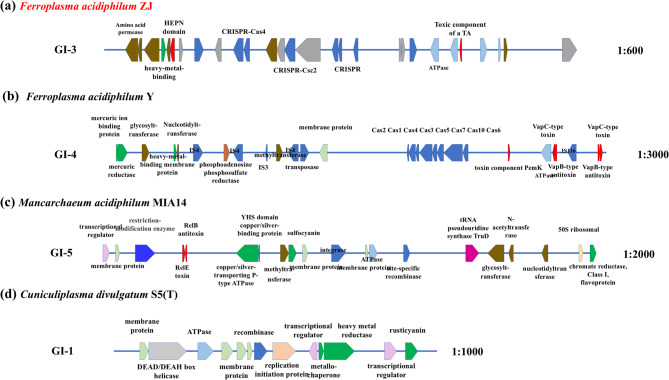
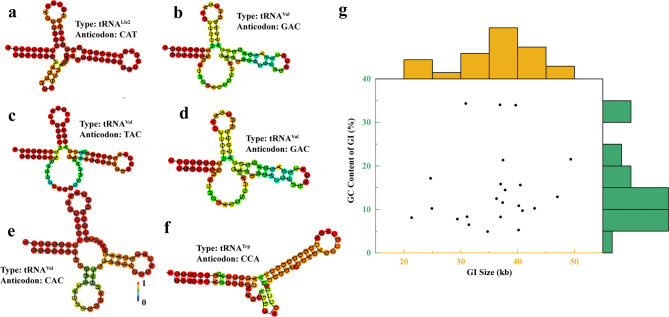
Acid mine drainage (AMD) is an extremely acidic leachate highly contaminated with metal ions, yet it harbors a significantly high abundance of archaea. Genomic islands (GIs), as one of the productions of horizontal gene transfer (HGT), play an important role in the environmental adaptation and evolutionary processes of archaea. However, the distribution, structure, and function of GI within the genomes of archaea remain poorly understood. In this study, through the bioinformatic analysis of archaea in AMD, including Ferroplasma acidiphilum ZJ isolated from laboratory and 25 acidophilic archaea collected from NCBI database, 176 GIs were predicted and annotated. Furthermore, we analyzed their structural features and provided insights into the role of HGT in environmental adaptation. The size and distribution of GIs in the genomes were found to be random. In the majority of GIs, the GC content was lower than the average GC content of the strain genome, suggesting that GIs were typically looped out of the genomes with poor stability and transferred into those with higher stability. tRNAs with classical stem-loop secondary structures have been found at the ends of several GIs, suggesting that GIs frequently integrate near tRNAs. In contrast to functional genes directly involved in cellular life processes, GIs were more likely to carry genes related to genetic information and metabolism. Several GIs were identified to carry genes involved in iron oxidation, mercury reduction, and various toxin-antitoxin systems, which enhance the adaptability of the strains to highly acidic environments.
酸性矿山排水(AMD)是一种被金属离子高度污染的极强酸性渗滤液,但其中古菌的丰度却显著很高。基因组岛(GIs)作为水平基因转移(HGT)的产物之一,在古菌的环境适应和进化过程中发挥着重要作用。然而,古菌基因组中基因组岛的分布、结构和功能仍知之甚少。在本研究中,通过对酸性矿山排水中古菌的生物信息学分析,包括从实验室分离的嗜酸亚铁原体ZJ和从NCBI数据库收集的25株嗜酸古菌,预测并注释了176个基因组岛。此外,我们分析了它们的结构特征,并深入探讨了水平基因转移在环境适应中的作用。发现基因组岛在基因组中的大小和分布是随机的。在大多数基因组岛中,GC含量低于菌株基因组的平均GC含量,这表明基因组岛通常是从稳定性较差的基因组中分离出来,并转移到稳定性较高的基因组中。在几个基因组岛的末端发现了具有经典茎环二级结构的tRNA,这表明基因组岛经常整合在tRNA附近。与直接参与细胞生命过程的功能基因相比,基因组岛更有可能携带与遗传信息和代谢相关的基因。鉴定出几个基因组岛携带参与铁氧化、汞还原和各种毒素 - 抗毒素系统的基因,这些基因增强了菌株对高酸性环境的适应性。