Huang Nan-Chieh, Mukundan Arvind, Karmakar Riya, Syna Syna, Chang Wen-Yen, Wang Hsiang-Chen
Diving Medical and Physiology Training Center, Zuoying Armed Forces General Hospital, No. 553, Junxiao Rd., Zuoying District, Kaohsiung City 813204, Taiwan.
Department of Information Engineering, I-Shou University, No.1, Sec. 1, Syuecheng Rd., Dashu District, Kaohsiung City 84001, Taiwan.
Bioengineering (Basel). 2025 Jun 30;12(7):714. doi: 10.3390/bioengineering12070714.
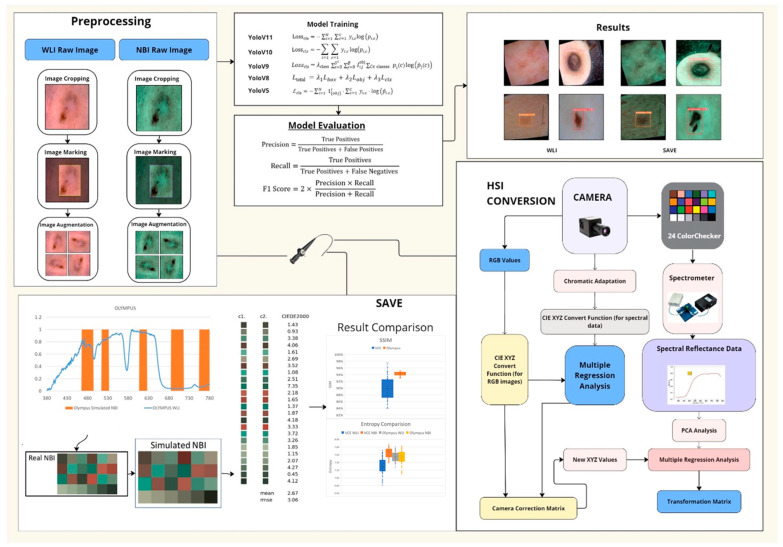
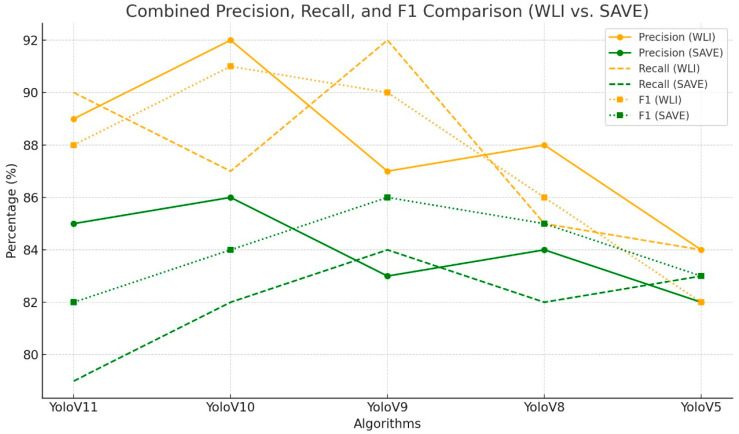
: Skin lesions, including dermatofibroma, lichenoid lesions, and acrochordons, are increasingly prevalent worldwide and often require timely identification for effective clinical management. However, conventional RGB-based imaging can overlook subtle vascular characteristics, potentially delaying diagnosis. A novel spectrum-aided vision enhancer (SAVE) that transforms standard RGB images into simulated narrowband imaging representations in a single step was proposed. The performances of five cutting-edge object detectors, based on You Look Only Once (YOLOv11, YOLOv10, YOLOv9, YOLOv8, and YOLOv5) models, were assessed across three lesion categories using white-light imaging (WLI) and SAVE modalities. Each YOLO model was trained separately on SAVE and WLI images, and performance was measured using precision, recall, and F1 score. Among all tested configurations, YOLOv10 attained the highest overall performance, particularly under the SAVE modality, demonstrating superior precision and recall across the majority of lesion types. YOLOv9 exhibited robust performance, especially for dermatofibroma detection under SAVE, albeit slightly lagging behind YOLOv10. Conversely, YOLOv11 underperformed on acrochordon detection (cumulative F1 = 65.73%), and YOLOv8 and YOLOv5 displayed lower accuracy and higher false-positive rates, especially in WLI mode. Although SAVE improved the performance of YOLOv8 and YOLOv5, their results remained below those of YOLOv10 and YOLOv9. Combining the SAVE modality with advanced YOLO-based object detectors, specifically YOLOv10 and YOLOv9, markedly enhances the accuracy of lesion detection compared to conventional WLI, facilitating expedited real-time dermatological screening. These findings indicate that integrating snapshot-based narrowband imaging with deep learning object detection models can improve early diagnosis and has potential applications in broader clinical contexts.
皮肤病变,包括皮肤纤维瘤、苔藓样病变和皮赘,在全球范围内日益普遍,通常需要及时识别以便进行有效的临床管理。然而,传统的基于RGB的成像可能会忽略细微的血管特征,从而可能延迟诊断。一种新型的光谱辅助视觉增强器(SAVE)被提出,它能在一步中将标准RGB图像转换为模拟窄带成像表示。基于“你只看一次”(YOLOv11、YOLOv10、YOLOv9、YOLOv8和YOLOv5)模型的五个前沿目标检测器的性能,在三种病变类别中使用白光成像(WLI)和SAVE模式进行了评估。每个YOLO模型分别在SAVE和WLI图像上进行训练,并使用精确率、召回率和F1分数来衡量性能。在所有测试配置中,YOLOv10获得了最高的整体性能,特别是在SAVE模式下,在大多数病变类型中表现出卓越的精确率和召回率。YOLOv9表现出稳健的性能,尤其是在SAVE模式下对皮肤纤维瘤的检测,尽管略落后于YOLOv10。相反,YOLOv11在皮赘检测方面表现不佳(累积F1 = 65.73%),而YOLOv8和YOLOv5显示出较低的准确率和较高的假阳性率,特别是在WLI模式下。虽然SAVE提高了YOLOv8和YOLOv5的性能,但它们的结果仍低于YOLOv10和YOLOv9。将SAVE模式与基于先进YOLO的目标检测器(特别是YOLOv10和YOLOv9)相结合,与传统WLI相比,显著提高了病变检测的准确性,有助于加快实时皮肤病筛查。这些发现表明,将基于快照的窄带成像与深度学习目标检测模型相结合可以改善早期诊断,并在更广泛的临床环境中有潜在应用。