Chang Yang-Yi, Hsiao Hung-Chun, Wang Ting-Wei
School of Medicine, National Yang-Ming Chiao Tung University, Taipei 30010, Taiwan.
Chang Gung Memorial Hospital, Linkou 333423, Taiwan.
Cancers (Basel). 2025 Jul 14;17(14):2329. doi: 10.3390/cancers17142329.
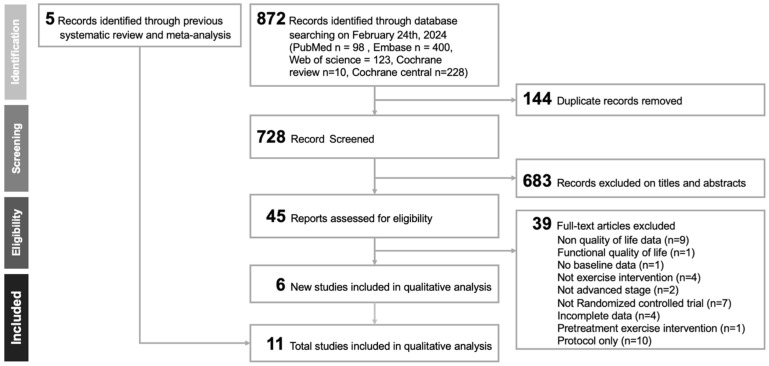
This systematic review and network meta-analysis aimed to determine the most effective therapeutic exercise modality for improving quality of life (QoL) in patients with advanced-stage cancer. Specifically, the study compared the effects of aerobic training, strength training, and combined aerobic and strength training on QoL outcomes. A systematic literature search was conducted in PubMed, Embase, Cochrane Reviews, and the Cochrane Central Register of Controlled Trials up to 24 February 2023. The review adhered to PRISMA guidelines. Included studies were randomized controlled trials (RCTs) involving adult patients with advanced-stage cancers (e.g., pancreatic, colorectal, lung, breast, prostate, gastrointestinal, gynecological, hematological, head and neck, melanoma, or cancers with bone metastases). The primary outcome was post-intervention QoL, while the secondary outcome assessed was the dropout rate across exercise modalities. Aerobic training demonstrated the greatest improvement in QoL with a standardized mean difference (SMD) of 0.30 (95% CI: 0.00 to 0.61), followed by strength training (SMD = 0.13; 95% CI: -0.41 to 0.66) and combined training (SMD = 0.07; 95% CI: -0.11 to 0.24). However, none of the interventions showed statistically significant superiority. Dropout rates were comparable across all exercise modalities and control groups, suggesting strong adherence and feasibility of these interventions in advanced cancer populations. While all exercise modalities were associated with improved QoL in patients with advanced-stage cancer, no single intervention emerged as significantly superior. Aerobic exercise may offer a slight advantage, although this effect was not statistically significant. These results highlight the importance of individualized exercise prescriptions based on patient preference, functional status, and treatment context. Further research is warranted to identify patient subgroups that may benefit most from specific exercise interventions and to explore QoL subdomains such as fatigue, emotional well-being, and physical functioning.
本系统综述和网状荟萃分析旨在确定改善晚期癌症患者生活质量(QoL)的最有效治疗性运动方式。具体而言,该研究比较了有氧运动训练、力量训练以及有氧运动与力量训练相结合对生活质量结果的影响。截至2023年2月24日,在PubMed、Embase、Cochrane系统评价和Cochrane对照试验中央注册库中进行了系统的文献检索。该综述遵循PRISMA指南。纳入的研究为随机对照试验(RCT),涉及成年晚期癌症患者(如胰腺癌、结直肠癌、肺癌、乳腺癌、前列腺癌、胃肠道癌、妇科癌、血液系统癌、头颈癌、黑色素瘤或伴有骨转移的癌症)。主要结局是干预后的生活质量,而评估的次要结局是各运动方式的退出率。有氧运动训练在生活质量方面改善最大,标准化均数差(SMD)为0.30(95%CI:0.00至0.61),其次是力量训练(SMD = 0.13;95%CI:-0.41至0.66)和联合训练(SMD = 0.07;95%CI:-0.11至0.24)。然而,没有一种干预措施显示出统计学上的显著优势。所有运动方式和对照组的退出率相当,表明这些干预措施在晚期癌症人群中具有很强的依从性和可行性。虽然所有运动方式都与晚期癌症患者生活质量的改善相关,但没有一种干预措施明显更具优势。有氧运动可能有轻微优势,尽管这种效果在统计学上不显著。这些结果强调了根据患者偏好、功能状态和治疗背景制定个性化运动处方的重要性。有必要进一步研究以确定可能从特定运动干预中获益最大的患者亚组,并探索生活质量的子领域,如疲劳、情绪健康和身体功能。