Zhong Liepeng, Qiu Yujun, Zhang Mingrui, Wei Shanchuan, Qiu Shuiling, Ma Zhiyi, Gu Mingming, Wang Benzhi, Zhang Xinyue, Gu Mingke, Shen Nanqi, Gan Qianfu
College of Animal Science, Fujian Agriculture and Forestry University, Fuzhou 350002, China.
Animals (Basel). 2025 Jul 11;15(14):2049. doi: 10.3390/ani15142049.
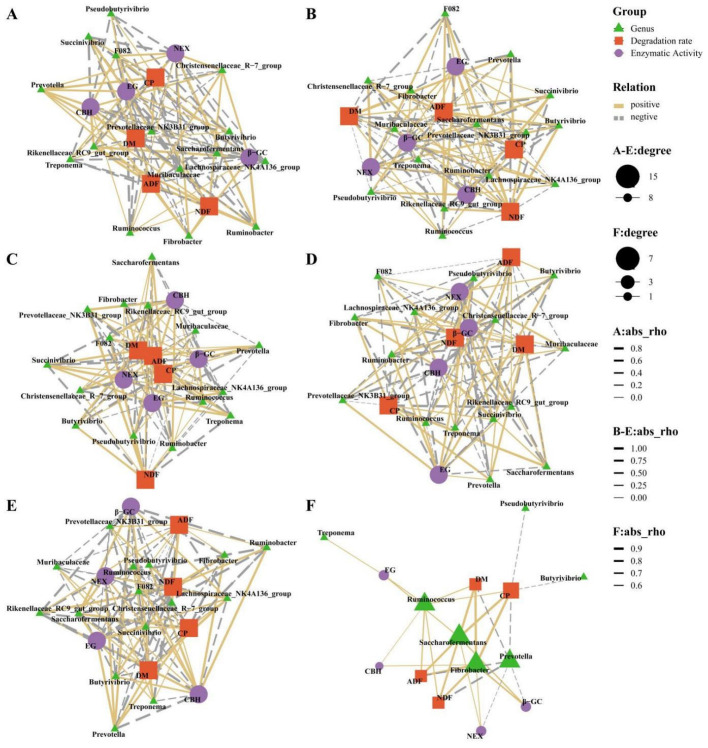
The objective of this study is to investigate the degradation characteristics of oat grass in the rumen of Mindong goats and changes in microbial community attached to the grass surface. Four healthy male goats, aged 14 months, with permanent rumen fistula, in eastern Fujian, were selected as experimental animals. The rumen degradation rate of oat grass was measured at 4, 12, 24, 36, 48, and 72 h using the nylon bag method. Surface physical structure changes in oat grass were observed using scanning electron microscopy (SEM), cellulase activity was measured, and bacterial composition was analyzed using high-throughput 16S rRNA gene sequencing technology. The findings of this study indicate that oat grass had effective degradation rates (ED) of 47.94%, 48.69%, 38.41%, and 30.24% for dry matter (DM), crude protein (CP), neutral detergent fiber (NDF), and acidic detergent fiber (ADF), respectively. The SEM was used to investigate the degradation process of oat grass in the rumen. After 24 h, extensive degradation of non-lignified tissue was observed, resulting in the formation of cavities. At 36 h, significant shedding was observed, and by 72 h, only the epidermis and thick-walled tissue, which exhibited resistance to degradation, remained intact. Surface-attached microorganisms produced β-GC, EG, CBH, and NEX enzymes. The activity of these enzymes exhibited a significant increase between 4 and 12 h and showed a positive correlation with the degradation rate of nutrients. However, the extent of correlation varied. and were identified as key genera involved in the degradation of roughage, with their abundance decreasing over time. Principle Coordinate Analysis (PCOA) revealed no significant differences in the rumen microbial structure across different time points. However, Non-Metric Multidimensional Scaling (NMDS) indicated a discernible diversity order among the samples. According to the Spearman correlation coefficient test, , , and exhibited the closest relationship with nutrient degradation rate and surface enzyme activity, displaying a significant positive correlation. In summary, this study delineates a time-resolved correlative framework linking microbial succession to structural and enzymatic dynamics during oat grass degradation.
本研究的目的是调查燕麦草在闽东山羊瘤胃中的降解特性以及附着在草表面的微生物群落变化。选取4只14月龄、具有永久性瘤胃瘘管的健康雄性闽东山羊作为实验动物。采用尼龙袋法在4、12、24、36、48和72小时测定燕麦草的瘤胃降解率。利用扫描电子显微镜(SEM)观察燕麦草表面物理结构变化,测定纤维素酶活性,并采用高通量16S rRNA基因测序技术分析细菌组成。本研究结果表明,燕麦草干物质(DM)、粗蛋白(CP)、中性洗涤纤维(NDF)和酸性洗涤纤维(ADF)的有效降解率(ED)分别为47.94%、48.69%、38.41%和30.24%。利用SEM研究燕麦草在瘤胃中的降解过程。24小时后,观察到非木质化组织广泛降解,形成空洞。36小时时,观察到明显脱落,到72小时时,仅表皮和厚壁组织保持完整,表现出抗降解能力。表面附着的微生物产生β - GC、EG、CBH和NEX酶。这些酶的活性在4至12小时之间显著增加,与养分降解率呈正相关。然而,相关程度有所不同。 和 被确定为参与粗饲料降解的关键属,其丰度随时间下降。主坐标分析(PCOA)显示不同时间点瘤胃微生物结构无显著差异。然而,非度量多维尺度分析(NMDS)表明样本间存在明显的多样性顺序。根据Spearman相关系数检验, 、 和 与养分降解率和表面酶活性关系最为密切,呈显著正相关。总之,本研究描绘了一个时间分辨的相关框架,将燕麦草降解过程中的微生物演替与结构和酶动力学联系起来。