Robertson Reece, Doucet Emery, Spicer Ernest, Deffner Sebastian
Department of Physics, University of Maryland, Baltimore County (UMBC), Baltimore, MD 21250, USA.
Quantum Science Institute, University of Maryland, Baltimore County (UMBC), Baltimore, MD 21250, USA.
Entropy (Basel). 2025 Jun 20;27(7):658. doi: 10.3390/e27070658.
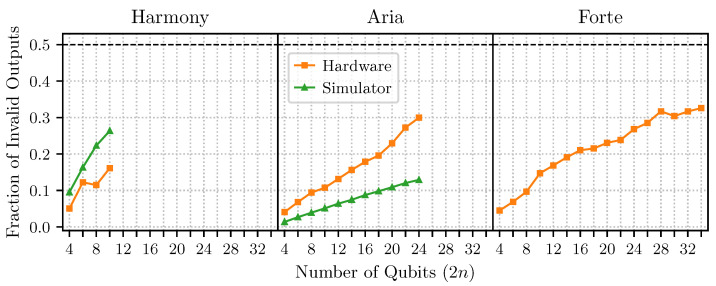
Simon's algorithm was one of the first to demonstrate a genuine quantum advantage in solving a problem. The algorithm, however, assumes access to fault-tolerant qubits. In our work, we use Simon's algorithm to benchmark the error rates of devices currently available in the "quantum cloud". As a main result, we objectively compare the different physical platforms made available by IBM and IonQ. Our study highlights the importance of understanding the device architectures and topologies when transpiling quantum algorithms onto hardware. For instance, we demonstrate that two-qubit operations on spatially separated qubits on superconducting chips should be avoided.
西蒙算法是最早在解决问题时展现出真正量子优势的算法之一。然而,该算法假定可使用容错量子比特。在我们的工作中,我们使用西蒙算法来衡量“量子云”中当前可用设备的错误率。作为主要成果,我们客观地比较了IBM和IonQ提供的不同物理平台。我们的研究强调了在将量子算法转换到硬件上时理解设备架构和拓扑结构的重要性。例如,我们证明应避免在超导芯片上空间分离的量子比特上进行双量子比特操作。