Jin Dingsha, Xu Yanchao, Iqbal Asif, Liu Yuqing, Zhang Yage, Lin Youzhen, Tang Liqiong, Wang Xinhua, Wang Junjie, Huang Mengshu, Xu Peng, Wang Xiaoning
Sanya Institute, Hainan Academy of Agricultural Sciences, Sanya 572000, China.
Institute of Food Crops, Hainan Academy of Agricultural Sciences, Haikou 571100, China.
Int J Mol Sci. 2025 Jul 11;26(14):6660. doi: 10.3390/ijms26146660.
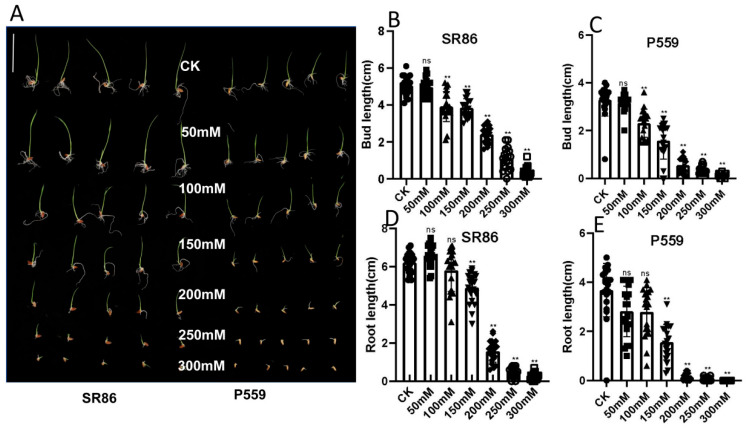
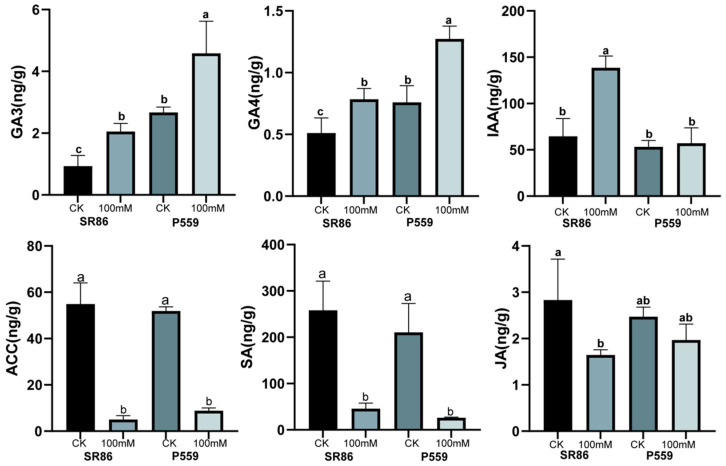
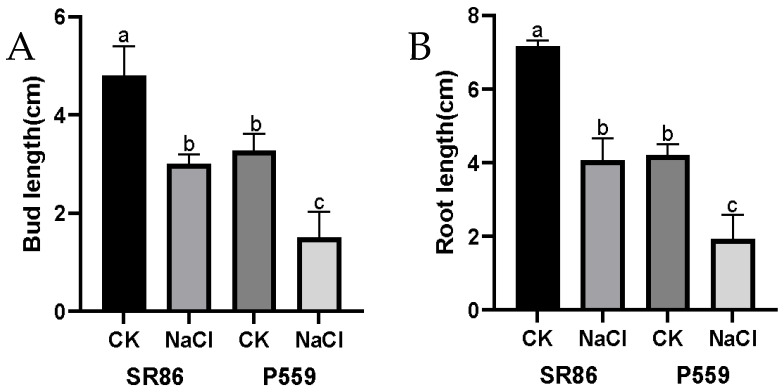
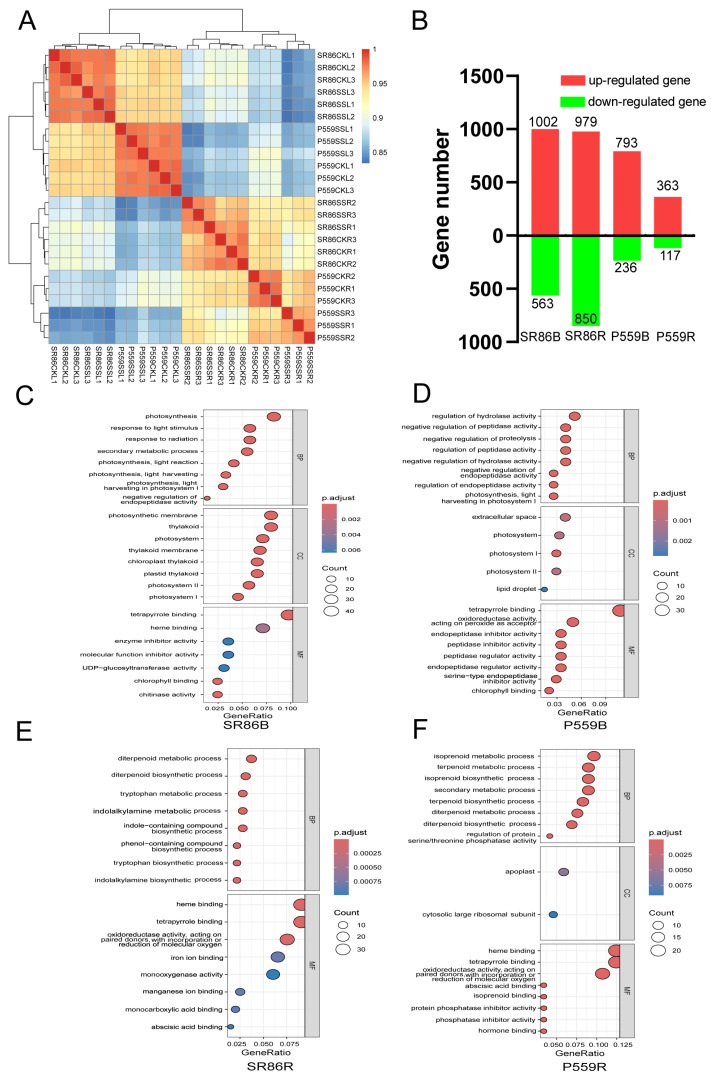
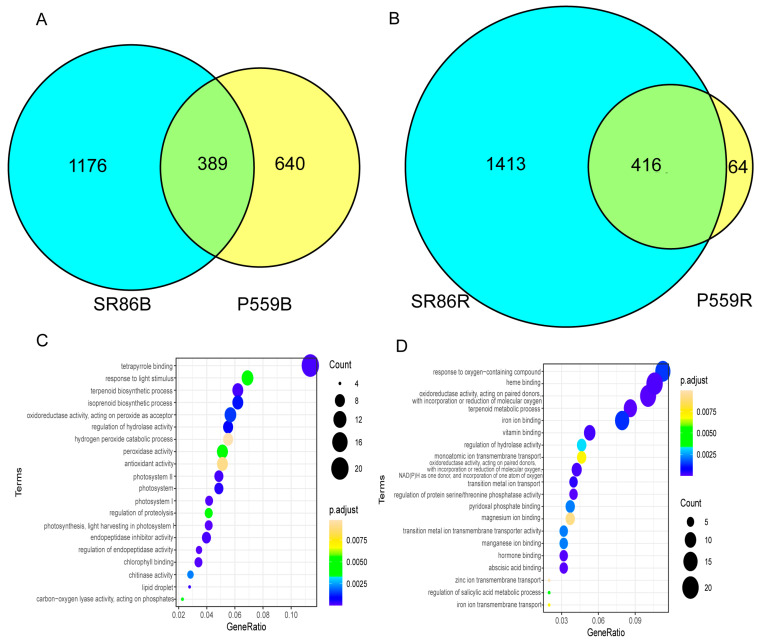
Salt stress is a major constraint to seed germination and early seedling growth in rice, affecting crop establishment and productivity. To understand the mechanisms underlying salt tolerance, we investigated two rice varieties with contrasting responses as follows: salt-tolerant sea rice 86 (SR86) and salt-sensitive P559. Germination assays under increasing NaCl concentrations (50-300 mM) revealed that 100 mM NaCl induced clear phenotypic divergence. SR86 maintained bud growth and showed enhanced root elongation under moderate salinity, while P559 exhibited significant growth inhibition. Transcriptomic profiling of buds and roots under 100 mM NaCl identified over 3724 differentially expressed genes (DEGs), with SR86 showing greater transcriptional plasticity, particularly in roots. Gene ontology enrichment revealed tissue- and genotype-specific responses. Buds showed enrichment in photosynthesis-related and redox-regulating pathways, while roots emphasized ion transport, hormonal signaling, and oxidative stress regulation. SR86 specifically activated genes related to photosystem function, DNA repair, and transmembrane ion transport, while P559 showed activation of oxidative stress-related and abscisic acid (ABA)-regulated pathways. Hormonal profiling supported transcriptomic findings as follows: both varieties showed increased gibberellin 3 (GA3) and gibberellin 4 (GA4) levels under salt stress. SR86 showed elevated auxin (IAA) and reduced jasmonic acid (JA), whereas P559 maintained stable IAA and JA levels. Ethylene precursor and salicylic acid levels declined in both varieties. ABA levels rose slightly but not significantly. These findings suggest that SR86's superior salt tolerance results from rapid growth, robust transcriptional reprogramming, and coordinated hormonal responses. This study offers key insights into early-stage salt stress adaptation and identifies molecular targets for improving stress resilience in rice.
盐胁迫是水稻种子萌发和幼苗早期生长的主要限制因素,影响作物的定植和生产力。为了解耐盐性的潜在机制,我们研究了两个反应截然不同的水稻品种:耐盐海水稻86(SR86)和盐敏感品种P559。在不断增加的NaCl浓度(50-300 mM)下进行的发芽试验表明,100 mM NaCl诱导了明显的表型差异。SR86在中度盐度下保持芽的生长并显示出增强的根伸长,而P559则表现出显著的生长抑制。对100 mM NaCl处理下的芽和根进行转录组分析,鉴定出超过3724个差异表达基因(DEG),SR86表现出更大的转录可塑性,尤其是在根中。基因本体富集揭示了组织和基因型特异性反应。芽在光合作用相关和氧化还原调节途径中表现出富集,而根则强调离子运输、激素信号传导和氧化应激调节。SR86特异性激活了与光系统功能、DNA修复和跨膜离子运输相关的基因,而P559则显示出氧化应激相关和脱落酸(ABA)调节途径的激活。激素分析支持了转录组学的发现,如下所示:两个品种在盐胁迫下赤霉素3(GA3)和赤霉素4(GA4)水平均升高。SR86生长素(IAA)升高,茉莉酸(JA)降低,而P559的IAA和JA水平保持稳定。两个品种的乙烯前体和水杨酸水平均下降。ABA水平略有上升但不显著。这些发现表明,SR86的卓越耐盐性源于其快速生长、强大的转录重编程和协调的激素反应。本研究为早期盐胁迫适应提供了关键见解,并确定了提高水稻抗逆性的分子靶点。