Han Luyi, Zhang Tianyu, D'Angelo Anna, van der Voort Anna, Pinker-Domenig Katja, Kok Marleen, Sonke Gabe, Gao Yuan, Wang Xin, Lu Chunyao, Liang Xinglong, Teuwen Jonas, Tan Tao, Mann Ritse
Department of Radiology and Nuclear Medicine, Radboud University Medical Centre, Geert Grooteplein 10, Nijmegen, 6525 GA, the Netherlands.
Department of Radiology, The Netherlands Cancer Institute, Plesmanlaan 121, Amsterdam, 1066 CX, the Netherlands.
EClinicalMedicine. 2025 Jul 17;86:103356. doi: 10.1016/j.eclinm.2025.103356. eCollection 2025 Aug.
Neoadjuvant therapy (NAT) regimens for breast cancer are generally determined according to cancer stage and molecular subtypes without fully considering the inter-patient variability, which may lead to inefficiency or overtreatment. Artificial intelligence (AI) may support personalized regimen recommendations by learning the synergistic relationship between pre-NAT individual-patient data, regimens, and corresponding short- or long-term therapy responses.
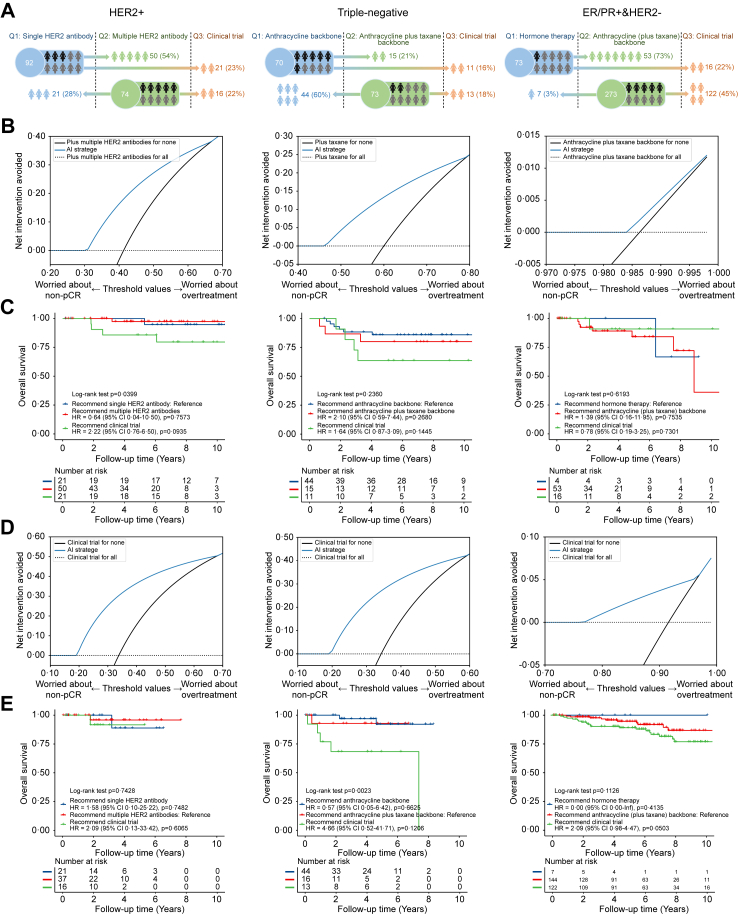
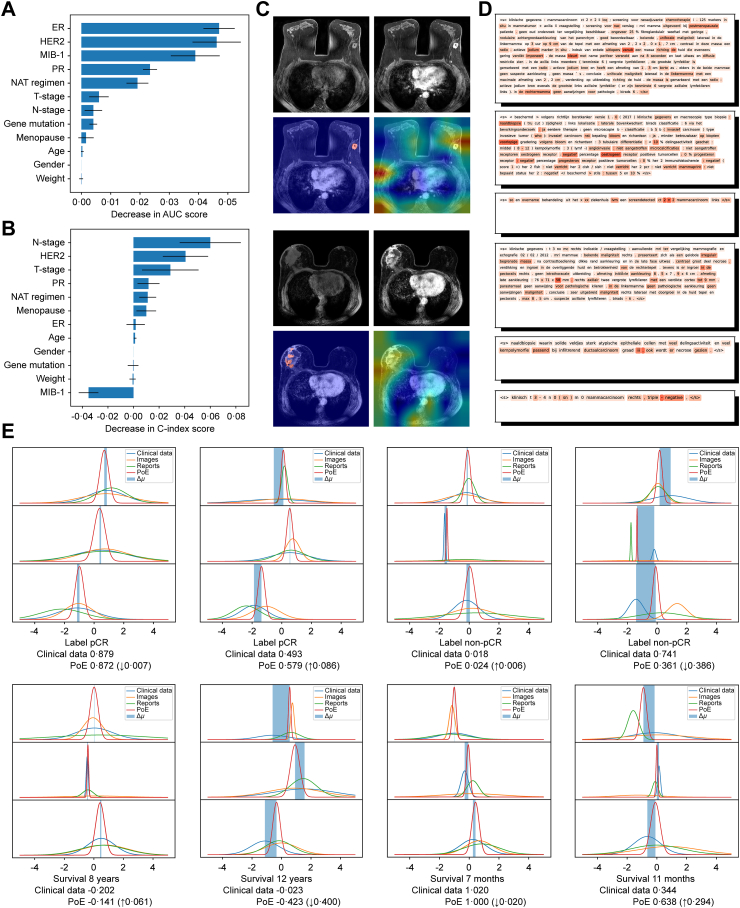
In this retrospective study, we collected data from breast cancer patients treated with NAT between 2000 and 2020 from the Netherlands and the USA. Median follow-up times ranged from 3·7 to 4·9 years across molecular subtypes and cohorts. We developed and externally validated a multi-modal model integrating pre-NAT clinical data, dynamic contrast enhanced (DCE)-MRI images, and medical reports to predict pathological complete response (pCR) and likelihood of survival after NAT. We subsequently evaluated potential benefits for patients receiving a personalized regimen recommended based on these predictions.
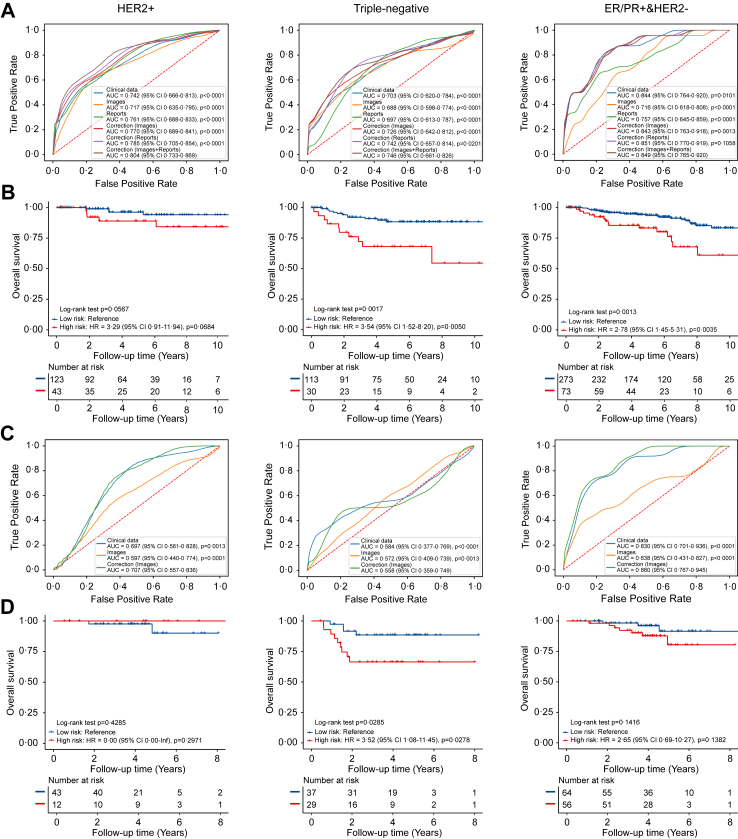
We trained our model on 655 patients and validated it on internal (655 patients) and external (241 patients) cohorts. Given the factual regimens, the model can correctly predict the corresponding therapy response, with areas under the receiver operating characteristic curves (AUC) of 0·80 (95% CI 0·73-0·87), 0·75 (0·66-0·83), and 0·85 (0·77-0·92) for pCR prediction of human epidermal growth factor receptor 2 (HER2)+, triple-negative, and estrogen receptor/progesterone receptor (ER/PR)+&HER2- patients in the internal validation cohort, respectively. Performance in the external validation cohort was 0·707 (0·557-0·836), 0·558 (0·359-0·749), and 0·860 (0·767-0·945) for the corresponding molecular subtypes, respectively. In the internal validation cohort, survival prediction identified high-risk patients across different molecular subtypes, as demonstrated by a hazard ratio (HR) of 3·29 (0·91-11·94) (HER2+), 3·54 (1·52-8·20) (triple-negative), and 2·78 (1·45-5·31) (ER/PR+&HER2-), albeit results were not significant for HER2+ cancers.
Our findings indicate that the prognostic scores generated by the response model could identify patient subgroups with relatively poor outcomes under their actual treatments. These preliminary findings may inform future efforts toward personalized NAT regimen selection beyond traditional criteria such as cancer stage and subtype, but should be interpreted cautiously and validated in prospective studies with longer follow-up because these tumors can relapse at a later stage.
None.
乳腺癌的新辅助治疗(NAT)方案通常根据癌症分期和分子亚型来确定,而没有充分考虑患者之间的差异,这可能导致治疗无效或过度治疗。人工智能(AI)可以通过了解NAT前个体患者数据、治疗方案以及相应的短期或长期治疗反应之间的协同关系,来支持个性化治疗方案的推荐。
在这项回顾性研究中,我们收集了2000年至2020年期间在荷兰和美国接受NAT治疗的乳腺癌患者的数据。各分子亚型和队列的中位随访时间为3.7至4.9年。我们开发并外部验证了一个多模态模型,该模型整合了NAT前的临床数据、动态对比增强(DCE)-MRI图像和医学报告,以预测病理完全缓解(pCR)和NAT后的生存可能性。随后,我们评估了基于这些预测为患者推荐个性化治疗方案的潜在益处。
我们在655例患者上训练了模型,并在内部队列(655例患者)和外部队列(241例患者)上进行了验证。根据实际治疗方案,该模型能够正确预测相应治疗反应,在内部验证队列中,对于人表皮生长因子受体2(HER2)阳性、三阴性以及雌激素受体/孕激素受体(ER/PR)阳性&HER2阴性患者的pCR预测,受试者操作特征曲线(AUC)下面积分别为0.80(95%CI 0.73-0.87)、0.75(0.66-0.83)和0.85(0.77-0.92)。外部验证队列中相应分子亚型的表现分别为0.707(0.557-0.836)、0.558(0.359-0.749)和0.860(0.767-0.945)。在内部验证队列中,生存预测识别出不同分子亚型的高危患者,风险比(HR)分别为3.29(0.91-11.94)(HER2阳性)、3.54(1.52-8.20)(三阴性)和2.78(1.4-5.31)(ER/PR阳性&HER2阴性),尽管HER2阳性癌症的结果不显著。
我们的研究结果表明,反应模型生成的预后评分可以识别在实际治疗下预后相对较差的患者亚组。这些初步发现可能为未来超越癌症分期和亚型等传统标准的个性化NAT方案选择提供参考,但应谨慎解读,并在随访时间更长的前瞻性研究中进行验证,因为这些肿瘤可能在后期复发。
无。