Daimari Nikhil Kumar, Gogoi Ashish, Biswas Rajib, Mazumder Nirmal
Applied Optics and Photonics Lab, Department of Physics, Tezpur University, Tezpur, Assam 784028 India.
Department of Biophysics, Manipal School of Life Sciences, Manipal Academy of Higher Education, Manipal, Karnataka 576104, India.
ACS Omega. 2025 Jul 10;10(28):30985-30995. doi: 10.1021/acsomega.5c03914. eCollection 2025 Jul 22.
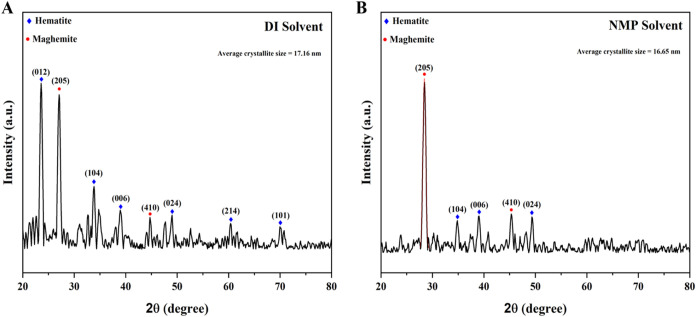
The choice of solvent in the synthesis of nanoparticles plays a pivotal role in influencing the nucleation and growth kinetics of nanoparticles. Deionized water (DI) due to its cost-effectiveness, low toxicity, and ability to dissolve precursor salts effectively makes an ideal solvent medium, while aprotic organic solvents such as -methyl-2-pyrrolidone (NMP) with high dipole moment also demonstrate their efficacy as dual solvent-reducing agents. Herein, this study aims to explore the effect of different solvent media on the biosynthesis of iron nanoparticles (FeNPs) and their impact on the optical, structural, and morphological properties. Green tea extract acts as a reducing agent aiding in stable nanoparticle formation by surface capping with active phytochemical functional groups. The synthesized FeNPs were characterized using ultraviolet-visible (UV-vis) spectroscopy, X-ray diffraction (XRD), field emission scanning electron microscopy (FESEM), energy-dispersive X-ray (EDX), zeta sizer, and Fourier transform infrared (FTIR) spectroscopy. The appearance of absorption peaks affirmed ligand-to-metal charge transfer and double exciton transitions undergoing in the optical structure of the nanoparticles. XRD analysis confirmed the formation of a mixed-phase hematite (α-FeO) and maghemite (γ-FeO) nanostructure with rhombohedral and cubic lattices. Morphological studies by FESEM specify high-yield synthesis of FeNPs with mean particle size of 52.20 ± 14.65 and 51.77 ± 13.82 nm for DI and NMP, respectively. The oxidation of NMP solvent molecules also functioned as a coreducing agent for the reduction of metal Fe species allowing the growth of FeNPs at ambient room temperature. The effectiveness of NMP in FeNPs synthesis highlights its potential as a practical route for producing iron-based nanomaterials while revealing key aspects of solvent-nanoparticle interactions.
在纳米颗粒的合成中,溶剂的选择对影响纳米颗粒的成核和生长动力学起着关键作用。去离子水(DI)因其成本效益高、毒性低且能有效溶解前驱体盐,成为理想的溶剂介质,而具有高偶极矩的非质子有机溶剂,如N-甲基-2-吡咯烷酮(NMP),也证明了其作为双重溶剂还原剂的功效。在此,本研究旨在探讨不同溶剂介质对铁纳米颗粒(FeNPs)生物合成的影响及其对光学、结构和形态性质的影响。绿茶提取物作为还原剂,通过与活性植物化学官能团进行表面封端,有助于形成稳定的纳米颗粒。使用紫外可见(UV-vis)光谱、X射线衍射(XRD)、场发射扫描电子显微镜(FESEM)、能量色散X射线(EDX)、zeta粒度分析仪和傅里叶变换红外(FTIR)光谱对合成的FeNPs进行表征。吸收峰的出现证实了纳米颗粒光学结构中发生的配体到金属的电荷转移和双激子跃迁。XRD分析证实形成了具有菱面体和立方晶格的混合相赤铁矿(α-Fe₂O₃)和磁赤铁矿(γ-Fe₂O₃)纳米结构。FESEM的形态学研究表明,DI和NMP合成的FeNPs产率高,平均粒径分别为52.20±14.65和51.77±13.82 nm。NMP溶剂分子的氧化也作为金属铁物种还原的共还原剂,使FeNPs在室温下生长。NMP在FeNPs合成中的有效性突出了其作为生产铁基纳米材料的实用途径的潜力,同时揭示了溶剂-纳米颗粒相互作用的关键方面。