Elez Katarina, Hempel Tim, Shrimp Jonathan H, Moor Nicole, Raich Lluís, Rocha Cheila, Winter Robin, Le Tuan, Pöhlmann Stefan, Hoffmann Markus, Hall Matthew D, Noé Frank
Department of Mathematics and Computer Science, Freie Universität Berlin, Berlin, Germany.
Department of Physics, Freie Universität Berlin, Berlin, Germany.
Nat Commun. 2025 Jul 29;16(1):6949. doi: 10.1038/s41467-025-62139-5.
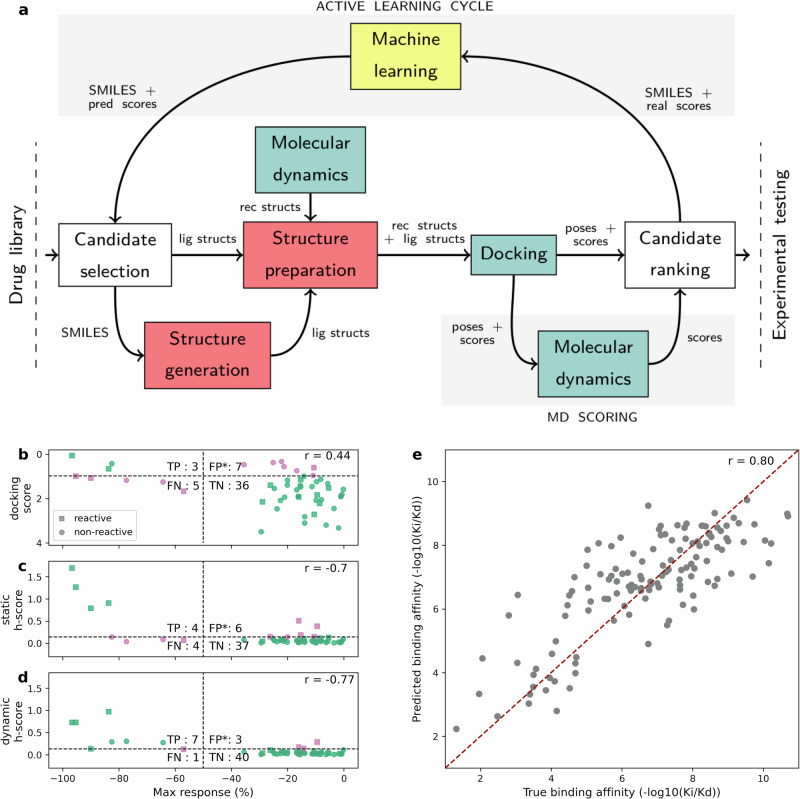
Drug screening resembles finding a needle in a haystack: identifying a few effective inhibitors from a large pool of potential drugs. Large experimental screens are expensive and time-consuming, while virtual screening trades off computational efficiency and experimental correlation. Here we develop a framework that combines molecular dynamics (MD) simulations with active learning. Two components drastically reduce the number of candidates needing experimental testing to less than 20: (1) a target-specific score that evaluates target inhibition and (2) extensive MD simulations to generate a receptor ensemble. The active learning approach reduces the number of compounds requiring experimental testing to less than 10 and cuts computational costs by ∼29-fold. Using this framework, we discovered BMS-262084 as a potent inhibitor of TMPRSS2 (IC50 = 1.82 nM). Cell-based experiments confirmed BMS-262084's efficacy in blocking entry of various SARS-CoV-2 variants and other coronaviruses. The identified inhibitor holds promise for treating viral and other diseases involving TMPRSS2.
要从大量潜在药物中识别出几种有效的抑制剂。大型实验筛选既昂贵又耗时,而虚拟筛选则要在计算效率和实验相关性之间进行权衡。在此,我们开发了一个将分子动力学(MD)模拟与主动学习相结合的框架。有两个要素大幅减少了需要进行实验测试的候选药物数量,使其少于20种:(1)一种评估靶点抑制作用的靶点特异性评分,(2)用于生成受体系综的广泛MD模拟。主动学习方法将需要进行实验测试的化合物数量减少到少于10种,并将计算成本降低了约29倍。利用这个框架,我们发现BMS-262084是跨膜丝氨酸蛋白酶2(TMPRSS2)的一种有效抑制剂(IC50 = 1.82 nM)。基于细胞的实验证实了BMS-262084在阻断各种严重急性呼吸综合征冠状病毒2(SARS-CoV-2)变体及其他冠状病毒进入细胞方面的有效性。所鉴定出的抑制剂有望用于治疗涉及TMPRSS2的病毒性疾病和其他疾病。