Chen Xiaomi, Liu Kun, Liu Quan, Kong Jing, Cristino Valentino A M, Lo Kin-Ho, Xie Zhengchao, Wang Zhi, Song Dongfu, Kwok Chi-Tat
Department of Electromechanical Engineering, Faculty of Science and Technology, University of Macau, Macao, China.
Zhuhai Institute of Advanced Technology, Chinese Academy of Sciences, Zhuhai 519085, China.
Materials (Basel). 2025 Jul 14;18(14):3306. doi: 10.3390/ma18143306.
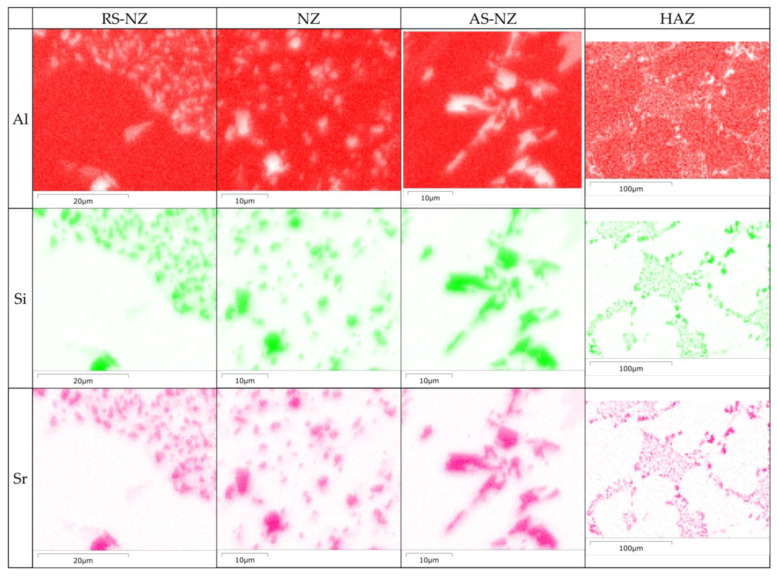
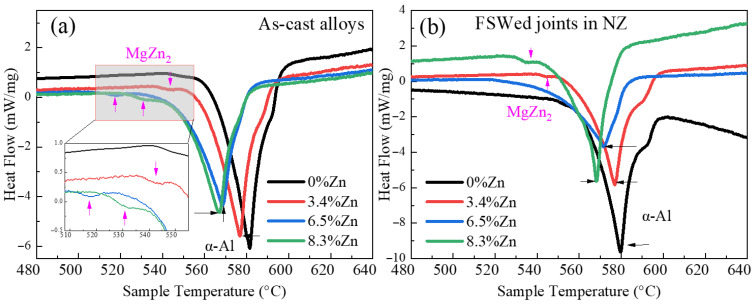
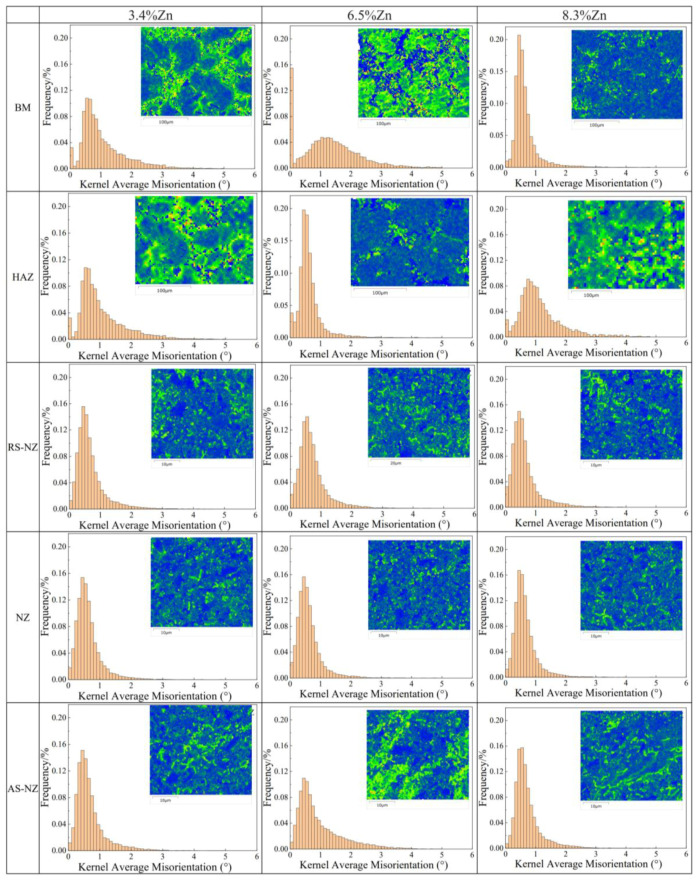
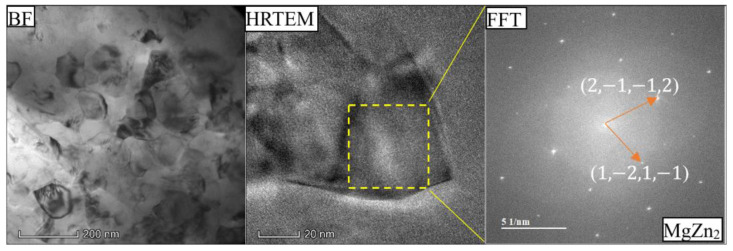
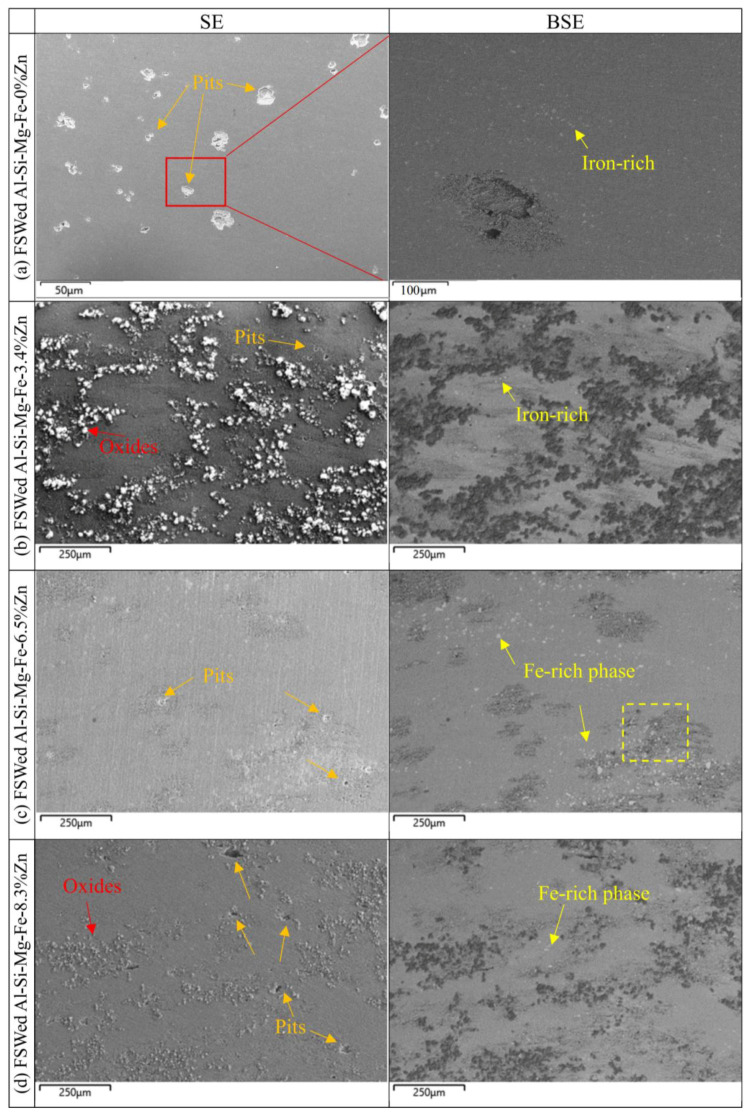
With the ongoing development of lightweight automobiles, research on new aluminum alloys and welding technology has gained significant attention. Friction stir welding (FSW) is a solid-state joining technique for welding aluminum alloys without melting. In this study, novel squeeze-cast Al-Si-Mg-Fe-Zn alloys with different Zn contents (0, 3.4, 6.5, and 8.3 wt%) were friction stir welded (FSWed) at a translational speed of 200 mm/min and a rotational speed of 800 rpm. These parameters were chosen based on the observations of visually sound welds, defect-free and fine-grained microstructures, homogeneous secondary phase distribution, and low roughness. Zn can affect the microstructure of Al-Si-Mg-Fe-Zn alloys, including the grain size and the content of secondary phases, leading to different mechanical and corrosion behavior. Adding different Zn contents with Mg forms the various amount of MgZn, which has a significant strengthening effect on the alloys. Softening observed in the weld zones of the alloys with 0, 3.4, and 6.5 wt% Zn is primarily attributed to the reduction in Kernel Average Misorientation (KAM) and a decrease in the Si phase and MgZn. Consequently, the mechanical strengths of the FSWed joints are lower as compared to the base material. Conversely, the FSWed alloy with 8.3 wt% Zn exhibited enhanced mechanical properties, with hardness of 116.3 HV, yield strength (YS) of 184.4 MPa, ultimate tensile strength (UTS) of 226.9 MP, percent elongation (EL%) of 1.78%, and a strength coefficient exceeding 100%, indicating that the joint retains the strength of the as-cast one, due to refined grains and more uniformly dispersed secondary phases. The highest corrosion resistance of the FSWed alloy with 6.5%Zn is due to the smallest grain size and KAM, without MgZn and the highest percentage of {111} texture (24.8%).
随着轻型汽车的不断发展,新型铝合金及焊接技术的研究备受关注。搅拌摩擦焊(FSW)是一种用于焊接铝合金的固态连接技术,无需熔化。在本研究中,对具有不同锌含量(0、3.4、6.5和8.3 wt%)的新型挤压铸造Al-Si-Mg-Fe-Zn合金,以200 mm/min的平移速度和800 rpm的旋转速度进行搅拌摩擦焊(FSWed)。这些参数是基于外观良好的焊缝、无缺陷且细晶的微观结构、均匀的二次相分布以及低粗糙度的观察结果而选择的。锌会影响Al-Si-Mg-Fe-Zn合金的微观结构,包括晶粒尺寸和二次相的含量,从而导致不同的力学和腐蚀行为。添加不同锌含量与镁形成不同数量的MgZn,对合金具有显著的强化作用。在含0、3.4和6.5 wt%锌的合金焊缝区观察到的软化主要归因于核心平均取向差(KAM)的降低以及Si相和MgZn的减少。因此,与母材相比,搅拌摩擦焊接头的力学强度较低。相反,含8.3 wt%锌的搅拌摩擦焊合金表现出增强的力学性能,硬度为116.3 HV,屈服强度(YS)为184.4 MPa,极限抗拉强度(UTS)为226.9 MP,伸长率(EL%)为1.78%,强度系数超过100%,表明接头保留了铸态合金的强度,这归因于细化的晶粒和更均匀分布的二次相。含6.5%锌的搅拌摩擦焊合金具有最高的耐腐蚀性,这是由于其最小的晶粒尺寸和KAM,没有MgZn且{111}织构的百分比最高(24.8%)。