Zhao Shuanglei, Li Qianxian, Liu Zhou, Wang Bin, Sun Zhaoqing, Wen Mingxiu, Lu Yifan, Hu Yi, Chen Siji, Han Jie, Zhang Hongjia, Gong Ming
Department of cardiac surgery, Beijing Anzhen Hospital, Capital Medical University, Beijing, China.
Department of Cardiology, Qingdao Hospital, University of Health and Rehabilitation Sciences (Qingdao Municipal Hospital), China.
Int J Cardiol Heart Vasc. 2025 Jul 22;60:101755. doi: 10.1016/j.ijcha.2025.101755. eCollection 2025 Oct.
Lipoproteins and insulin resistance are associated with the prognosis of cardiovascular disease, with strong evidence supporting a causal relationship for some; however, whether lipoproteins and insulin resistance have prognostic value in patients with infective endocarditis after valve surgery remains unclear.
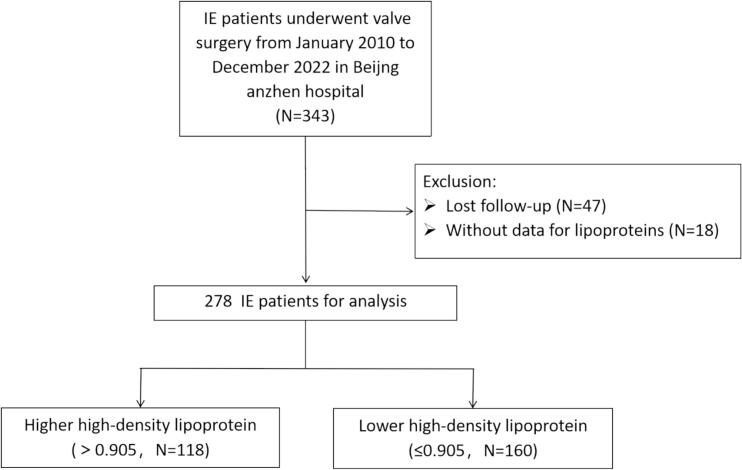
We included 278 consecutive patients with a definite diagnosis of IE who underwent valve surgery from January 2010 to December 2022. Mortality was analyzed in relation to lipid profile and insulin resistance. Patients were divided into a higher high-density lipoprotein (>0.905 mmol/L) group and a lower high-density lipoprotein (≤0.905 mmol/L) group based on the cutoff value of the high-density lipoprotein. A Kaplan-Meier survival analysis was conducted for patients in two groups. Subgroup analysis and restricted cubic splines regression of the association between baseline high-density lipoprotein and incident all-cause mortality were performed.
Among 278 patients (mean age 44.96 years, 28.1 % female), there were 36 all-cause mortalities during a median 60.98 months follow-up. Kaplan-Meier survival analysis showed lower 12-year mortality in patients with high-density lipoprotein levels > 0.905 mmol/L (HR = 0.125, p < 0.001). There were no significant interactions in any of the subgroups. The adverse effect of high-density lipoprotein on all-cause mortality was consistent after adjusting for the confounders across all subgroups. The restricted cubic splines regression model revealed a linear association between high-density lipoprotein and the risk of all-cause mortality ( for nonlinearity = 0.477), and this linear association is more pronounced in women.
High-density lipoprotein levels are associated with lower mortality in infective endocarditis patients after valve surgery, particularly in female patients.
脂蛋白和胰岛素抵抗与心血管疾病的预后相关,有充分证据支持其中一些存在因果关系;然而,脂蛋白和胰岛素抵抗在瓣膜置换术后感染性心内膜炎患者中是否具有预后价值仍不清楚。
我们纳入了2010年1月至2022年12月期间连续278例确诊为感染性心内膜炎并接受瓣膜置换术的患者。分析死亡率与血脂谱和胰岛素抵抗的关系。根据高密度脂蛋白的临界值,将患者分为高密度脂蛋白水平较高(>0.905 mmol/L)组和较低(≤0.905 mmol/L)组。对两组患者进行Kaplan-Meier生存分析。对基线高密度脂蛋白与全因死亡率之间的关联进行亚组分析和受限立方样条回归分析。
在278例患者(平均年龄44.96岁,女性占28.1%)中,在中位60.98个月的随访期间有36例全因死亡。Kaplan-Meier生存分析显示,高密度脂蛋白水平>0.905 mmol/L的患者12年死亡率较低(HR = 0.125,p<0.001)。在任何亚组中均无显著交互作用。在对所有亚组的混杂因素进行调整后,高密度脂蛋白对全因死亡率的不良影响是一致的。受限立方样条回归模型显示高密度脂蛋白与全因死亡风险之间存在线性关联(非线性检验P值 = 0.477),且这种线性关联在女性中更为明显。
瓣膜置换术后感染性心内膜炎患者的高密度脂蛋白水平与较低的死亡率相关,尤其是女性患者。