Köroǧlu Mihraç, Yılmaz Coşkun, Tan Çetin, Çelikel Baha Engin, Budak Cemalettin, Kavuran Korhan, Susuz Yunus Emre, Barut Yaşar, Ceylan Tülay, Soyer Fikret, Sezer Süreyya Yonca, Şahin Fatma Neşe
Faculty of Sport Sciences, Batman University, Batman, Türkiye.
Kelkit Aydın Doğan Vocational School, Gümüşhane University, Gümüşhane, Türkiye.
Front Psychol. 2025 Jul 15;16:1632095. doi: 10.3389/fpsyg.2025.1632095. eCollection 2025.
The extant research on judo sports has principally concentrated on the physiological effects of training. Conversely, there has been limited attention paid to studies on psychological resilience, self-control, and emotional expression levels. The present study examined the effects of Judo exercises on psychological resilience, self-control, and emotional expression levels in healthy male subjects.
The present study comprised 50 healthy, sedentary male subjects. The subjects were randomly divided into two groups: one group participated in judo training (JT) and the other group served as the control group (CON). The sample sizes for the JT and CON groups were both 25. The JT group underwent judo training, while the CON group maintained their usual lifestyle. The Brief Psychological Resilience Scale, the Multidimensional Brief Self-Control Scale, and the Berkeley Emotion Expression Scale were administered prior to and following the 6-week training period.
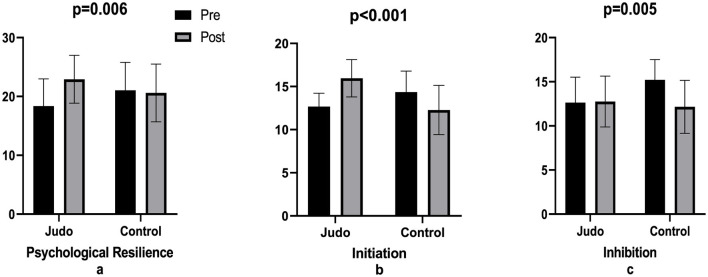
The study demonstrated that a 6-week judo training regimen exerted a significant effect on the psychological resilience score (e.s. = 1.047, < 0.001), while no such effect was observed in the Control group (e.s. = 0.0091, = 0.751). In the context of self-control levels, an effect was observed on the Initiation sub-dimension (e.s. = 1, 739, < 0.001), yet no effect was found on the Inhibition dimension (e.s. = 0.052, = 0.892). In the control group, a significant decrease was identified in the Initiation sub-dimension (e.s. = 0, 785, = 0.001) and Inhibition sub-dimension (e.s. = 1, 861, < 0.001). The findings indicate that impulse power (e.s. = 0.395) and concealment (e.s. = 0.428) exerted a negligible influence on the emotional expression sub-dimensions. Conversely, psychological resilience (e.s. = 0.886) demonstrated a substantial impact.
The judo exercises demonstrated a favorable impact on psychological resilience, self-control, and emotional expression levels in healthy male subjects. The findings of this study may offer significant insights into the impact of judo exercises on psychological resilience, self-control, and emotion expression levels. These findings could serve as a guide for the development of future interventions and program design in the domain of sport psychology.
目前关于柔道运动的研究主要集中在训练的生理影响上。相反,对心理韧性、自我控制和情绪表达水平的研究关注较少。本研究考察了柔道练习对健康男性受试者心理韧性、自我控制和情绪表达水平的影响。
本研究包括50名健康的久坐男性受试者。受试者被随机分为两组:一组参加柔道训练(JT),另一组作为对照组(CON)。JT组和CON组的样本量均为25。JT组进行柔道训练,而CON组保持其通常的生活方式。在为期6周的训练期之前和之后,分别使用简短心理韧性量表、多维简短自我控制量表和伯克利情绪表达量表进行测量。
研究表明,为期6周的柔道训练方案对心理韧性得分有显著影响(效应量=1.047,P<0.001),而对照组未观察到这种影响(效应量=0.0091,P=0.751)。在自我控制水平方面,对启动子维度有影响(效应量=1.739,P<0.001),但对抑制维度没有影响(效应量=0.052,P=0.892)。在对照组中,启动子维度(效应量=0.785,P=0.001)和抑制子维度(效应量=1.861,P<0.001)均有显著下降。研究结果表明,冲动力量(效应量=0.39)和掩饰(效应量=0.428)对情绪表达子维度的影响可忽略不计。相反,心理韧性(效应量=0.886)显示出重大影响。
柔道练习对健康男性受试者的心理韧性、自我控制和情绪表达水平有积极影响。本研究结果可能为柔道练习对心理韧性、自我控制和情绪表达水平的影响提供重要见解。这些发现可为运动心理学领域未来干预措施的开发和项目设计提供指导。