Cheng David, Lee Boram, Jeffers Abra M, Stover Maeve, Kephart Lindsay, Chadwick Ginny, Kruse Gina R, Evins A Eden, Rigotti Nancy A, Levy Douglas E
Biostatistics Center, Massachusetts General Hospital, Boston.
Department of Medicine, Harvard Medical School, Boston, Massachusetts.
JAMA Netw Open. 2025 Jul 1;8(7):e2524184. doi: 10.1001/jamanetworkopen.2025.24184.
Seven states have policies restricting the sale of flavored e-cigarettes. Limited evidence exists regarding these policies' association with the use of tobacco products across age groups.
To evaluate associations of e-cigarette flavor restriction policies with e-cigarette and cigarette use by age group over multiple years.
DESIGN, SETTING, AND PARTICIPANTS: In this cross-sectional study, annual state-level prevalences of e-cigarette and cigarette use in the US between 2015 and 2023 were separately estimated among youths (high school age) using data from the Youth Risk Behavior Survey (YRBS) and young adults (ages 18-24 years) and adults (ages ≥25 years) using the Behavioral Risk Factor Surveillance System (BRFSS). Six policy states had multiple years of postpolicy data available; other states were control states. Associations between policy and prevalence of e-cigarette and cigarette use in each postpolicy year were estimated annually using difference-in-differences analysis, setting 2019 as the prepolicy year and 2020 to 2023 as postpolicy years.
Statewide policy restricting sales of non-tobacco flavored e-cigarettes.
State annual prevalence of past 30-day (YRBS) and current (BRFSS) e-cigarette and cigarette use.
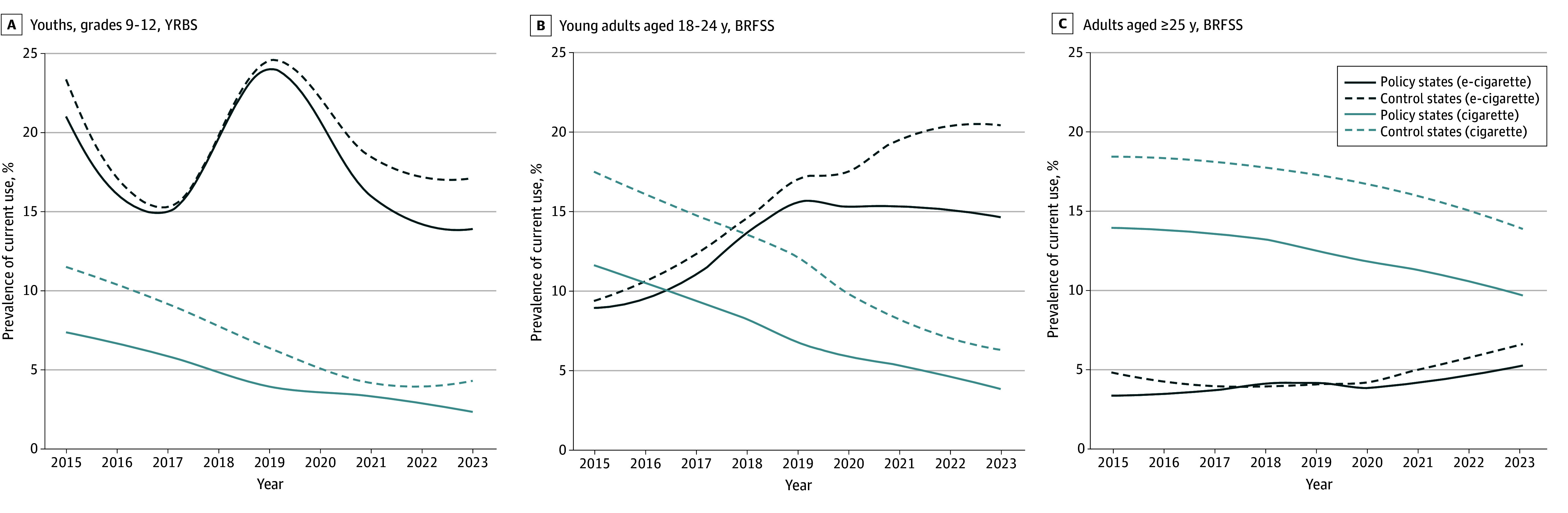
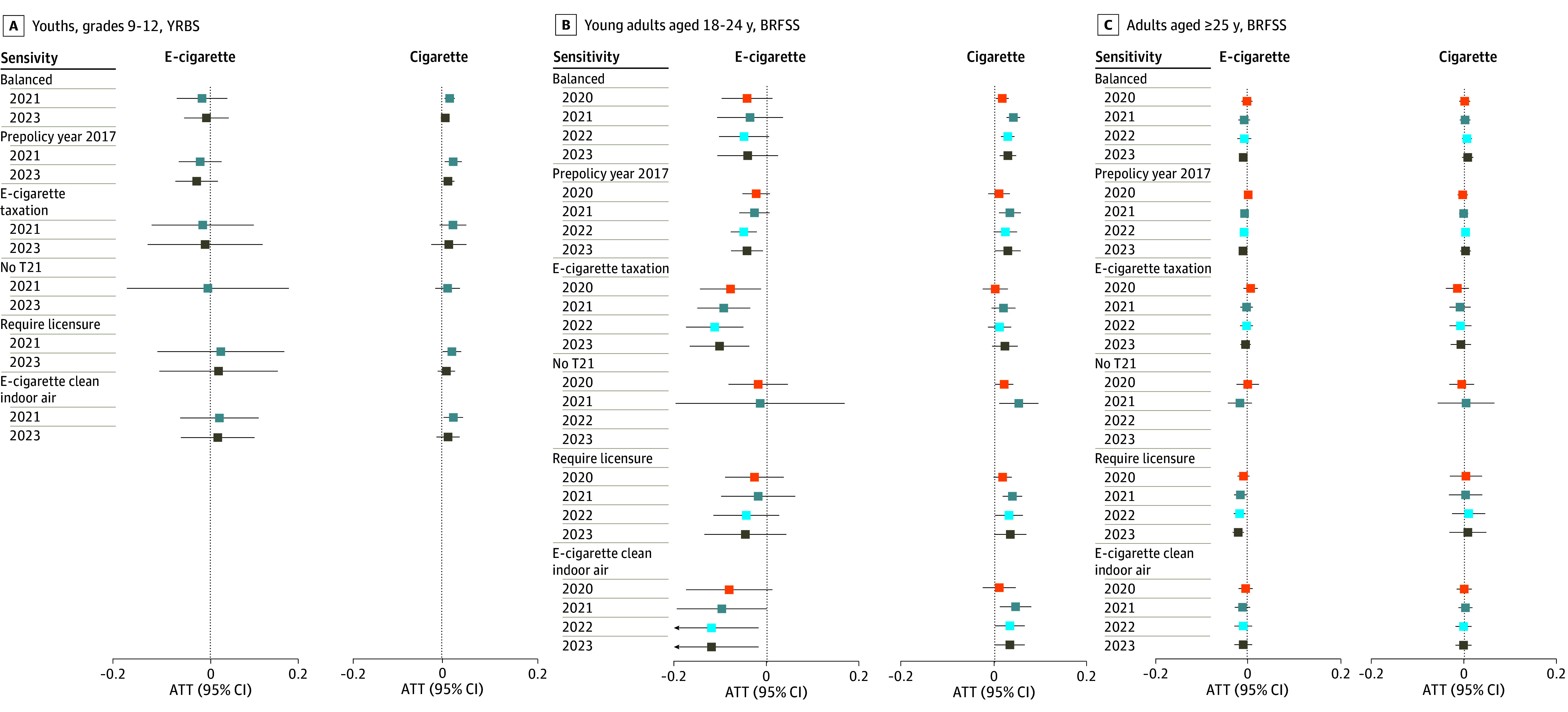
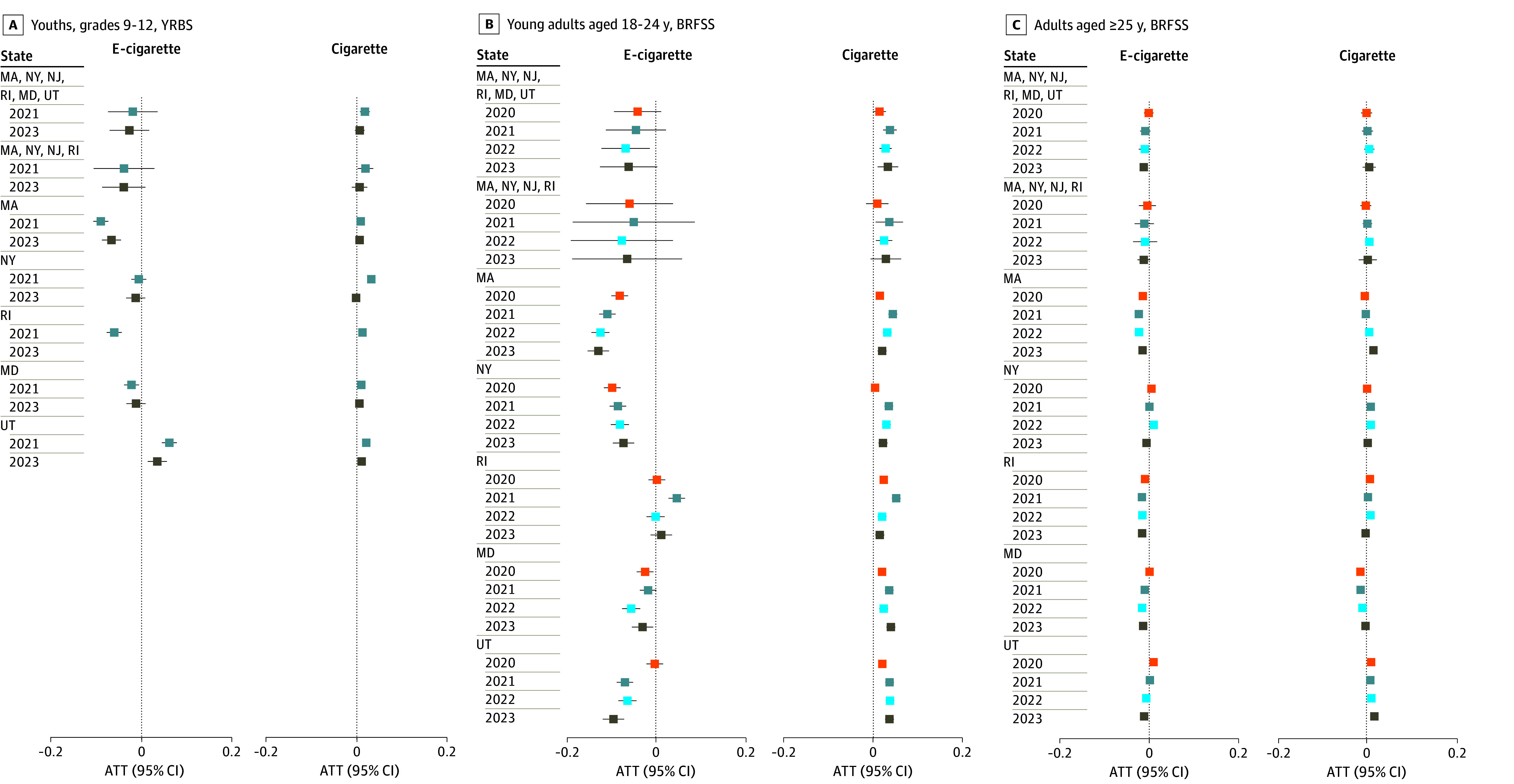
Prevalence data were obtained for 186 (YRBS) and 386 (BRFSS) state-years for e-cigarettes and 191 (YRBS) and 456 (BRFSS) state-years for cigarettes. In recent years, e-cigarette use prevalence decreased among youths (eg, the change in mean prevalence from 2019 to 2023 was 24.1% to 14.0% for policy states and 24.6% to 17.2% for control states) but increased in control states among young adults (eg, mean prevalence, 17.0% in 2019 to 20.4% in 2023). Cigarette use prevalence decreased in policy and control states, although policy states exhibited lower prepolicy prevalence and attenuated postpolicy decreases (eg, mean prevalence, 6.7% in 2019 to 3.8% in 2023 among young adults) relative to control states (eg, mean prevalence, 12.1% in 2019 to 6.3% in 2023 among young adults). Flavor policies were associated with reduced e-cigarette use among young adults in 2022 (average treatment effect among the treated [ATT], -6.7 percentage points; 95% CI, -1.3 to -12.1 percentage points) and adults aged 25 years or older in 2023 (ATT, -1.2 percentage points; 95% CI, -2.0 to -0.4 percentage points) and increased cigarette use among youths in 2021 (ATT, 1.8 percentage points; 95% CI, 0.7 to 2.9 percentage points) and young adults in 2021 (ATT, 3.7 percentage points; 95% CI, 2.2 to 5.2 percentage points), 2022 (ATT, 2.7 percentage points; 95% CI, 1.4 to 4.1 percentage points), and 2023 (ATT, 3.2 percentage points; 95% CI, 0.9 to 5.5 percentage points).
In this study, flavor restriction policies were associated with some reductions in e-cigarette use but also unintended increases in cigarette use, highlighting a need for further work evaluating potential substitution outcomes and prevention of tobacco use among youths.
七个州出台了限制调味电子烟销售的政策。关于这些政策与各年龄组烟草制品使用之间的关联,现有证据有限。
评估电子烟口味限制政策与多年来各年龄组电子烟和香烟使用情况之间的关联。
设计、背景和参与者:在这项横断面研究中,利用青少年风险行为调查(YRBS)的数据,分别估算了2015年至2023年美国青少年(高中年龄)中电子烟和香烟使用的年度州级患病率;利用行为风险因素监测系统(BRFSS)的数据,估算了18至24岁的年轻人和25岁及以上成年人中电子烟和香烟使用的年度州级患病率。六个政策州有多年的政策后数据可用;其他州为对照州。每年使用差异分析估计政策与每个政策后年份电子烟和香烟使用患病率之间的关联,将2019年设为政策前年份,2020年至2023年设为政策后年份。
全州范围内限制销售非烟草口味电子烟的政策。
过去30天(YRBS)电子烟和香烟使用的州年度患病率以及当前(BRFSS)电子烟和香烟使用的州年度患病率。
获取了186个(YRBS)和386个(BRFSS)州年的电子烟患病率数据,以及191个(YRBS)和456个(BRFSS)州年的香烟患病率数据。近年来,青少年中电子烟使用患病率有所下降(例如,政策州从2019年到2023年的平均患病率变化为24.1%至14.0%,对照州为24.6%至17.2%),但对照州中25岁及以上成年人的电子烟使用患病率有所上升(例如,2019年平均患病率为17.0%,2023年为20.4%)。政策州和对照州的香烟使用患病率均有所下降,尽管政策州在政策前的患病率较低,且政策后的下降幅度较小(例如,25岁及以上成年人中,政策州从2019年的平均患病率6.7%降至2023年的3.8%),而对照州(例如,25岁及以上成年人中,从2019年的平均患病率12.1%降至2023年的6.3%)。口味政策与2022年25岁及以上成年人中电子烟使用减少有关(处理组的平均处理效应[ATT]为-6.7个百分点;95%置信区间为-1.3至-12.1个百分点),以及与2023年25岁及以上成年人中电子烟使用减少有关(ATT为-1.2个百分点;95%置信区间为-2.0至-0.4个百分点),还与2021年青少年中香烟使用增加有关(ATT为1.8个百分点;95%置信区间为0.7至2.9个百分点),以及与2021年、2022年和2023年25岁及以上成年人中香烟使用增加有关(2021年ATT为3.7个百分点;95%置信区间为2.2至5.2个百分点;2022年ATT为2.7个百分点;95%置信区间为1.4至4.1个百分点;2023年ATT为3.2个百分点;95%置信区间为0.9至5.5个百分点)。
在本研究中,口味限制政策与电子烟使用的一些减少有关,但也意外导致了香烟使用的增加,这凸显了需要进一步开展工作,评估潜在的替代结果以及预防青少年烟草使用。