Hesse Kerrick, Khanji Mohammed Y, Chahal C Anwar A, Petersen Steffen E, Aung Nay
William Harvey Research Institute, NIHR Barts Biomedical Research Centre, Queen Mary University London, Charterhouse Square, London EC1M 6BQ, UK.
Academic Cardiovascular Unit, James Cook University Hospital, Marton Road, Middlesbrough TS4 3BW, UK.
Eur Heart J Imaging Methods Pract. 2025 Jul 18;3(2):qyaf092. doi: 10.1093/ehjimp/qyaf092. eCollection 2025 Jul.
Left ventricular hypertrophy (LVH) regionality carries diagnostic and prognostic importance. Mean absolute deviation of maximum segmental wall thickness () is a novel left ventricular wall thickness (LVWT) heterogeneity biomarker from cardiovascular magnetic resonance imaging (CMR).
To compare to indexed LV mass (), maximum () and mean () wall thickness to predict incident cardiovascular disease (CVD) and differentiate physiological from pathological LVH in highly physically active individuals.
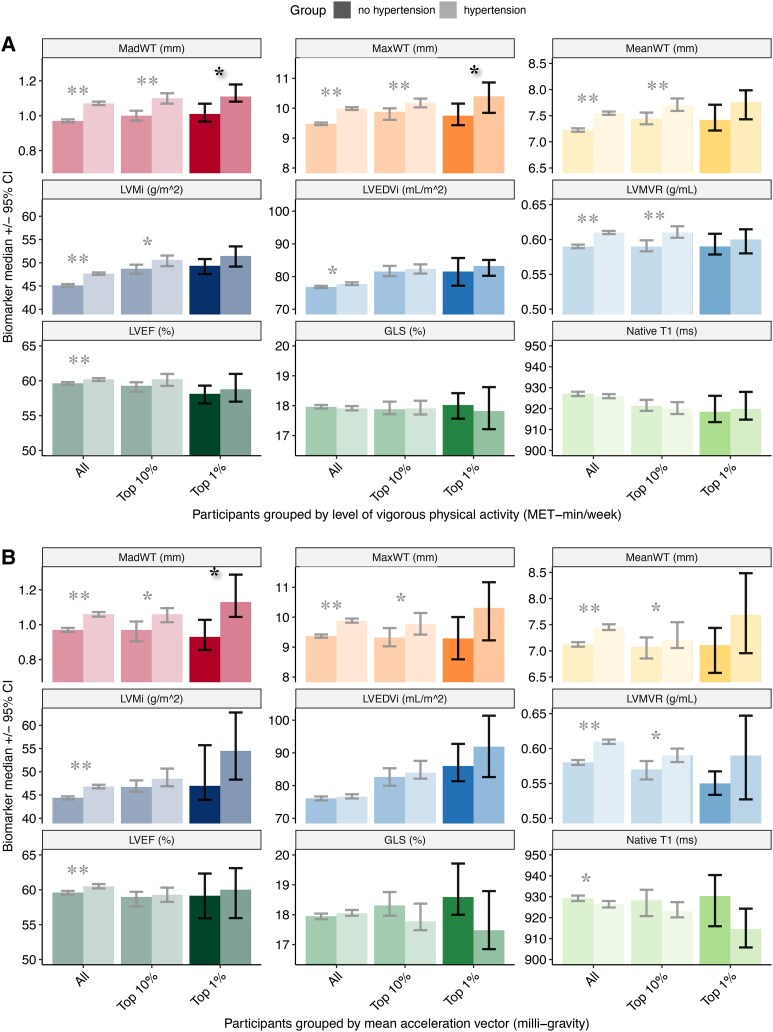
Deep learning-assisted analysis of 44 930 UK Biobank CMR scans produced WT indices. Cox regression modelled major adverse cardiovascular events (MACE), heart failure (HF), arrhythmia, and all-cause death against LVWT indices. In the top 1% most physically active biomarker differences between propensity score matched hypertensive and non-hypertensive groups were compared. Over median (Q1, Q3) follow-up of 5.7 (4.9, 7.1) years, , and were associated with greater risk of MACE, HF, arrhythmia ( < 0.05), but not all-cause death ( > 0.05). After adjusting for CMR biomarkers, including , remained independently prognostic of the greatest number of endpoints, including MACE, HF, and arrhythmia [HR 1.13 (1.04-1.23); HR 1.15 (1.01-1.32); and HR 1.26 (1.18-1.35) respectively]. In the top 1% most physically active by three metrics, was the only significantly different biomarker between hypertensive and non-hypertensive participants ( < 0.05).
is important prognostically beyond LV mass and may be useful when differentiating physiological from hypertensive LVH. Although findings require confirmation in athletic and diseased cohorts, is readily translatable to deep learning-assisted clinical CMR reporting, especially in early unexplained LVH.
左心室肥厚(LVH)的区域性具有诊断和预后意义。最大节段壁厚度的平均绝对偏差()是一种来自心血管磁共振成像(CMR)的新型左心室壁厚度(LVWT)异质性生物标志物。
比较与左心室质量指数()、最大()和平均()壁厚度,以预测心血管疾病(CVD)的发生,并区分高体力活动个体的生理性与病理性LVH。
对44930例英国生物银行CMR扫描进行深度学习辅助分析,得出WT指数。Cox回归模型将主要不良心血管事件(MACE)、心力衰竭(HF)、心律失常和全因死亡与LVWT指数进行建模。在倾向评分匹配的高血压组和非高血压组中,比较了前1%体力活动最多的生物标志物差异。在中位(Q1,Q3)随访5.7(4.9,7.1)年期间,、和与MACE、HF、心律失常的风险增加相关(<0.05),但与全因死亡无关(>0.05)。在调整了包括在内的CMR生物标志物后,仍然是包括MACE、HF和心律失常在内的最多终点的独立预后指标[HR分别为1.13(1.04 - 1.23);HR为1.15(1.01 - 1.32);HR为1.26(1.18 - 1.35)]。在按三个指标衡量的前1%体力活动最多的人群中,是高血压参与者和非高血压参与者之间唯一有显著差异的生物标志物(<0.05)。
在预后方面,超出左心室质量具有重要意义,在区分生理性与高血压性LVH时可能有用。尽管研究结果需要在运动员和患病队列中得到证实,但很容易转化为深度学习辅助的临床CMR报告,尤其是在早期不明原因的LVH中。