Chadalavada Sucharitha, Rauseo Elisa, Salih Ahmed, Naderi Hafiz, Khanji Mohammed, Vargas Jose D, Lee Aaron M, Amir-Kalili Alborz, Lockhart Lisette, Graham Ben, Chirvasa Mihaela, Fung Kenneth, Paiva Jose, Sanghvi Mihir M, Slabaugh Gregory G, Jensen Magnus T, Aung Nay, Petersen Steffen E
William Harvey Research Institute, NIHR Barts Biomedical Research Centre, Queen Mary University of London, Charterhouse Square, London, UK.
Barts Heart Centre, St Bartholomew's Hospital, Barts Health NHS Trust, West Smithfield, London, UK.
Eur Heart J Imaging Methods Pract. 2024 Sep 16;2(3):qyae094. doi: 10.1093/ehjimp/qyae094. eCollection 2024 Jul.
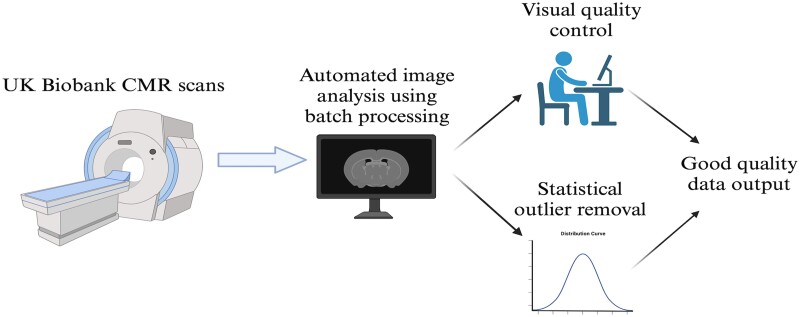
Automated algorithms are regularly used to analyse cardiac magnetic resonance (CMR) images. Validating data output reliability from this method is crucial for enabling widespread adoption. We outline a visual quality control (VQC) process for image analysis using automated batch processing. We assess the performance of automated analysis and the reliability of replacing visual checks with statistical outlier (SO) removal approach in UK Biobank CMR scans.
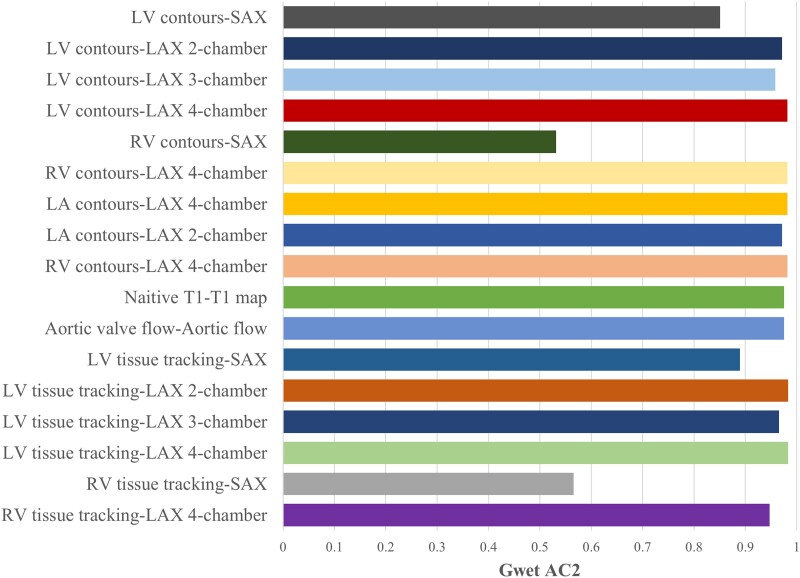
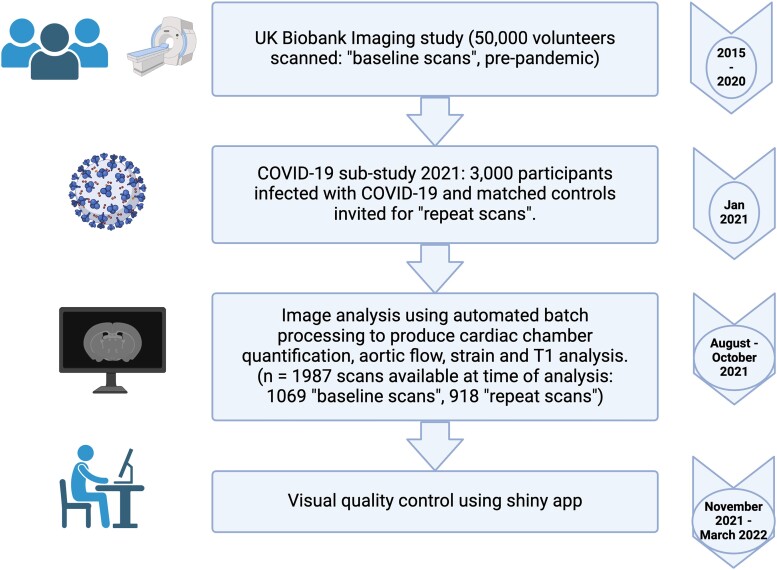
We included 1987 CMR scans from the UK Biobank COVID-19 imaging study. We used batch processing software (Circle Cardiovascular Imaging Inc.-CVI42) to automatically extract chamber volumetric data, strain, native T1, and aortic flow data. The automated analysis outputs (∼62 000 videos and 2000 images) were visually checked by six experienced clinicians using a standardized approach and a custom-built R Shiny app. Inter-observer variability was assessed. Data from scans passing VQC were compared with a SO removal QC method in a subset of healthy individuals ( = 1069). Automated segmentation was highly rated, with over 95% of scans passing VQC. Overall inter-observer agreement was very good (Gwet's AC2 0.91; 95% confidence interval 0.84, 0.94). No difference in overall data derived from VQC or SO removal in healthy individuals was observed.
Automated image analysis using CVI42 prototypes for UK Biobank CMR scans demonstrated high quality. Larger UK Biobank data sets analysed using these automated algorithms do not require in-depth VQC. SO removal is sufficient as a QC measure, with operator discretion for visual checks based on population or research objectives.
自动算法经常用于分析心脏磁共振(CMR)图像。验证该方法的数据输出可靠性对于其广泛应用至关重要。我们概述了一种使用自动批处理进行图像分析的视觉质量控制(VQC)流程。我们评估了英国生物银行CMR扫描中自动分析的性能以及用统计离群值(SO)去除方法替代视觉检查的可靠性。
我们纳入了来自英国生物银行COVID-19成像研究的1987次CMR扫描。我们使用批处理软件(Circle Cardiovascular Imaging Inc.-CVI42)自动提取心室容积数据、应变、固有T1和主动脉血流数据。由六名经验丰富的临床医生使用标准化方法和定制的R Shiny应用程序对自动分析输出(约62000个视频和2000张图像)进行视觉检查。评估了观察者间的变异性。将通过VQC的扫描数据与健康个体子集(n = 1069)中的SO去除质量控制方法进行比较。自动分割得到高度评价,超过95%的扫描通过VQC。观察者间总体一致性非常好(Gwet's AC2 0.91;95%置信区间0.84,0.94)。在健康个体中,未观察到VQC或SO去除得出的总体数据有差异。
使用CVI42原型对英国生物银行CMR扫描进行自动图像分析显示出高质量。使用这些自动算法分析的更大的英国生物银行数据集不需要深入的VQC。SO去除作为一种质量控制措施就足够了,操作人员可根据人群或研究目标酌情进行视觉检查。