Yamashita Kaoru, Kibe Toshiro, Yoshimine Shusei, Uto Akari, Uchino Minako, Sugimura Mitsutaka
Department of Dental Anesthesiology, Field of Oral and Maxillofacial Rehabilitation, Advanced Therapeutics Course, Graduate School of Medical and Dental Sciences, Kagoshima University, Kagoshima, Japan.
Department of Oral and Maxillofacial Surgery, Field of Oral and Maxillofacial Rehabilitation, Advanced Therapeutics Course, Graduate School of Medical and Dental Sciences, Kagoshima University, Kagoshima, Japan.
Front Physiol. 2025 Jul 16;16:1607816. doi: 10.3389/fphys.2025.1607816. eCollection 2025.
The vasovagal reflex is the most frequent emergency that occurs during dental procedures, but its underlying mechanism is not understood. In this study, we conducted autonomic monitoring of patients with a history of vasovagal reflexes.
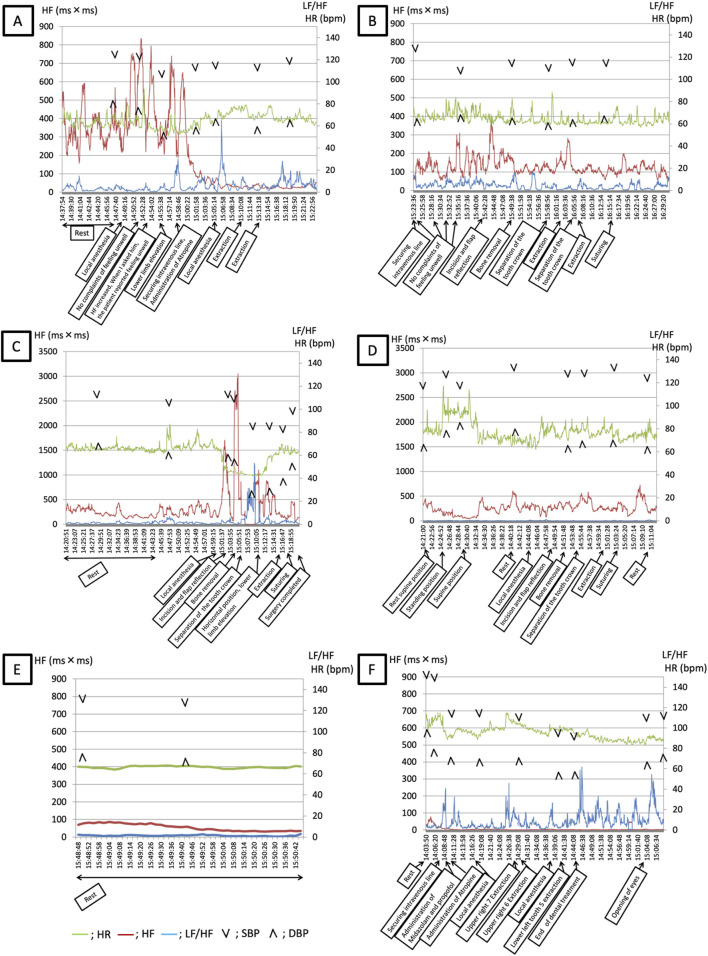
We focused on the high-frequency component, an indicator of parasympathetic activity, and interrupted the treatment when the high-frequency component increased. Treatment was then resumed after confirming that there was no mood disturbance and no increase in the high-frequency component. In another patient with a history of dental treatment-induced vasovagal reflex, autonomic activity during treatment was measured under atropine sulfate hydrate administration.
Analysis of heart rate variability during the vasovagal reflex showed that parasympathetic hyperactivity was followed by sympathetic hyperactivity, indicating real-time changes in autonomic nervous system activity. In addition, the high-frequency component, which decreased after atropine sulfate hydrate administration, did not increase during treatment, along with the low-frequency to high-frequency ratio, a measure of sympathetic nervous system activity, and the vasovagal reflex did not occur. We believe that the visualization of a patient's autonomic nervous system activity during dental treatment will improve the quality of systemic management and lead to the realization of a safe and comfortable treatment environment.
血管迷走反射是牙科手术过程中最常见的急症,但其潜在机制尚不清楚。在本研究中,我们对有血管迷走反射病史的患者进行了自主神经监测。
我们关注高频成分,它是副交感神经活动的一个指标,当高频成分增加时中断治疗。在确认没有情绪障碍且高频成分没有增加后,再恢复治疗。在另一位有牙科治疗诱发血管迷走反射病史的患者中,在给予水合硫酸阿托品的情况下测量了治疗期间的自主神经活动。
对血管迷走反射期间心率变异性的分析表明,副交感神经活动亢进之后是交感神经活动亢进,这表明自主神经系统活动存在实时变化。此外,水合硫酸阿托品给药后降低的高频成分在治疗期间没有增加,同时作为交感神经系统活动指标的低频与高频比值也没有增加,血管迷走反射未发生。我们认为,在牙科治疗期间对患者自主神经系统活动进行可视化将提高全身管理质量,并有助于实现安全舒适的治疗环境。