Uto Akari, Yamashita Kaoru, Yoshimine Shusei, Uchino Minako, Kibe Toshiro, Sugimura Mitsutaka
Department of Dental Anesthesiology, Field of Oral and Maxillofacial Rehabilitation, Advanced Therapeutics Course, Graduate School of Medical and Dental Sciences, Kagoshima University, Kagoshima, Japan.
Department of Oral and Maxillofacial Surgery, Field of Oral and Maxillofacial Rehabilitation, Advanced Therapeutics Course, Graduate School of Medical and Dental Sciences, Kagoshima University, Kagoshima, Japan.
J Clin Monit Comput. 2025 Feb;39(1):45-52. doi: 10.1007/s10877-024-01210-w. Epub 2024 Aug 22.
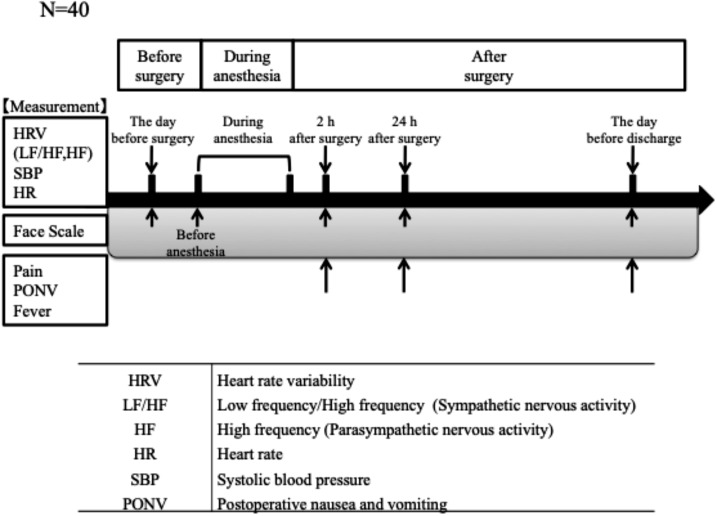
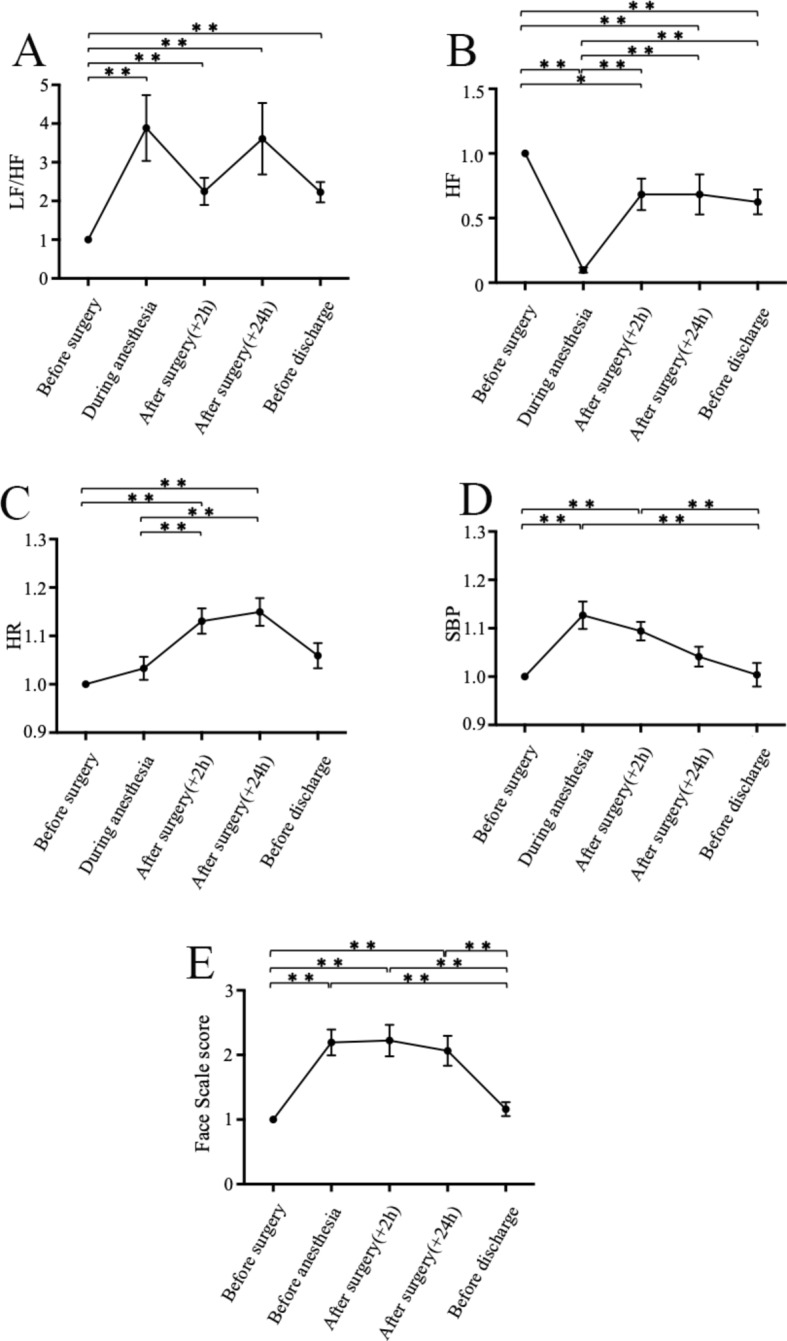
Perioperative stress in pediatric patients is often difficult to assess via interviews; thus, an objective measure to assess perioperative stress is needed. To visualize perioperative stress, we observed autonomic nervous system (ANS) activity, circulatory dynamics, and psychological status in pediatric patients undergoing alveolar bone grafting under general anesthesia. This prospective observational study included 40 patients aged 8-12 years who were scheduled for alveolar bone grafting in our hospital. ANS activity was analyzed using heart rate variability the day before surgery, during general anesthesia, 2 h postoperatively, 24 h postoperatively, and the day before discharge. ANS assessment included LF/HF (sympathetic nervous system activity) and HF (parasympathetic nervous system activity). Additionally, heart rate (HR), systolic blood pressure (SBP), face scale (FS) score were recorded. Data from 31 patients, excluding dropouts, were analyzed. The ratio of change to the preoperative value was compared. After surgery, the LF/HF, HR, SBP, and FS score significantly increased (P < 0.01) and HF significantly decreased (2 h postoperatively: P < 0.05, 24 h postoperatively, before discharge: P < 0.01). SBP recovered to preoperative values 24 h postoperatively, and HR and FS scores recovered to preoperative values before discharge. However, even before discharge, LF/HF remained significantly higher than preoperative values, and HF remained significantly lower than preoperative values (P < 0.01). Conclusion We observed perioperative stress from multiple perspectives. Circulatory dynamics and psychological status recovered by the day before discharge; however, ANS activity did not. Therefore, evaluating ANS activity may be useful in visualizing potential perioperative stress in pediatric patients.
小儿患者围手术期的应激反应往往难以通过访谈进行评估;因此,需要一种客观的方法来评估围手术期应激。为了直观呈现围手术期应激,我们观察了在全身麻醉下接受牙槽骨移植的小儿患者的自主神经系统(ANS)活动、循环动力学和心理状态。这项前瞻性观察性研究纳入了40例年龄在8至12岁、计划在我院接受牙槽骨移植的患者。在手术前一天、全身麻醉期间、术后2小时、术后24小时以及出院前一天,使用心率变异性分析ANS活动。ANS评估包括低频/高频(交感神经系统活动)和高频(副交感神经系统活动)。此外,记录心率(HR)、收缩压(SBP)、面部量表(FS)评分。对31例患者(不包括退出研究的患者)的数据进行分析。比较与术前值的变化率。术后,低频/高频、心率、收缩压和FS评分显著升高(P < 0.01),高频显著降低(术后2小时:P < 0.05,术后24小时、出院前:P < 0.01)。术后24小时收缩压恢复到术前值,心率和FS评分在出院前恢复到术前值。然而,即使在出院前,低频/高频仍显著高于术前值,高频仍显著低于术前值(P < 0.01)。结论我们从多个角度观察了围手术期应激。循环动力学和心理状态在出院前一天恢复;然而,ANS活动并未恢复。因此,评估ANS活动可能有助于直观呈现小儿患者潜在的围手术期应激。