Zhang Shuai, Li Lulu, Wang Jingyu, Li Yuan, Zhou Yongkang, Tao Yuqing, Yu Cuntao, Sun Xiaogang, Guo Hongwei, Zhao Dong, Chang Yi, Sun Jing, Qian Xiangyang
Department of Cardiovascular Surgery at Fuwai Hospital, Chinese Academy of Medical Sciences & Peking Union Medical College/National Center for Cardiovascular Diseases, Beijing, China.
Key Laboratory of Cardiovascular Epidemiology, Department of Epidemiology at Fuwai Hospital, State Key Laboratory of Cardiovascular Disease, Chinese Academy of Medical Sciences & Peking Union Medical College/National Center for Cardiovascular Diseases, Beijing, China.
Ann Med. 2025 Dec;57(1):2540018. doi: 10.1080/07853890.2025.2540018. Epub 2025 Jul 31.
During emergency surgery, patients with acute type A aortic dissection (ATAAD) experience unfavourable outcomes throughout their hospital stay. The combination of total aortic arch replacement (TAR) and frozen elephant trunk (FET) implantation has become a dependable choice for surgical treatment. The objective of this research was to utilize a machine learning technique based on artificial intelligence to detect the factors that increase the risk of mortality within 30 days after surgery in patients who undergo TAR in combination with FET.
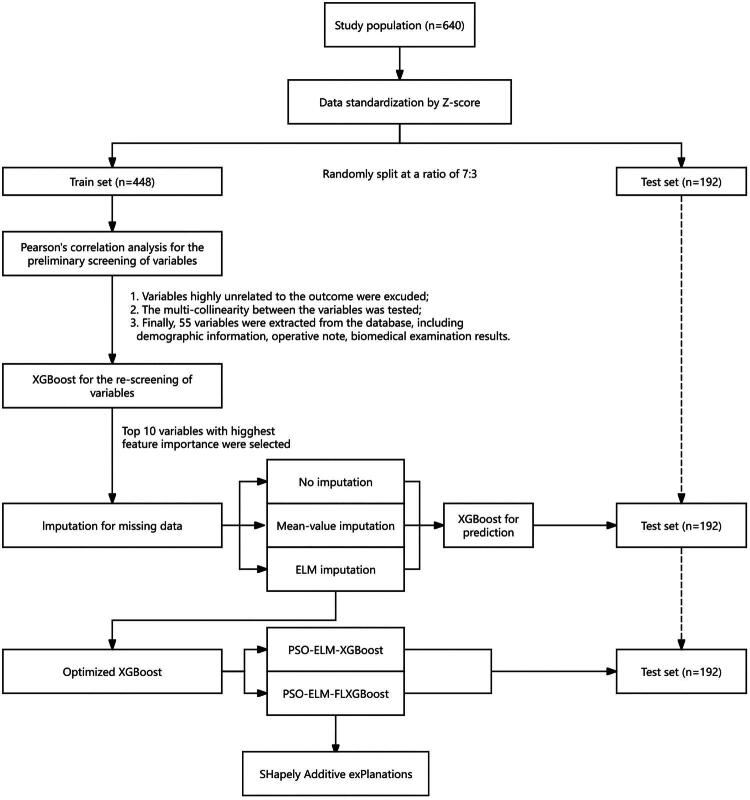
From January 2015 to December 2020, a total of 640 patients with ATAAD who underwent TAR and FET were included in this study. The subjects were divided into a test group and a validation group in a random manner, with a ratio of 7 to 3. The objective of our research was to create predictive models by employing different supervised machine learning techniques, such as XGBoost, logistic regression, support vector machine (SVM) and random forest (RF), to assess and compare their respective performances. Furthermore, we employed SHapley Additive exPlanation (SHAP) measures to allocate interpretive attributional values.
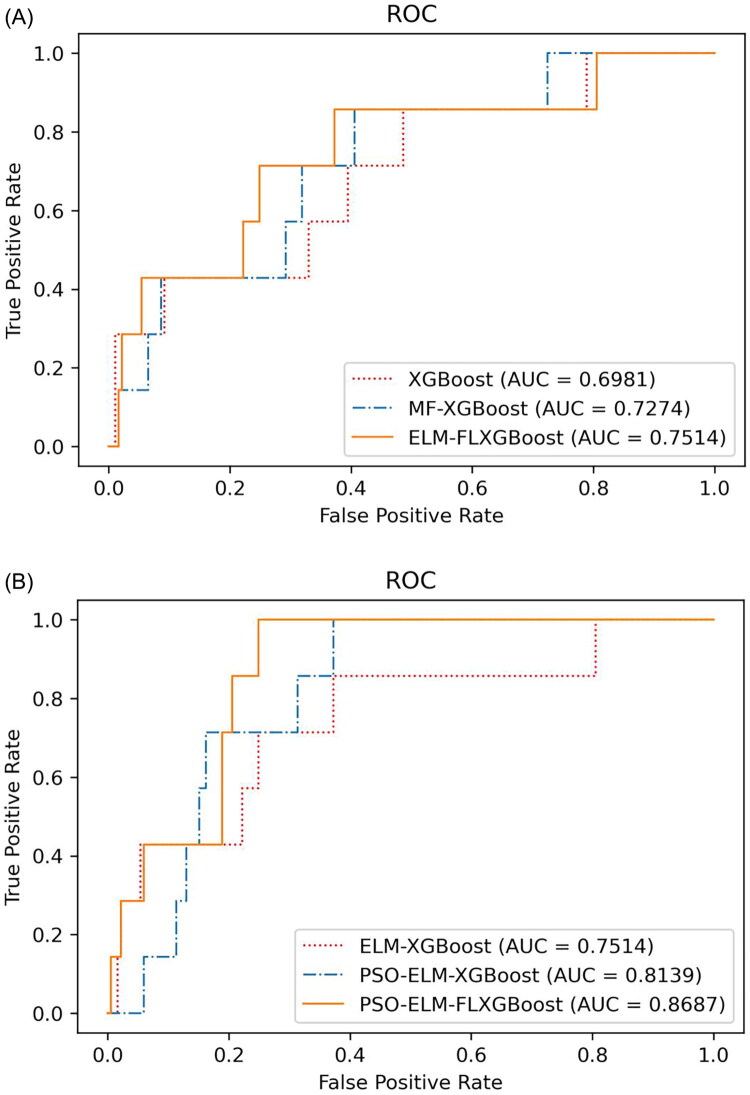
Among all the patients, 37 (5.78%) experienced perioperative mortality. Subsequently, a total 50 of 10 highly associated variables were selected for model construction. By implementing the new method, the AUC value significantly improved from 0.6981 using the XGBoost model to 0.8687 with the PSO-ELM-FLXGBoost model.
In this study, machine learning methods were successfully established to predict ATAAD perioperative mortality, enabling the optimization of postoperative treatment strategies to minimize the postoperative complications following cardiac surgeries.
在急诊手术期间,急性A型主动脉夹层(ATAAD)患者在整个住院期间预后不佳。全主动脉弓置换术(TAR)联合象鼻支架植入术(FET)已成为手术治疗的可靠选择。本研究的目的是利用基于人工智能的机器学习技术,检测接受TAR联合FET手术的患者术后30天内增加死亡风险的因素。
2015年1月至2020年12月,本研究共纳入640例行TAR和FET的ATAAD患者。受试者以7:3的比例随机分为测试组和验证组。我们研究的目的是通过采用不同的监督机器学习技术,如XGBoost、逻辑回归、支持向量机(SVM)和随机森林(RF),创建预测模型,以评估和比较它们各自的性能。此外,我们采用SHapley加法解释(SHAP)方法来分配解释性归因值。
所有患者中,37例(5.78%)发生围手术期死亡。随后,从10个高度相关的变量中总共选择了50个用于模型构建。通过实施新方法,AUC值从使用XGBoost模型的0.6981显著提高到使用PSO-ELM-FLXGBoost模型的0.8687。
在本研究中,成功建立了机器学习方法来预测ATAAD围手术期死亡率,从而能够优化术后治疗策略,以尽量减少心脏手术后的术后并发症。