Chen Qiyi, Wang Yulin, Zhang Yixiao, Liu Fangyu, Shao Kejie, Lai Hao, Wang Chunsheng, Ji Qiang
Department of Cardiovascular Surgery, Zhongshan Hospital Fudan University, 200032 Shanghai, China.
Shanghai Municipal Institute for Cardiovascular Diseases, 200032 Shanghai, China.
Rev Cardiovasc Med. 2025 Apr 21;26(4):26943. doi: 10.31083/RCM26943. eCollection 2025 Apr.
Extended aortic arch repair (EAR) is increasingly adopted for treating acute type A aortic dissection (ATAAD). However, existing prediction models may not be suitable for assessing the in-hospital death risk in ATAAD patients undergoing EAR. This study aims to develop a comprehensive risk prediction model for in-hospital death following EAR based on patient's preoperative status and surgical data, which may contribute to identification of high-risk individuals and improve outcomes following EAR.
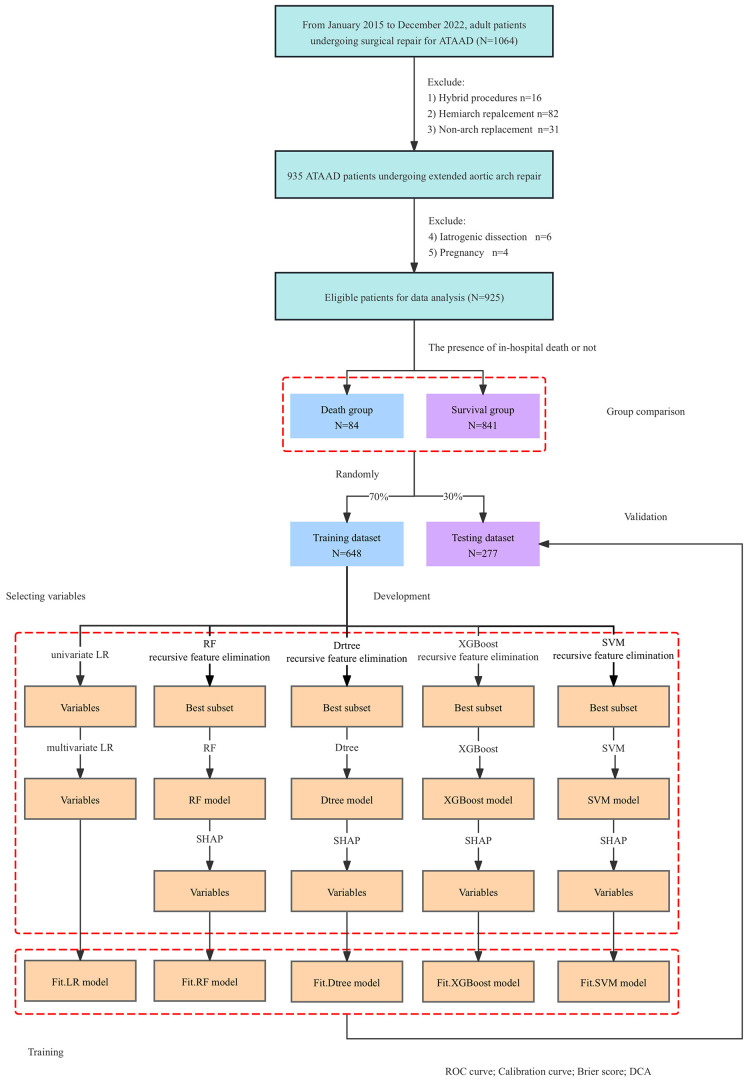
We reviewed clinical records of consecutive adult ATAAD patients undergoing EAR at our institute between January 2015 and December 2022. Utilizing data from 925 ATAAD patients undergoing EAR, we employed multivariable logistic regression and machine learning techniques, respectively, to develop nomograms for in-hospital mortality. Employed machine learning techniques included simple decision tree, random forest (RF), eXtreme Gradient Boosting (XGBoost), and support vector machine (SVM).
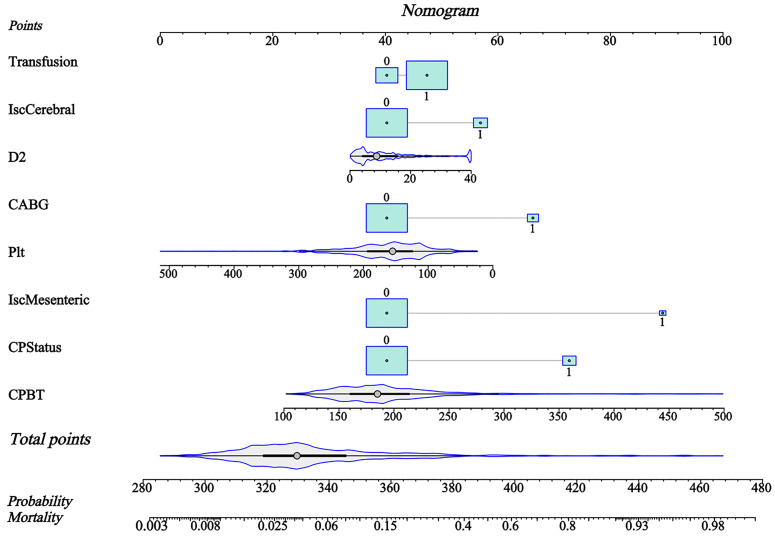
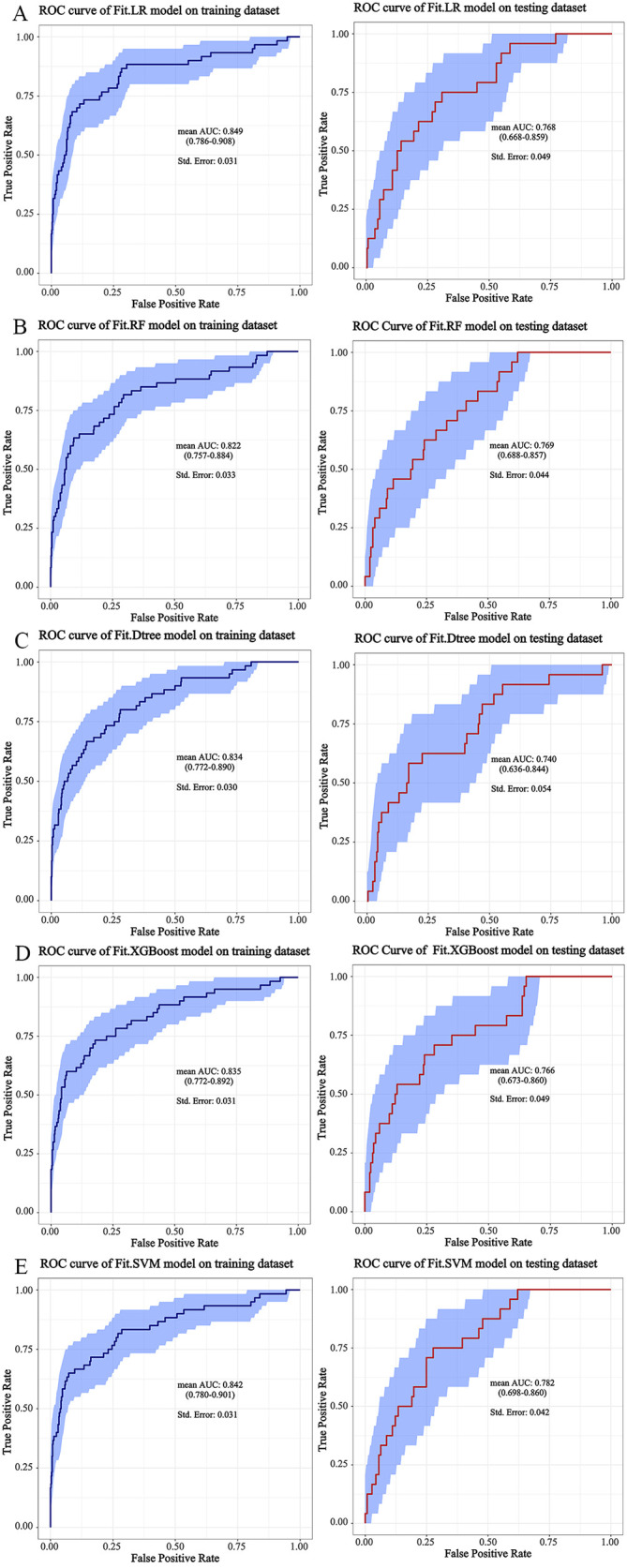
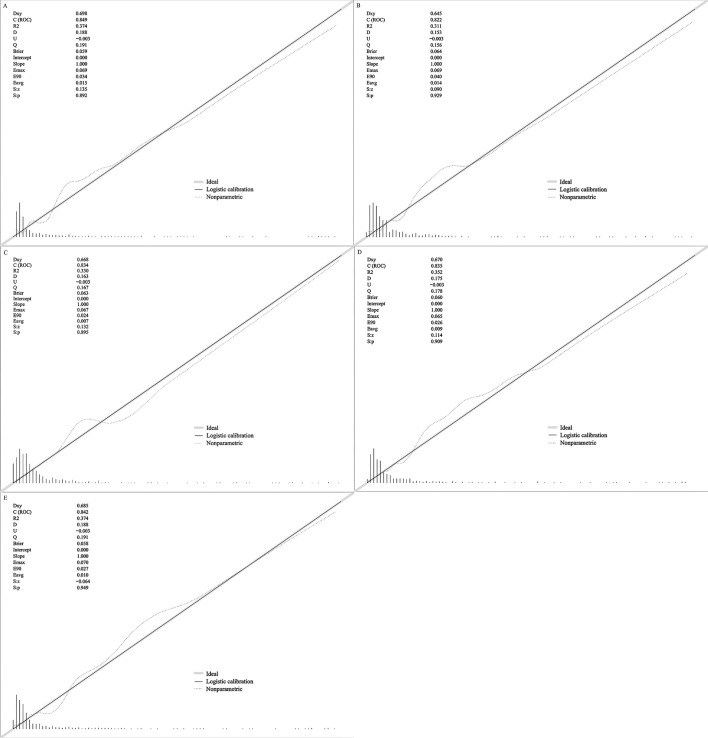
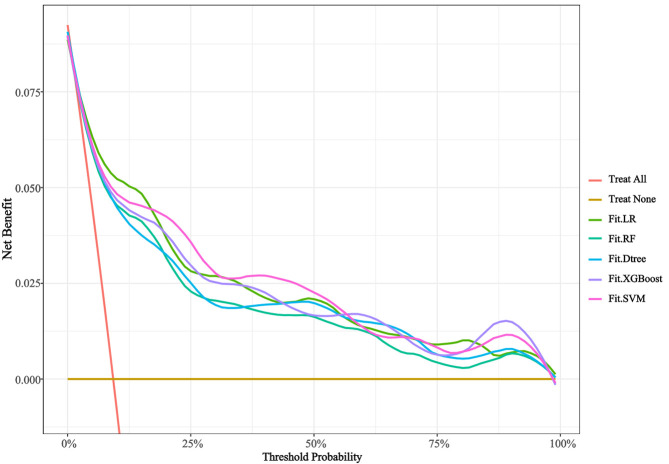
The nomogram based on SVM outperformed others, achieving a mean area under the receiver operating characteristic (ROC) curve (AUC) of 0.842 on training dataset and a mean AUC of 0.782 on testing dataset, accompanied by a Brier score of 0.058. Key risk factors included cerebral malperfusion, mesenteric malperfusion, preoperative critical station, Marfan syndrome, platelet count, D-dimer, coronary artery bypass grafting, and cardiopulmonary bypass time. A web-based application was developed for clinical use.
We develop a novel nomogram risk prediction model based on SVM algorithm for in-hospital death following extended aortic arch repair for ATAAD with good discrimination and accuracy.
Registration number ChiCTR2200066414, https://www.chictr.org.cn/showproj.html?proj=187074.
对于急性A型主动脉夹层(ATAAD)的治疗,越来越多地采用主动脉弓扩大修复术(EAR)。然而,现有的预测模型可能不适用于评估接受EAR的ATAAD患者的院内死亡风险。本研究旨在基于患者术前状况和手术数据,开发一种用于EAR术后院内死亡的综合风险预测模型,这可能有助于识别高危个体并改善EAR术后的结局。
我们回顾了2015年1月至2022年12月期间在我院接受EAR的连续性成年ATAAD患者的临床记录。利用925例接受EAR的ATAAD患者的数据,我们分别采用多变量逻辑回归和机器学习技术,开发了院内死亡率的列线图。所采用的机器学习技术包括简单决策树、随机森林(RF)、极端梯度提升(XGBoost)和支持向量机(SVM)。
基于SVM的列线图表现优于其他列线图,在训练数据集上的受试者操作特征(ROC)曲线下平均面积(AUC)为0.842,在测试数据集上的平均AUC为0.782,Brier评分为0.058。关键危险因素包括脑灌注不良、肠系膜灌注不良、术前危急状态、马凡综合征、血小板计数、D-二聚体、冠状动脉搭桥术和体外循环时间。开发了一个基于网络的应用程序供临床使用。
我们基于SVM算法开发了一种用于ATAAD主动脉弓扩大修复术后院内死亡的新型列线图风险预测模型,具有良好的区分度和准确性。
注册号ChiCTR2200066414,https://www.chictr.org.cn/showproj.html?proj=187074。