Costanzo Mariangela Benedetta, Vitale Alessandro, Biondi Antonio, Polizzi Giancarlo, Gugliuzzo Antonio
Department of Agriculture, Food and Environment, University of Catania, Catania, Italy.
PLoS One. 2025 Jul 31;20(7):e0329063. doi: 10.1371/journal.pone.0329063. eCollection 2025.
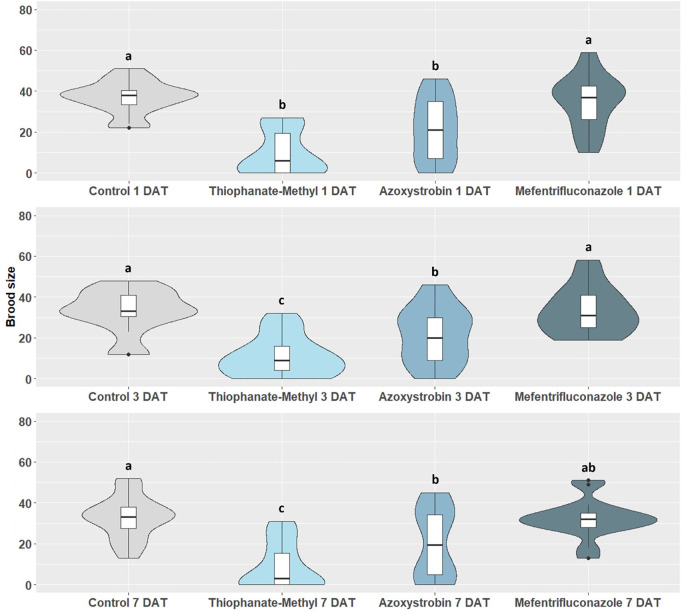
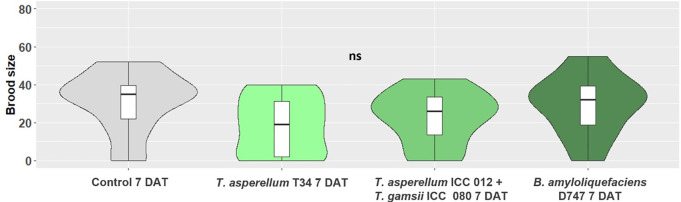
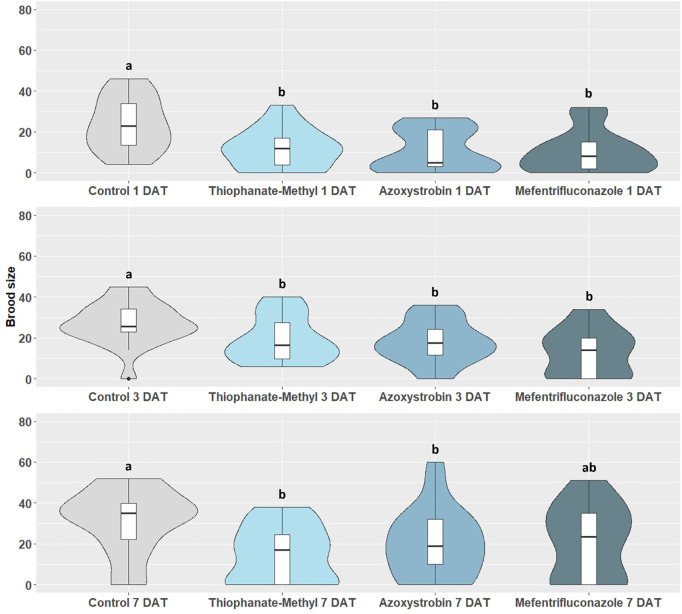
Little is known about effective control strategies targeting the invasive ambrosia beetle Xylosandrus compactus. This fungus-farming beetle is highly dependent on its primary nutritional fungal mutualist Ambrosiella xylebori. Traditionally, insect pest control programs target the pest directly. Here, we tested the potential of synthetic and microbial based fungicides to suppress the fungal mutualist, consequently hampering the beetle development. Thiophanate-methyl application to bay laurel (Laurus nobilis L.) stem sections proved to be effective in reducing the mutualist fungus occurrence in infested galleries, as well as to reduce the mean X. compactus brood size. Thiophanate-methyl and azoxystrobin significantly reduced the mean beetle brood size in extended laboratory conditions. Similarly, these two fungicides were the most effective in reducing the fungal lesion length, both when tested by soil or spray applications. Overall, thiophanate-methyl showed the highest reduction of the X. compactus brood size by spray application. No or low impact on X. compactus infestations was observed when testing the triazole mefentrifuconazole. Among tested microbial based fungicides, Trichoderma asperellum T34 was the only one causing a reduction of the fungal lesion length. To the best of our knowledge, this study provides, for the first time, baseline data on the potential of fungicides for disrupting the mutualistic interaction between X. compactus and its primary mutualist A. xylebori. These findings will help in developing novel and effective integrated pest management approaches based on the mycobiome alteration and targeting X. compactus in its invaded range.
对于针对入侵性的紧密材小蠹(Xylosandrus compactus)的有效控制策略,人们了解甚少。这种培育真菌的小蠹高度依赖其主要营养共生真菌——木栖曲霉(Ambrosiella xylebori)。传统上,害虫控制计划直接针对害虫。在此,我们测试了合成杀菌剂和微生物源杀菌剂抑制这种共生真菌的潜力,从而阻碍小蠹的发育。在月桂(Laurus nobilis L.)茎段上施用甲基托布津被证明能有效减少受侵染虫道中共生真菌的出现,并减少紧密材小蠹的平均子代数量。在延长的实验室条件下,甲基托布津和嘧菌酯显著降低了小蠹的平均子代数量。同样,当通过土壤处理或喷雾处理进行测试时,这两种杀菌剂在减少真菌病斑长度方面最为有效。总体而言,通过喷雾处理,甲基托布津对紧密材小蠹子代数量的减少效果最为显著。在测试三唑类的苯醚甲环唑时,未观察到对紧密材小蠹侵染有影响或影响较小。在所测试的微生物源杀菌剂中,棘孢木霉T34是唯一能减少真菌病斑长度的药剂。据我们所知,本研究首次提供了关于杀菌剂破坏紧密材小蠹与其主要共生菌木栖曲霉之间共生相互作用潜力的基线数据。这些发现将有助于基于真菌群落改变,在紧密材小蠹的入侵范围内开发新的、有效的综合害虫管理方法。