Schlueter Daniel A, Horstmann Gernot, Austerschmidt Kim L, Koenig Jessica, Flieger Maximilian, Beblo Thomas, Driessen Martin, Schäbitz Wolf, Toepper Max
Department of Psychiatry and Psychotherapy, Evangelisches Klinikum Bethel (EvKB), University Medical Center OWL, Bielefeld University, Remterweg 69-71, 33617, Bielefeld, Germany.
Department of Neuro-Cognitive Psychology, Bielefeld University, Universitätsstraße 25, 33615, Bielefeld, Germany.
Neurol Res Pract. 2025 Jul 31;7(1):55. doi: 10.1186/s42466-025-00406-y.
Strokes are often accompanied by physical and cognitive impairments affecting driving safety. After the recommended period of abstinence from driving, the patient must decide whether his or her driving safety is still impaired, which requires a valid self-assessment of the own driving skills. At present, it is uncertain whether stroke survivors are able to provide a valid self-assessment.
12 stroke patients and 17 healthy controls participated in this prospective longitudinal on-road study. All participants underwent repeated neuropsychological and standardized on-road assessment at 4-month intervals (2 and 6 months after the stroke in the patient group). Statistical analyses included repeated measures ANOVA, group comparisons and correlation analyses.
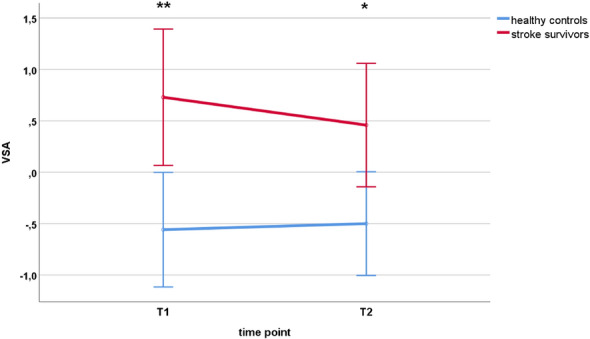
Our results revealed that in stroke survivors compared to healthy drivers, the validity of self-assessment (VSA) of the own on-road driving performance is impaired in the direction of overestimation (at both time points). In addition, the VSA of stroke survivors at second time point correlated with driving-relevant cognitive and non-cognitive measures.
Our results suggest that the VSA of the own driving competence is impaired after stroke. Other than expected, the differences between stroke survivors and healthy drivers did not disappear within the 4-months-interval. Consequently, an impaired VSA in stroke survivors must be considered before deciding to let them drive again.
中风常伴有影响驾驶安全的身体和认知障碍。在建议的禁驾期过后,患者必须确定自己的驾驶安全是否仍受影响,这需要对自身驾驶技能进行有效的自我评估。目前,尚不确定中风幸存者是否能够进行有效的自我评估。
12名中风患者和17名健康对照者参与了这项前瞻性纵向道路研究。所有参与者每隔4个月(患者组中风后2个月和6个月)接受重复的神经心理学和标准化道路评估。统计分析包括重复测量方差分析、组间比较和相关性分析。
我们的结果显示,与健康驾驶者相比,中风幸存者对自身道路驾驶表现的自我评估有效性(VSA)在高估方向上受到损害(在两个时间点均如此)。此外,中风幸存者在第二个时间点的VSA与驾驶相关的认知和非认知指标相关。
我们的结果表明,中风后对自身驾驶能力的VSA会受到损害。与预期不同的是,中风幸存者和健康驾驶者之间的差异在4个月的间隔内并未消失。因此,在决定让中风幸存者再次驾驶之前,必须考虑其受损的VSA。